
UNITED STATES
SECURITIES AND EXCHANGE COMMISSION
WASHINGTON, D.C. 20549
Form 10-K
(Mark One)
| ANNUAL REPORT PURSUANT TO SECTION 13 OR 15(d) OF THE SECURITIES EXCHANGE ACT OF 1934 | |||||
For the fiscal year ended September 30 , 2026
OR
| TRANSITION REPORT PURSUANT TO SECTION 13 OR 15(d) OF THE SECURITIES EXCHANGE ACT OF 1934 | |||||
For the transition period from to
Commission file number 001-11593
______________________________________________________________
The Scotts Miracle-Gro Co mpany
(Exact name of registrant as specified in its charter)
| (State or other jurisdiction of incorporation or organization) | (I.R.S. Employer Identification No.) | |||||||
(Address of principal executive offices) (Zip Code)
Registrant’s telephone number, including area code:
(937 ) 644-0011
Securities registered pursuant to Section 12(b) of the Act:
| Title of Each Class | Trading Symbol(s) | Name of Each Exchange on Which Registered | ||||||
Securities registered pursuant to Section 12(g) of the Act:
None
______________________________________________________________
Indicate by check mark if the registrant is a well-known seasoned issuer, as defined in Rule 405 of the Securities Act. Yes þ No o
Indicate by check mark if the registrant is not required to file reports pursuant to Section 13 or Section 15(d) of the Act. Yes o No þ
Indicate by check mark whether the registrant (1) has filed all reports required to be filed by Section 13 or 15(d) of the Securities Exchange Act of 1934 during the preceding 12 months (or for such shorter period that the registrant was required to file such reports), and (2) has been subject to such filing requirements for the past 90 days. Yes þ No o
Indicate by check mark whether the registrant has submitted electronically every Interactive Data File required to be submitted pursuant to Rule 405 of Regulation S-T (§ 232.405 of this chapter) during the preceding 12 months (or for such shorter period that the registrant was required to submit such files). Yes þ No o
Indicate by check mark whether the registrant is a large accelerated filer, an accelerated filer, a non-accelerated filer, a smaller reporting company, or an emerging growth company. See the definitions of “large accelerated filer,” “accelerated filer,” “smaller reporting company,” and “emerging growth company” in Rule 12b-2 of the Exchange Act. (Check one):
| ☑ | Accelerated filer | ☐ | |||||||||
| Non-accelerated filer | ☐ | Smaller reporting company | |||||||||
| Emerging growth company | |||||||||||
If an emerging growth company, indicate by check mark if the registrant has elected not to use the extended transition period for complying with any new or revised financial accounting standards provided pursuant to Section 13(a) of the Exchange Act. o
Indicate by check mark whether the registrant has filed a report on and attestation to its management’s assessment of the effectiveness of its internal control over financial reporting under Section 404(b) of the Sarbanes-Oxley Act (15 U.S.C.7262(b)) by the registered public accounting firm that prepared or issued its audit report. ☑
If securities are registered pursuant to Section 12(b) of the Act, indicate by check mark whether the financial statements of the registrant included in the filing reflect the correction of an error to previously issued financial statements. o
Indicate by check mark whether any of those error corrections are restatements that required a recovery analysis of incentive-based compensation received by any of the registrant’s executive officers during the relevant recovery period pursuant to §240.10D-1(b). o
Indicate by check mark whether the registrant is a shell company (as defined in Rule 12b-2 of the Act). Yes ☐ No þ
The aggregate market value of Common Shares (the only common equity of the registrant) held by non-affiliates (for this purpose, executive officers and directors of the registrant are considered affiliates) as of March 27, 2026 (the last business day of the most recently completed second quarter) was approximately $2,708,601,855 .
There were 58,224,075 Common Shares of the registrant outstanding as of November 20, 2026.
______________________________________________________________
DOCUMENTS INCORPORATED BY REFERENCE:
Portions of the definitive Proxy Statement for the registrant’s 2027 Annual Meeting of Shareholders are incorporated by reference into Part III of this Annual Report on Form 10-K. Such Proxy Statement will be filed with the Securities and Exchange Commission within 120 days of the registrant’s fiscal year ended September 30, 2026.
Table of Contents
The Scotts Miracle-Gro Company
Annual Report on Form 10-K
For the Fiscal Year Ended September 30, 2026
Table of Contents
| Page | |||||||||||
Table of Contents
PART I
ITEM 1. BUSINESS
Company Description and Development of the Business
The discussion below describes the business conducted by The Scotts Miracle-Gro Company, an Ohio corporation (“Scotts Miracle-Gro” and, together with its subsidiaries, the “Company,” “we,” “our” or “us”), including general developments in our business during fiscal 2026. Each reference in this Annual Report on Form 10-K (“Form 10-K”) to a “fiscal” year is to our fiscal year ended or ending, as applicable, on September 30 of the referenced year. For additional information on recent business developments, see “ITEM 7. MANAGEMENT’S DISCUSSION AND ANALYSIS OF FINANCIAL CONDITION AND RESULTS OF OPERATIONS” of this Form 10-K.
Through our U.S. Consumer and Other segments, we are the leading marketer of branded consumer lawn and garden products in North America. Our products are marketed under some of the most recognized brand names in the consumer lawn and garden industry. Our key consumer lawn and garden brands include Scotts® Turf Builder® lawn fertilizer and Scotts® grass seed products; Miracle-Gro® soil, plant food and gardening products; Ortho® herbicide and pesticide products; and Tomcat® rodent control and animal repellent products. We are the exclusive agent of Monsanto Company, a subsidiary of Bayer AG (“Monsanto”), for the marketing and distribution of certain of Monsanto’s consumer Roundup®1 branded products within the United States (“U.S.”) and certain other specified countries. In addition, we have an equity interest in Bonnie Plants, LLC, a joint venture with Alabama Farmers Cooperative, Inc. (“AFC”), focused on planting, growing, developing, distributing, marketing and selling live plants. During fiscal 2026, we completed the sale of the Hawthorne business in North America to Vireo Growth Inc. (“Vireo”) (CSE: VREO; OTCQX: VREOF). Prior to the divestiture, the Hawthorne business was a leading provider of nutrients, lighting and other materials used for indoor and hydroponic gardening in North America. The historical results of the Hawthorne business have been classified as discontinued operations for all periods presented.
Scotts Miracle-Gro traces its heritage to a company founded by O.M. Scott in Marysville, Ohio in 1868. In the mid-1900s, we became widely known for the development of quality lawn fertilizers and grass seeds that led to the creation of a new industry – consumer lawn care. In the 1990s, we significantly expanded our product offering with three leading brands in the U.S. home lawn and garden industry. In fiscal 1995, through a merger with Stern’s Miracle-Gro Products, Inc., which was founded by Horace Hagedorn and Otto Stern in Long Island, New York in 1951, we acquired the Miracle-Gro® brand, the industry leader in water-soluble garden plant foods. In fiscal 1999, we acquired the Ortho® brand in the U.S. and obtained exclusive rights to market Monsanto’s consumer Roundup® brand within the U.S. and other contractually specified countries. In fiscal 2013, we acquired the Tomcat® consumer rodent control business including the brand and other intellectual property. The acquisition of Ortho® and Tomcat®, in addition to our relationship with Monsanto, added industry-leading weed, pest and disease control products to our portfolio. Today, the Scotts®, Miracle-Gro®, Ortho®, Tomcat® and Roundup® brands make us the most widely recognized company in the consumer lawn and garden industry in the U.S.
SMG 2.0 is our multi-year strategy to grow our core lawn and garden business. The strategy focuses on refreshing and expanding our product portfolio, reaching consumers through additional sales channels, increasing consumer participation in lawn and gardening, and using artificial intelligence (“AI”) to improve operating efficiency. Our capital allocation strategy in support of SMG 2.0 includes (i) incremental reinvestments in technology, advertising and research and development, (ii) an annual capital expenditure target of 2.5 percent to 3.5 percent of net sales, (iii) ongoing quarterly dividends, (iv) opportunistic repurchases of the common shares of Scotts Miracle-Gro (“Common Shares”), (v) strong balance sheet management through achievement of mid-term financial targets, including leverage ratio of 3x to 3.5x and (vi) strategic tuck-in acquisitions and partnerships accretive to topline sales and neutral to positive on leverage. Our technology investments include a multi-year transformation of our information technology (“IT”) infrastructure, including the implementation of SAP S/4HANA and complementary software, intended to modernize business processes and improve operating efficiency. Our October 2026 acquisition of the Black Kow® brand asset portfolio supports our strategy by adding the brand’s composted cow manure and organic soil products to our core lawn and garden offerings.
Effective June 26, 2026, Nathan E. Baxter was appointed as our President & Chief Executive Officer, succeeding James Hagedorn as Chief Executive Officer. Mr. Hagedorn also resigned from the Board of Directors of Scotts Miracle-Gro (“Board of Directors”), and Peter Shumlin became Chairman of the Board.
1 Roundup® is a registered trademark of Monsanto Technology LLC, a company affiliated with Monsanto Company.
2
Table of Contents
Business Segments
We have three operating segments: U.S. Consumer, Other and Bonnie Plants; and one reportable segment: U.S. Consumer. U.S. Consumer consists of our consumer lawn and garden business in the United States. Other primarily consists of our consumer lawn and garden business in Canada. Bonnie Plants consists of our equity interest in the Bonnie Plants, LLC joint venture, which is accounted for using the equity method of accounting. The Other and Bonnie Plants operating segments do not meet any of the quantitative thresholds requiring separate reportable segment disclosures. Corporate consists of general and administrative expenses and certain other income and expense items not allocated to our operating segments. Financial information about our segments for each of the three fiscal years ended September 30, 2026, 2025 and 2024 is presented in “NOTE 21. SEGMENT INFORMATION” of the Notes to Consolidated Financial Statements included in this Form 10-K.
Principal Products and Services
In our segments, we manufacture, market and sell lawn and garden products in the following categories:
Lawn Care: The lawn care category is designed to help users grow and enjoy the lawn they want. Products within this category include lawn fertilizer products under the Scotts®, O.M. SCOTT & Sons®, Turf Builder® and Step® brand and sub-brand names; traditional and alternative lines of grass seed products under the Scotts®, O.M. SCOTT & Sons®, EZ Seed®, PatchMaster® and Thick’R LawnTM brand and sub-brand names; and lawn-related weed, pest and disease control products primarily under the Scotts® brand name, including sub-brands such as GrubEx®. The lawn care category also includes spreaders and other durables under the Scotts® brand name, including Turf Builder® EdgeGuard® spreaders and Whirl® and Wizz® handheld spreaders.
Gardening and Landscape: The gardening and landscape category is designed to help consumers grow and enjoy flower and vegetable gardens and beautify landscaped areas. Products within this category include a complete line of water-soluble plant foods under the Miracle-Gro® brand and sub-brands such as LiquaFeed®; continuous-release plant foods under the Miracle-Gro® brand and sub-brands such as Shake ‘N Feed®; potting mixes, garden soils, ground cover and mulches under the Miracle-Gro®, Scotts®, Hyponex® and Earthgro® brand names; and organic garden products under the Miracle-Gro® Organic, Miracle-Gro® Organic Choice®, Scotts® and Whitney Farms® brand names. On October 1, 2026, we completed the acquisition of the Black Kow® brand asset portfolio, which includes composted cow manure and organic soil products.
Controls: The controls category is designed to help consumers protect their homes from pests and maintain external home areas. Our insect control products address a range of pests, including ants, mosquitoes, ticks, flying insects, wasps and hornets. Insect control products are marketed under the Ortho® brand name, including Ortho Max®, Home Defense® and Bug B Gon® sub-brands; rodent control products are marketed under the Tomcat® and Ortho® brands; selective weed control products are marketed under the Ortho Weed B GonTM sub-brand; and non-selective weed killer products are marketed under the GroundClear® brand name.
Marketing Agreement: We are Monsanto’s exclusive agent for the marketing and distribution of certain of Monsanto’s consumer Roundup® branded products in the United States and certain other specified countries.
We are party to the Third Amended and Restated Exclusive Agency and Marketing Agreement (the “Third Restated Agreement”) pursuant to which we provide certain consumer and trade marketing program services, sales, merchandising, warehousing and other selling and marketing support for certain of Monsanto’s consumer Roundup® branded products. The Company also performs other services on behalf of Monsanto, including manufacturing conversion services, pursuant to ancillary agreements. For additional details regarding the Third Restated Agreement, see “ITEM 1A. RISK FACTORS — Risks Related to Our Business — In the event the Third Restated Agreement for Monsanto’s consumer Roundup® products terminates or Monsanto’s consumer Roundup® business materially declines, we would lose a substantial source of future earnings and overhead expense absorption” in this Form 10-K and “NOTE 7. MARKETING AGREEMENT” of the Notes to Consolidated Financial Statements included in this Form 10-K.
Acquisitions and Divestitures
There were no material acquisitions or divestitures during fiscal 2026 or fiscal 2025.
Principal Markets and Methods of Distribution
We sell our products through our direct sales force, e-commerce website and network of brokers and distributors primarily to home centers, mass merchandisers, warehouse clubs, large hardware chains, independent hardware stores, nurseries, food and drug stores, garden centers and e-commerce platforms.
The majority of our shipments to customers are made via common carriers or through distributors in the U.S. Third parties manage most of our key distribution centers, which are strategically located across the U.S. and Canada. Growing media products are generally shipped direct-to-store without passing through a distribution center.
3
Table of Contents
Raw Materials
We purchase raw materials for our products from various sources. We are subject to market risk as a result of the fluctuating prices of raw materials due to, among other things, political instability, international conflicts and hostilities, trade restrictions and other government regulations, duties and tariffs and price controls. The raw materials impacted by these fluctuations include, but are not limited to, urea and other fertilizer inputs, resins, diesel, gasoline, natural gas, sphagnum peat, bark and grass seed. In procuring these materials, we seek to maintain a continuous supply, minimize costs and improve the predictability of supply and pricing. We seek to achieve these objectives through negotiation of contracts with favorable terms directly with vendors. When appropriate, we commit to purchase a certain percentage of our needs in advance of the lawn and garden season to secure pre-determined prices. We also hedge certain commodities, particularly diesel and urea, to improve cost predictability and control. Sufficient raw materials were available during fiscal 2026.
Trademarks, Patents, Trade Secrets and Licenses
We believe that our trademarks, patents, trade secrets and licenses provide us with significant competitive advantages. We pursue a vigorous trademark protection strategy consisting of registration, renewal and maintenance of key trademarks and proactive monitoring and enforcement activities to protect against infringement. The Scotts®, Miracle-Gro®, Ortho®, Tomcat®, Hyponex® and Earthgro® brand names and logos, as well as a number of product trademarks, including Turf Builder®, EZ Seed®, Organic Choice®, Home Defense Max®, Nature Scapes® and Weed B Gon Max® are registered in the United States and/or internationally and are considered material to our business.
In addition, we actively develop and maintain an extensive portfolio of utility and design patents covering a variety of subject matters and technologies relevant to the business such as fertilizer, weed killer, chemical and growing media compositions and processes; grass seed varieties; and mechanical dispensing devices such as applicators, spreaders and sprayers. Our utility patents provide protection generally extending to 20 years from the date of filing, and some of our patents will continue well into the next decade. We also hold exclusive and non-exclusive patent licenses and supply arrangements permitting the use and sale of additional patented fertilizers, pesticides, electrical and mechanical devices. Although our portfolio of trade secrets, patents and patent licenses is important to our success, no single trade secret, patent or group of related patents, alone, is considered critical to the operation of any of our business segments or the business as a whole.
Seasonality and Backlog
Our business is highly seasonal, with more than 75% of our annual net sales occurring in our second and third fiscal quarters combined. Our annual net sales are further concentrated in our second and third fiscal quarters by retailers who rely on our ability to deliver products closer to when consumers buy our products. We expect to begin receiving significant orders for the upcoming spring season late in the winter, with orders to continue through the spring season. Historically, substantially all orders have been received and shipped within the same fiscal year with minimal carryover of open orders at the end of the fiscal year.
Significant Customers
The Home Depot and Lowe’s are our two largest customers and are the only customers that individually represent more than 10% of reported consolidated net sales during any of the three most recent fiscal years. For additional details regarding significant customers, see “ITEM 1A. RISK FACTORS — Risks Related to Our Business — Because of the concentration of our sales to a small number of retail customers, the loss of one or more of, or a significant reduction in orders from, any of our top customers, or a material reduction in the inventory of our products that they carry, could adversely affect our financial results” of this Form 10-K and “NOTE 21. SEGMENT INFORMATION” of the Notes to Consolidated Financial Statements included in this Form 10-K.
Competitive Marketplace
The markets in which we sell our products are highly competitive. We compete primarily on the basis of brand strength, product innovation, product quality, product performance, advertising, value, supply chain competency, field sales support, in-store sales support and the strength of our relationships with major retailers and distributors.
In the lawn and garden and pest control markets, our products compete against branded products as well as private label products. Primary competitors include Spectrum Brands Holdings, Inc., Central Garden & Pet Company, Kellogg Garden Products, GardenCore (formerly Oldcastle Retail, Inc.), Lebanon Seaboard Corporation, Reckitt Benckiser Group plc, The Procter & Gamble Company, Jonathan Green, Inc., SBM Life Science Corp., Woodstream Corporation and This Land, Inc. dba Sunday Lawn Care. We also compete with smaller regional competitors in many of our markets.
In Canada, we face competition in the lawn and garden market from Premier Tech Ltd. and a variety of local companies including private label brands.
4
Table of Contents
Research and Development
We continually invest in research and development to design new or improve existing product formulations and packaging, as well as to streamline our manufacturing processes. Spending on research and development was $34.4 million, $30.6 million and $29.7 million in fiscal 2026, fiscal 2025 and fiscal 2024, respectively, including product registration costs of $7.1 million, $7.8 million and $7.6 million, respectively. In addition to our own research and development activities, we actively seek ways to leverage the research and development activities of our suppliers and other business partners.
Regulatory Considerations
Laws and regulations in the United States and other countries affect the manufacture, sale, distribution, use and/or application of our products in several ways. For example, in the United States, all pesticide products must comply with the Federal Insecticide, Fungicide, and Rodenticide Act (“FIFRA”), and most pesticide products require registration with the U.S. Environmental Protection Agency (the “U.S. EPA”) and similar state agencies before they can be sold or distributed. The use of certain pesticide products is also regulated by the U.S. EPA in addition to various local, state and federal environmental and/or public health agencies. These regulations may restrict or ban the use of certain ingredients or categories of products altogether. Analogous regulatory regimes apply to pesticides that we sell or distribute in other countries.
Fertilizer and growing media products are also subject to various laws and regulations, some of which require registration, mandate labeling requirements and/or govern the sale and distribution of the products. Our grass seed products are regulated in the U.S. by the Federal Seed Act and state regulations. Similar to pesticides, analogous international regulations apply to fertilizers, growing media and seeds that we sell or distribute outside of the United States. In addition, governmental agencies regulate our operations including the disposal, transport, handling and storage of waste, air and water discharges from our facilities and workplace health and safety.
Governmental authorities generally require operating facilities to obtain permits (sometimes on an annual basis) relating to site-specific conditions and/or activities. For example, permits must be obtained to harvest peat and to discharge storm water run-off or water pumped from peat deposits. In some locations, these facilities have been required to create water retention ponds to control the sediment content of discharged water. The permits typically specify the condition in which the property must be left after the peat is fully harvested, with the residual use typically being natural wetland habitats combined with open water areas.
Regulatory agencies around the world have been establishing programs and restrictions relating to preventing the release of per- and polyfluoroalkyl substances (“PFAS”) into the air, drinking water systems and food supply and to expand cleanup efforts to remediate the impacts of PFAS pollution. Further, many states have taken independent action to address PFAS ranging from appropriation bills for funding research to complete bans on any PFAS-containing products. Complicating this patchwork of state regulation is that many states define PFAS differently than the U.S. EPA with the state definitions being comparatively much broader in scope. It is likely, therefore, that some of these actions will have an impact – direct or indirect – on our business.
Packaging has also become subject to increased governmental scrutiny. Several states in the U.S. have enacted legislation to reduce single use plastics and establish extended producer responsibility programs, which are designed to bolster the recycling industry by transferring the cost of packaging disposal to the manufacturers. Extended producer responsibility programs typically include targets and reporting responsibilities for, among other things, post-consumer recycling usage, compostable packaging, material reduction and refill strategies. Similar extended producer responsibility programs are active in several Canadian provinces.
The expansion of our business may expand the regulatory oversight to which we are subject. If we enter new product categories and/or new jurisdictions, we may become subject to additional applicable legal and regulatory requirements.
For more information regarding how compliance with local, state, federal and foreign laws and regulations may affect us, see “ITEM 1A. RISK FACTORS — Risks Related to Regulation of Our Company — Compliance with environmental and other public health regulations or changes in such regulations or regulatory enforcement priorities could increase our costs of doing business or limit our ability to market certain products” of this Form 10-K.
Regulatory Matters
We are subject to various regulatory proceedings, none of which are expected to be material to our business. At September 30, 2026, $2.9 million was accrued for environmental matters. During fiscal 2026, fiscal 2025 and fiscal 2024, we expensed $0.8 million, $0.5 million and $0.1 million, respectively, for such environmental matters. We had no material capital expenditures during the last three fiscal years related to environmental or regulatory matters.
5
Table of Contents
Human Capital
We believe our culture and commitment to our associates create value for our business and our shareholders. Every associate, and every job, contributes to our success and helps us achieve our purpose. We seek to create an environment that values the health, safety and wellness of our teams, and we work to equip them with the knowledge and skills to serve our business and develop in their careers.
This discussion includes information regarding human capital matters that we believe may be of interest to shareholders generally. We recognize that certain other stakeholders (such as customers, associates and non-governmental organizations) may be interested in more detailed information on these topics. We encourage you to review the “People You Grow With” section of our 2026 Corporate Responsibility Report and our 2026 Corporate Responsibility Disclosures, located on our website at https://scottsmiraclegro.com/en-us/corporate/responsibility/cr-report.html, for more detailed information regarding our human capital programs and initiatives. The contents of our corporate website are not incorporated by reference in this Form 10-K or in any other report or document we file with the Securities and Exchange Commission (the “SEC”).
Associates
As of September 30, 2026, we employed approximately 5,100 associates. During peak sales and production periods in fiscal 2026, our workforce totaled approximately 6,300, comprised of approximately 5,500 associates including seasonal associates and approximately 800 in temporary labor. Included within these numbers, during fiscal 2026, we employed a total of approximately 2,100 full-time and seasonal in-store associates within the United States to help our retail partners merchandise our products in their lawn and garden departments directly to consumers.
Development and Engagement
We believe associate growth and business growth go hand in hand. Our associate development approach reflects how we believe people learn through on-the-job experience, exposure to mentors and coaches and formal education. Our managers support development through cross functional assignments, expanded roles, rotational opportunities and ongoing coaching. Our annual goal-setting process includes enterprise goals and individual goals to create internal alignment and provide a foundation for development conversations throughout the year. We have launched a Leadership Essentials initiative, a 10-week digital development course for our people leaders. Through weekly interactive workshops, virtual collaboration and hands-on activities, participants develop skills to build trust, communicate effectively, delegate and promote accountability. The program connects leaders across the organization, offering peer learning opportunities and insights from seasoned facilitators.
We recognize our associates’ achievements through multiple channels: peer-to-peer recognition on our intranet, department meetings, formal annual department awards and our internal social platform, where we celebrate professional achievements and personal milestones.
Inclusion and Belonging
We are committed to a workplace where everyone can bring their whole selves to work. Nine active employee resource groups (“ERGs”) provide community, connection and education for associates. Our ERGs consist of the Scotts Women’s Network, Scotts Black Employee Network, Scotts GroPride, Scotts Young Professionals, Scotts Associate Board, Scotts Associates for a Greener Earth, Scotts Christian Fellowship “G5,” Scotts Gro-Masters (Toastmasters International) and Scotts Veterans Network.
Associate Health and Well-Being
We provide opportunities intended to help our associates live their best lives from a physical, financial and personal standpoint. Our LiveTotal Health program provides flexible and inclusive benefits to advance this holistic approach to wellness. Benefit eligibility varies by employment type and region. We offer access to Lyra Health, a mental health platform for all associates and eligible family members. Lyra offers self-guided resources, coaching, therapy, medication management and crisis support. We also provide mandatory training to people leaders that equips them to better support associates’ mental wellness.
We utilize Maven Family Support to provide support across fertility, pregnancy, postpartum, parenting and menopause, including access to mental health specialists trained in reproductive health. We utilize Hinge Health for musculoskeletal care through digital physical therapy and pain management. Our associates at our corporate headquarters have access to an on-site fitness center and on-site primary care services.
6
Table of Contents
Talent Attraction
We believe that building strong teams requires developing talent from within while recruiting diverse candidates externally. We are committed to expanding opportunities and building teams that reflect the communities where we operate and the consumers we serve. We offer onsite, hybrid and remote arrangements where appropriate to support work-life balance and enable us to attract talent from broader geographic areas.
Health and Safety
The health and safety of our associates is fundamental to our operations and culture. We have revised our safety values to make them more impactful and easier to remember using the VALUE acronym: Value our safety each and every day; Acknowledge our safety successes; Learn from our incidents; Understand our power to act; and Evaluate our performance and culture.
Our drivers of safety include:
•Leadership Engagement: We believe safety starts with our senior leadership and extends through every level of the organization. Our leaders are expected to actively champion safety, hold themselves accountable and model the appropriate behaviors.
•Behavior-Based Safety and Engagement Programs: In fiscal 2026, we added specific behavior-based observation goals for leaders in both the safety scorecard and as part of a safety observation and discussion challenge. During fiscal 2026, we continued our Kickoff for Safety with our supply chain teams and added an enterprise-wide safety engagement program using safety subjects from National Safety Month.
•Enhanced Training: We completed dust hazard analysis training for our health and safety leaders and added loader/dozer “Train the Trainer” courses for our growing media site teams.
•Incident Management System Evolution: We continue to utilize a serious injury and fatality prevention focus, emphasizing learning from high-energy events across the enterprise, including events that do not result in injury. This approach is intended to help us identify hazards and prevent injuries.
Corporate Responsibility
The Board of Directors has ultimate oversight for corporate responsibility matters and utilizes the Nominating and Governance Committee and Innovation Committee to effect this oversight. The Nominating and Governance Committee oversees sustainability programs, goals, progress, policies, practices, performance and reporting. The Nominating and Governance Committee chair serves as the liaison between management and the Board of Directors, providing quarterly updates on corporate responsibility strategy and progress. In consultation with the Nominating and Governance Committee, the Innovation Committee guides the Board of Directors and management on corporate responsibility policies and practices related to product technologies, marketing and branding.
The Company delegates day-to-day corporate responsibility management through a structured governance framework. Our Executive Vice President & Chief Brand Officer oversees sustainability matters at the executive level and is accountable for overall sustainability strategy and performance. At the management level, our Corporate Responsibility Steering Committee meets quarterly to review program progress, set goals and monitor their progress, benchmark peers and evaluate investor sustainability assessments. Two specialized subcommittees support the Corporate Responsibility Steering Committee: the Climate Subcommittee and the Customer Sustainability Subcommittee. The Climate Subcommittee analyzes the drivers of Scope 1 and Scope 2 greenhouse gas emissions, monitors voluntary emission reduction measures, evaluates climate transition risks and opportunities and supports climate-related initiatives. The Customer Sustainability Subcommittee aligns customer sustainability requests with our sustainability program to support retail partners’ sustainability goals and prepare for future reporting requirements.
7
Table of Contents
Our stakeholders, including shareholders, consumers, customers, suppliers, associates, bankers, insurers, communities as well as the environment and society, are essential to our business. We endeavor to make our workforce more inclusive, our business more sustainable and our communities more engaged by maintaining strong sustainability practices. In fiscal 2026, we published our annual Corporate Responsibility Report and Corporate Responsibility Disclosures, prepared in reference to the Global Reporting Initiative Universal Standards 2021 and with consideration for the Sustainability Accounting Standards Board’s Chemicals industry standard and the recommendations of the Task Force on Climate-Related Financial Disclosures. The 2026 Corporate Responsibility Report highlights key achievements, initiatives and strategic priorities pertaining to select significant topics aligned with our corporate responsibility strategy. The 2026 Corporate Responsibility Disclosures, the technical companion to the Corporate Responsibility Report, provides performance data, detailed metrics and disclosures with reference to reporting frameworks. Our corporate responsibility strategy focuses on three areas: (i) products you can count on; (ii) practices you can be proud of; and (iii) people you grow with. We set goals, benchmark our performance and monitor progress across these areas to support continuous improvement.
We publish our Corporate Responsibility Report, Corporate Responsibility Disclosures and several sustainability-related policies and statements on the corporate responsibility section of our corporate website, which is located at https://scottsmiraclegro.com/corporate/responsibility.html. These policies and statements address environmental, health and safety and human rights concerns. We maintain a Supplier Code of Conduct that establishes the minimum standards that suppliers must satisfy to sell goods to or do business with us. During fiscal 2026, we announced our GroForward 2030 Goals, which can be found at https://scottsmiraclegro.com/corporate/responsibility/esg-goals.html. The contents of our corporate website are not incorporated by reference in this Form 10-K or in any other report or document we file with the SEC.
Website and General Information
We maintain a website at http://investor.scotts.com. Information on our websites will not be deemed incorporated by reference into, and do not form any part of, this Form 10-K or any other report or document that we file with or furnish to the SEC. We file reports with the SEC and make available, free of charge, on or through our website, our Annual Reports on Form 10-K, Quarterly Reports on Form 10-Q, Current Reports on Form 8-K and amendments to those reports filed or furnished pursuant to Section 13(a) or 15(d) of the Securities Exchange Act of 1934, as amended (the “Exchange Act”), as well as our proxy and information statements, as soon as reasonably practicable after we electronically file such material with, or furnish it to, the SEC.
The SEC maintains a website at https://www.sec.gov that contains reports, proxy and information statements, and other information regarding issuers that file electronically with the SEC.
8
Table of Contents
ITEM 1A. RISK FACTORS
Cautionary Note Regarding Forward-Looking Statements
This Form 10-K, including the exhibits hereto and the information incorporated by reference herein, as well as our 2026 Annual Report to Shareholders (our “2026 Annual Report”), contain “forward-looking statements” within the meaning of Section 27A of the Securities Act of 1933, as amended, and Section 21E of the Exchange Act, which are subject to risks and uncertainties. Information regarding activities, events and developments that we expect or anticipate will or may occur in the future, including, but not limited to, information relating to our future growth and profitability targets and strategies designed to increase total shareholder value, are forward-looking statements based on management’s estimates, assumptions and projections. Forward-looking statements also include, but are not limited to, statements regarding our future economic and financial condition and results of operations, the plans and objectives of management and our assumptions regarding our performance and such plans and objectives, as well as the amount and timing of dividends and repurchases of Common Shares or other uses of cash flows. Forward-looking statements generally can be identified through the use of words such as “guidance,” “outlook,” “projected,” “believe,” “target,” “predict,” “estimate,” “forecast,” “strategy,” “may,” “goal,” “expect,” “anticipate,” “intend,” “plan,” “foresee,” “likely,” “will,” “should” and other similar words and variations.
Forward-looking statements in this Form 10-K and our 2026 Annual Report are predictions only and actual results could differ materially from management’s expectations due to a variety of factors, including those described below. All forward-looking statements attributable to us or persons working on our behalf are expressly qualified in their entirety by such risk factors and other cautionary statements that we make from time to time in our other SEC filings and public communications.
You should evaluate forward-looking statements in the context of these risks and uncertainties and are cautioned not to place undue reliance on such statements. These factors may not contain all of the factors that are important to you. We cannot assure you that we will realize the results or developments we expect or anticipate or, even if substantially realized, that they will result in the consequences or affect us or our operations in the way we expect. The forward-looking statements that we make in this Form 10-K and our 2026 Annual Report are based on management’s current views and assumptions regarding future events and speak only as of their dates. We disclaim any obligation to update any risk factor or to announce publicly any revisions to any of the forward-looking statements that we make, or to make corrections to reflect future events or developments, except as required by law.
Risks Related to Our Business
If we underestimate or overestimate demand for our products and do not maintain appropriate inventory levels, our net sales and/or working capital could be negatively impacted.
Our ability to manage our inventory levels to meet our customers’ demand for our products is important for our business. Our production levels and inventory management targets for our products are based on estimated demand, production capacity, timing of shipments and existing inventory levels. Due to a number of factors, including manufacturing lead times, seasonal purchasing patterns and the potential for material price increases, we may carry additional inventory and increase our working capital and related financing requirements. Carrying additional inventory may increase our warehousing costs and result in excess inventory that may become difficult to manage, unusable or obsolete and adversely impact our ability to realize anticipated returns from product sales. If we overestimate or underestimate either channel or retail demand for any of our products during a given season, we may not maintain appropriate inventory levels, which could negatively impact our net sales, profit margins, net earnings, working capital and/or cash flow, hinder our ability to meet customer demand, result in loss of customers or cause us to incur excess and obsolete inventory charges or excess warehouse storage costs.
An economic downturn and economic uncertainty may adversely affect demand for our products.
Impacts of general economic weakness may include, without limitation: reduced credit availability; reduced liquidity; volatility in credit, equity and foreign exchange markets; job losses, bankruptcies and elevated or volatile interest rates. In recent years, there have been instances of Congress and the President failing to reach agreement on federal budgetary and spending matters. A government shutdown or a default by the U.S. government on its debt obligations, or related credit-rating downgrades could also have adverse effects on the broader global economy and contribute to, or worsen, an economic recession. We believe that any extended or renewed economic disruptions or deterioration in the global economy could have an adverse impact on our business, financial condition or results of operations.
In addition, consumers may reduce discretionary spending during periods of economic uncertainty, which could reduce sales volumes of our products or result in a shift in our product mix from higher margin to lower margin products. Inflation remains elevated, and the cumulative effects of higher prices for necessities and elevated borrowing costs may reduce consumers’ purchasing power. These pressures, together with uncertainty regarding trade and other government policies, may adversely affect consumer confidence and discretionary spending and could have a material adverse impact on our business, financial condition or results of operations.
9
Table of Contents
Disruptions in availability or increases in the prices of raw materials, fuel or transportation costs could adversely affect our results of operations.
We source certain of our commodities and other raw materials on a global basis. The general availability and price of those raw materials can be affected by numerous forces beyond our control, including political instability, international conflicts and hostilities, trade restrictions and other government regulations, duties and tariffs, price controls, changes in currency exchange rates and weather. The wars in Ukraine and Iran and related sanctions and supply and transportation disruptions have contributed to increases and volatility in global fuel and fertilizer prices. A significant disruption in the availability or price of any of our key raw materials could negatively impact our business.
Increases in the prices of key commodities and other raw materials could adversely affect our ability to manage our cost structure. For example, during fiscal 2026, we experienced higher commodity and transportation costs and we expect incremental costs in fiscal 2027. Market conditions may limit our ability to raise selling prices to offset increases in our raw material costs. Further, sustained price increases may lead to declines in volume as competitors may not adjust their prices or customers and consumers may decide not to pay the higher prices, which could lead to sales declines and loss of market share. Our projections may not accurately predict the volume impact of price increases, which could adversely affect our business, financial condition and results of operations.
Because of the concentration of our sales to a small number of retail customers, the loss of one or more of, or a significant reduction in orders from, any of our top customers, or a material reduction in the inventory of our products that they carry, could adversely affect our financial results.
Our top two retail customers, The Home Depot and Lowe’s, together accounted for 51% of our fiscal 2026 net sales and 20% of our outstanding accounts receivable as of September 30, 2026. The loss of, or reduction in orders from, any major customer for any reason (including, for example, changes in a retailer’s strategy, reduction in inventories of our products that they maintain, claims or allegations that our products or products we market on behalf of third parties are unsafe, a decline in consumer demand, regulatory, legal or other external pressures or a change in marketing strategy), and customer disputes regarding shipments, fees, merchandise condition or related matters could have a material adverse effect on our business, financial condition, results of operations and cash flows. Our inability to collect accounts receivable from one of our major customers, or a significant deterioration in the financial condition of one of these customers, including a bankruptcy filing or a liquidation, could also have a material adverse effect on our financial condition, results of operations and cash flows.
We do not have long-term sales agreements with, or other contractual assurances as to future sales to, any of our major retail customers. In addition, continued consolidation in the retail industry has resulted in an increasingly concentrated retail base, and as a result, we are significantly dependent upon sales to key retailers who have significant bargaining strength. To the extent such concentration continues to occur, our net sales and income from operations may be increasingly sensitive to deterioration in the financial condition of, or other adverse developments involving our relationship with, one or more of our key customers. In addition, our business may be negatively affected by changes in the policies of our retailers, such as inventory status and strategy, limitations on access to shelf space including digital shelf space, price demands and other conditions.
We may not successfully develop new product lines and products or improve existing product lines and products.
Our future success depends on our ability to maintain an adequate innovation pipeline, improve our existing product lines and products and develop and manufacture new product lines and products to meet evolving consumer needs. We cannot provide any assurance that we will successfully develop and manufacture new product lines and products or product innovations that satisfy consumer needs or achieve market acceptance, or that we will develop, manufacture and market new product lines and products or product innovations in a timely manner. If we fail to successfully develop and manufacture new product lines and products or product innovations, our ability to maintain or grow our market share may be adversely affected, which could materially adversely affect our business, financial condition and results of operations. In addition, the development and introduction of new product lines and products and product innovations require substantial research and development expenditures, which we may be unable to recoup if such new product lines, products or innovations do not achieve market acceptance.
Many of the products we manufacture and market contain ingredients that are subject to regulatory approval. The need to obtain such approval could delay the launch of new products or product innovations or otherwise prevent us from developing and manufacturing certain products and product innovations.
10
Table of Contents
Our marketing activities may not be successful.
We invest substantial resources in advertising, consumer promotions and other marketing activities to maintain and expand our brand image. There can be no assurances that our marketing strategies will be effective or that the amount we invest in marketing activities will result in a corresponding increase in sales of our products. If our marketing initiatives are unsuccessful, including our ability to leverage omnichannel media, digital channels and emerging platforms to reach existing and potential customers, we will incur significant expenses without generating higher revenues.
The highly competitive nature of our markets could adversely affect our ability to maintain or grow revenues.
Each of our operating segments participates in highly competitive markets. Our products compete against national and regional products and private label products produced by various suppliers. Many of our competitors sell their products at prices lower than ours. Our most price sensitive consumers may trade down to lower-priced products or exit the lawn and garden market entirely during challenging economic times including inflationary periods or if current economic conditions worsen. We compete primarily on the basis of product innovation, product quality, product performance, value, brand strength, supply chain competency, field sales support, in-store sales support, the strength of our relationships with major retailers and advertising. Some of our competitors have significant financial resources. In addition, if our competitors adopt AI and other emerging technologies more rapidly or effectively than we do to optimize their cost structures or accelerate innovation, we could be placed at a competitive disadvantage. The strong competition that we face in all of our markets may prevent us from achieving our revenue goals, which may have a material adverse effect on our financial condition, results of operations and cash flows.
Our manufacturing operations, including our reliance on third-party manufacturers, could harm our business.
We may not be able to maintain or develop efficient, low-cost manufacturing capability and processes that will enable us to meet the quality, price, design and product standards or production volumes required to successfully manufacture our products. Our efforts to improve efficiencies in our manufacturing capabilities by investing in automation could be disruptive to our operations, divert the attention of management and require significant investments. Even if we successfully maintain and develop our manufacturing capabilities and processes, we may not be able to do so in time to satisfy the needs of our customers.
We rely on third parties to manufacture certain products. This reliance generates a number of risks, including decreased control over the production and related processes, which could lead to production delays or interruptions and inferior product quality control. In addition, performance problems at these third-party manufacturers could lead to cost overruns, shortages or other problems, which could increase our costs of production or result in delivery shortages or delays.
In addition, if one or more of our third-party manufacturers becomes insolvent or unwilling to continue to manufacture products of acceptable quality, at acceptable costs and in a timely manner, our ability to deliver products to our retail customers could be significantly impaired. Substitute manufacturers may not be available or, if available, may be unwilling or unable to manufacture the products we need on acceptable terms. Moreover, if customer demand for our products increases, we may be unable to secure sufficient additional capacity from our current third-party manufacturers, or others, on commercially reasonable terms, or at all.
Our business is subject to risks associated with sourcing and manufacturing outside of the U.S. and risks from tariffs and/or international trade wars.
We import certain of our raw materials from countries outside of the United States, including but not limited to China, Canada, India and certain countries in Southeast Asia. Our import operations are subject to complex and unpredictable customs laws, regulations, tax requirements, forced labor laws and trade regulations, such as tariffs set by governments, either through mutual agreements or bilateral actions. The U.S. has enacted tariffs on goods imported into the U.S. which have increased the cost of the goods we purchase. Significant additional tariffs and protectionist duties could be imposed by the U.S. with relatively short notice to us. These governmental actions could have, and any similar future actions may have, a material adverse effect on our business, financial condition and results of operations. The overall effect of these risks is that our costs may increase or we may experience supply disruptions. Our profitability may decline if we are unable to offset such increases through higher prices, and our sales could decline if our customers do not accept price increases.
Our reliance on a limited base of suppliers may result in disruptions to our business and adversely affect our financial results.
We rely on a limited number of suppliers for certain of our raw materials, product components and other necessary supplies, including certain ingredients used in our products. If we are unable to maintain supplier arrangements and relationships, if we are unable to contract with suppliers at the quantity and quality levels needed for our business, or if any of our key suppliers becomes insolvent or experiences other financial distress, we could experience disruptions in production, which could have a material adverse effect on our financial condition, results of operations and cash flows.
11
Table of Contents
A significant interruption in the operation of our or our suppliers’ facilities could adversely impact our capacity to manufacture products and supply our customers, which could adversely affect our results of operations and financial position.
Operations at our and our suppliers’ facilities are subject to disruption for a variety of reasons, including fire, flooding or other natural disasters, pandemics, acts of war, terrorism, government shutdowns and work stoppages. A significant interruption in the operation of our or our suppliers’ facilities could significantly impact our capacity to manufacture products and supply our products in a timely manner, particularly with respect to products that we manufacture at a limited number of facilities such as our fertilizer and liquid products, which could have a material adverse effect on our results of operations and financial position.
Disruptions to transportation channels that we use to distribute our products may adversely affect our margins and profitability.
We may experience disruptions to the transportation channels we use to distribute our products, including increased congestion, a lack of transportation capacity, increased fuel expenses, import or export controls or delays and labor disputes or shortages. Disruptions in our trucking capacity may result in reduced sales or increased costs, including the additional use of more expensive or less efficient alternatives to meet demand. Congestion can affect previously negotiated contracts with shipping companies, resulting in unexpected increases in shipping costs, reduction in our profitability or reduced sales.
Our international operations subject us to the costs and risks associated with operating internationally.
We operate manufacturing, sales and service facilities outside of the United States, particularly in Canada and Mexico. Accordingly, we are subject to risks associated with operating in foreign countries, including:
•fluctuations in currency exchange rates;
•limitations on the remittance of dividends and other payments by foreign subsidiaries;
•additional costs of compliance with local regulations;
•historically, in certain countries, higher rates of inflation than in the United States;
•changes in the economic conditions or consumer preferences or demand for our products in these markets;
•restrictive actions by multinational governing bodies, foreign governments or subdivisions thereof;
•changes in foreign labor laws and regulations affecting our ability to hire and retain associates;
•changes in U.S. and foreign laws regarding trade and investment, including the impact of tariffs;
•less robust protection of our intellectual property under foreign laws; and
•difficulty in obtaining distribution and support for our products, including the impact of shipping port delays.
In addition, our operations outside the United States are subject to the risk of new and different legal and regulatory requirements in local jurisdictions, potential difficulties in staffing and managing local operations and potentially adverse tax consequences. The costs associated with operating our continuing international business could adversely affect our financial condition, results of operations and cash flows.
In the event of a disaster, our disaster recovery and business continuity plans may fail, which could adversely interrupt our operations.
Our operations depend on our ability to protect our infrastructure against damage from catastrophes such as fires, explosions, natural disasters or severe weather, as well as events resulting from unauthorized security breach, power loss, telecommunications failure, act of war, terrorist attack, pandemic or other events that could have a significant disruptive effect on our operations. Further, the development of AI is creating more sophisticated avenues to disrupt operational systems. We cannot be certain that our disaster recovery and business continuity plans, or those of third-party service providers we rely on, will be successful in the event of a disaster. If our disaster recovery or business continuity plans are unsuccessful in a disaster recovery scenario, we could potentially experience material adverse impacts including loss of data, damage to important facilities, disruption to our operations, regulatory intervention, reputational harm and loss of customers.
Climate change and unfavorable weather conditions could adversely impact our financial results.
Our consumer lawn and garden business in any year is susceptible to weather conditions in the markets in which our products are sold. These climate conditions may adversely impact the sale of certain products or increase demand for other products thereby making the overall impact of abnormal or extreme weather conditions on us difficult to predict.
12
Table of Contents
The effects of climate change could include varying temperature levels, water shortages and changes to rainfall amounts, rainfall patterns, storm patterns and storm intensities. These effects could affect the availability and cost of raw materials, commodities and energy, which in turn may impact our ability to procure the quantities and levels of goods or services required to operate our business.
Consumers and businesses may independently change their behavior because of concerns regarding the impact of climate change and public perceptions. For example, consumers may elect to garden less frequently than historic patterns due to the unpredictability of weather patterns. Those consumers who are less directly impacted by climate change may also engage in less gardening due to discomfort or concerns about perceptions stemming from the direct impact of climate change on others. Current or potential retail customers may pull back from all or parts of the lawn and garden category in response to softening consumer demand. Our ability to finance the development of climate appropriate product offerings may also suffer if consumers become less engaged in lawn and gardening.
Our failure to adequately manage the consumer and retail impacts of climate change could have a material adverse effect on our financial condition, results of operations and cash flows.
Our business could be negatively impacted by corporate citizenship matters (including climate change) and/or our reporting of such matters.
Certain investors, customers, consumers, associates, bankers, insurers, governmental authorities and other stakeholders are increasing their focus on corporate citizenship matters (including climate change). Conversely, other stakeholders, including certain government authorities, have conveyed concern or opposition to the same matters. From time to time, we communicate certain initiatives, such as goals, regarding environmental matters, responsible sourcing and social investments, including pursuant to our Corporate Responsibility Report. We could fail, or be perceived to fail, to achieve such initiatives or goals, or we could fail to fully and accurately report our progress on such initiatives and goals. In addition, we could be criticized for the scope of such initiatives or goals or perceived as not acting responsibly in connection with these matters. Further, we may become the focus of stakeholders or governmental authorities who oppose our corporate citizenship initiatives.
There are adopted and proposed international accords and treaties, as well as federal, state and local laws and regulations, that would attempt to regulate certain disclosures and behavior pertaining to sustainability matters, including the effect of greenhouse gas emissions on the environment. If the U.S., state or foreign governments enact new climate change laws or regulations or make changes to existing laws or regulations, compliance with applicable laws or regulations may result in increased manufacturing costs for our products and may require additional investment in new pollution control equipment or changes to manufacturing methods for our products. Additional compliance burdens could be imposed by laws requiring the collection, measurement and analysis of climate-related data, such as Scope 1, 2 and 3 greenhouse gas emissions similar to the California statutory greenhouse gas emission reporting requirements. Such compliance may be costly, time-consuming and, because disclosures would largely depend on third-party cooperation, uncertain. Compliance with any new or more stringent laws or regulations, or stricter interpretations of existing laws, could require additional expenditures by us or our suppliers, in which case, the costs of raw materials and component parts could increase. We may incur some of these costs directly and others may be passed on to us from our third-party suppliers.
Any failure or perception of our failure (whether or not valid) to achieve our initiatives or goals with respect to corporate citizenship matters, to act responsibly with respect to corporate citizenship matters or to adequately manage the political, legal and regulatory impacts of corporate citizenship matters could adversely affect our financial condition, results of operations and cash flows. Also, our pursuit of corporate citizenship initiatives may result in negative attention from stakeholders or governmental authorities who oppose such initiatives, which could adversely affect our financial condition, results of operations and cash flows.
Uncertainty surrounding legislation, regulation and governmental policy at the U.S. federal level could lead to disruptions in or have the effect of negatively impacting our financial condition, results of operations and cash flows.
Uncertainty surrounding legislation, regulation and government policy at the U.S. federal level may impact the U.S. and global economies, international trade and relations, unemployment rates, energy prices, tariffs, immigration, taxes, inflation, interest rates and the general U.S. regulatory environment, among other things. Although we cannot predict the impact, if any, of these changes, they could negatively affect our financial condition, results of operations and cash flows.
13
Table of Contents
Product recalls or other product liability claims could materially and adversely affect our business, financial condition and results of operations.
Due to the highly regulated nature of our products, which are primarily designed for consumer use, we may be required to stop selling, return or recall products due to a variety of potential concerns including suspected or confirmed product contamination, adulteration, product mislabeling or misbranding, tampering or other deficiencies. Product recalls or voluntary market withdrawals could result in significant losses due to their costs, the destruction of product inventory and lost sales due to the unavailability of the product for a period of time. Adverse attention about these types of concerns, whether or not valid, may damage our reputation or discourage consumers from buying our products and could negatively impact our sales and financial condition.
We may also suffer losses if our products or operations violate applicable laws or regulations, or if our products are alleged to cause damage to property, injury, illness or death. A significant product liability, legal judgment or a related regulatory enforcement action against us, or a significant product recall or voluntary withdrawal, may materially and adversely affect our business, financial condition and results of operations.
If the perception of our brands or organizational reputation is damaged, our consumers, distributors and retailers may react negatively, which could materially and adversely affect our business, financial condition and results of operations.
We believe we have built our reputation on the trust of consumers and performance of our brands. Any incident that erodes consumer affinity for our brands or our business operations could significantly reduce our value and damage our business. For example, negative third-party research or media reports on our product quality, efficacy and safety, whether accurate or not, may adversely affect consumer perceptions, which could cause the value of our brands to suffer and adversely affect our business. We may also be adversely affected by news or other negative publicity, regardless of accuracy, regarding other aspects of our business, including:
•public health concerns, illness or safety;
•the perception of our environmental stewardship and the impacts our business has on the environment (including packaging, energy and water use and matters related to climate impact and waste management) and other sustainability issues;
•security breaches of confidential company, customer or employee information; or
•employee related claims relating to alleged employment discrimination, health care and benefit issues.
Such negative publicity may be widely and rapidly disseminated, including through social media platforms.
As part of our marketing initiatives, we have contracted with certain public figures to market and endorse our products. Although we apply specific selection criteria and carefully select public figures who we believe will connect effectively with our consumers, these individuals may fall out of favor with the public. Because consumers may associate these individuals with us, negative publicity concerning them may also lead to negative publicity about us and our products. In addition, AI platforms may generate inaccurate or incomplete information about our products, including information regarding their safe and effective application and use, regulatory status and environmental impacts. Such information could harm our reputation, lead to product misuse or expose us to liability. Regardless of origin, negative publicity could materially and adversely affect our brands and reputation and our revenue and profits.
If we are unable to effectively execute our e-commerce business, our reputation and operating results may be harmed.
We sell certain of our products through our online store and our retail customers’ e-commerce retail platforms. As consumers increasingly utilize e-commerce channels, the success of our business depends on our investment in e-commerce platforms, consumer preferences and buying trends relating to e-commerce, and our ability to both maintain the continuous operation of our online store and our fulfillment operations that support both our own and our retail customers’ e-commerce platforms. It is essential that these platforms provide a shopping experience that will generate orders and return visits.
Our e-commerce business is subject to various risks and uncertainties, including: changes in required technology interfaces; website downtime and other technical failures; costs and technical issues associated with website software, systems and technology investments and upgrades; data and system security; system failures, disruptions and breaches and the costs to address and remedy such failures; cyber attacks; and changes in and compliance with applicable federal and state regulations. In addition, our efforts to remain competitive with technology trends, including the use of new or improved technology such as AI and autonomous or agentic powered search platforms, creative user interfaces and other e-commerce marketing tools such as paid search and mobile applications may increase our costs but may not increase sales or attract consumers. For example, consumers are increasingly using AI assistants and autonomous shopping agents to research, compare and buy products for them, often with little or no direct contact with brands, product packaging or traditional advertising. Our failure to effectively address these risks and uncertainties may adversely affect the sales of our e-commerce business, as well as damage our reputation and brands.
14
Table of Contents
Additionally, the success of our e-commerce business and the satisfaction of our consumers depend on the timely receipt of our products by our consumers. The efficient delivery of our products to our consumers requires that our distribution centers have adequate capacity to support the current level of e-commerce operations and any anticipated increased levels that may occur as a result of the growth of our e-commerce business. If we encounter difficulties with our distribution centers, or if any distribution centers shut down for any reason, including as a result of pandemics, acts of war, terrorism, government shut downs, work stoppages and fire or other natural disasters, we could face inventory shortages that may result in out of stock conditions in our online store, incur significantly higher costs and longer lead times associated with distributing our products to our consumers and experience dissatisfaction from our consumers. Any of these issues could have a material adverse effect on our business and harm our reputation.
We may not successfully execute or realize the anticipated benefits of our strategic and transformational initiatives.
We have been executing certain strategic and transformational initiatives intended to generate cost savings, improve operational efficiencies and enhance our competitive position. These initiatives, including the upcoming implementation of a new enterprise resource planning (“ERP”) system and SMG 2.0, may have unintended consequences, such as business disruptions, diversion of management attention, reduced employee morale and productivity and negative impacts on relationships with customers, suppliers and business partners.
The ERP system implementation has required, and will continue to require, investment of personnel and financial resources to support implementation efforts and system functionality. Our multi-year SMG 2.0 growth strategy will require investments in advertising and marketing, research and development and technology. During implementation and the transition to the ERP system, as well as following implementation, we may experience system inefficiencies or integration challenges, delays in key business processes or workflows, data quality or migration issues, security access gaps or operational disruptions, including issues that may emerge only as the system operates at scale. Likewise, our SMG 2.0 growth strategy may result in inefficiencies as current Company assets and objectives are re-allocated to areas prioritized by SMG 2.0.
Costs associated with the ERP system implementation and SMG 2.0 may exceed our estimates. Delays in the implementation schedule for the ERP system and our SMG 2.0 growth strategy may also divert management’s attention and limit or delay our ability to pursue other organizational initiatives. Any such disruptions could impact, as applicable, operational priorities, resource allocation, our ability to process transactions (including order-to-cash processes, such as invoicing and collections), manage inventory and supply chain operations, including logistics, or fulfill customer orders, which could adversely impact our customer relationships, cash flows and business. Additionally, the expected value and cost savings from the ERP system, our SMG 2.0 growth strategy and other transformational initiatives may not be achieved, may be realized more slowly than anticipated, may not be sustained, including as a result of inadequate training or ineffective change management, or may be offset by increased costs or other unintended consequences.
If we are unable to timely and successfully execute our strategic or transformational initiatives or realize their anticipated value or benefits, our business, financial condition, and results of operations could be materially adversely affected.
Our operations, financial condition or reputation may be impaired if our information or operational technology systems fail to perform adequately or if we are the subject of a data breach or cyber attack.
We rely on information and operational technology systems to conduct business, including communicating with associates and our key retail customers, ordering and managing materials from suppliers, shipping products to retail customers and analyzing and reporting results of operations. If our information or operational technology systems are damaged or cease to function properly for an extended period of time, whether as a result of a significant cyber incident or any other adverse event, our ability to operate or communicate internally as well as with our retail customers, vendors, suppliers and other parties critical to our business, could be significantly impaired, which may adversely impact our business.
AI tools used in our operations or consumer-facing activities may generate inaccurate, biased or misleading information. Reliance on such outputs could lead to flawed business decisions, legal or regulatory claims and reputational harm.
While we have taken steps to ensure the security of our information and operational technology systems, including those of our customers, vendors, suppliers and other third-party service providers on whom we rely, our systems, as well as the systems utilized by our customers, vendors, suppliers and other third-party service providers, have, in the past, been and may, in the future, be vulnerable to cyber threats such as malware, security breaches, phishing attacks, unauthorized activity, system failures, defects, unintentional or malicious actions of associates, contractors and bad actors (e.g., cyber criminal groups, nation state actors and hacktivist organizations).
15
Table of Contents
We have experienced and may continue to experience an increase in the number of such cyber threats. The rapid evolution and growing adoption of AI and machine learning technologies present emerging risks to the security of our information, as well as the information of our customers and business partners. Furthermore, the increasing use of AI by threat actors is enhancing the sophistication, speed and effectiveness of cyber attacks and amplifying existing security challenges. Additionally, the use of AI by our associates, or by our customers and business partners, could increase our exposure to cyber threats. As cyber attacks increase in frequency and magnitude, we may be unable to obtain cybersecurity insurance in amounts and on terms we view as appropriate for our operations or we may incur increased premium costs associated with maintaining current deductibles, limits, terms and conditions.
Additionally, in the normal course of our business, we collect, store and transmit proprietary and confidential information regarding our customers, consumers, associates, suppliers and others, including personally identifiable information. We are required to comply with increasingly complex and changing data privacy and security laws and regulations, that apply to the collection, storage, use, transmission and protection of personal information and other consumer and employee data, including particularly the transfer of personal data between or among countries. High profile security breaches of the information systems of a number of U.S. companies and/or government agencies may result in increased regulations and new data privacy and security laws.
An operational failure or breach of security from increasingly sophisticated cyber threats could lead to the loss, misuse or unauthorized disclosure of this information about our customers, consumers, associates, suppliers and other business partners, which may result in regulatory or other legal proceedings, and have a material adverse effect on our business and reputation. We may not have the resources or technical sophistication to anticipate or prevent rapidly evolving types of cyber attacks. Any such attacks or precautionary measures taken to prevent attacks may result in increasing costs, including costs for additional technologies, training and third-party consultants. The losses incurred from a cybersecurity-related event as well as the precautionary measures required to address this evolving risk may adversely impact our financial condition, results of operations, cash flows and reputation.
Our insurance coverage may be insufficient to cover claims or liabilities and we may be unable to obtain adequate insurance coverage in the future.
We maintain insurance coverage to manage our exposure to past, present or future claims and liabilities that may adversely impact our financial position or results of operations. The extent of our insurance program is under continuous review and coverages are modified as we deem necessary to transfer current or emerging risks. Despite our program, it is possible that claims or liabilities against us may have a material adverse impact on our financial position or results of operations. In addition, we may not be able to obtain sufficient insurance coverage when our existing insurance policies expire.
We maintain an insurance program, subject to self-insured retention levels, that includes coverage to de-risk against costs associated with property damage, management liability, cargo liability, cyber threats, workers’ compensation, aviation, auto and general liability losses, and employee-related health care benefits. While we expect to be able to continue our insurance coverages, there can be no assurance that we will be able to procure insurance coverage, or that such policy limits will be adequate to cover any liability we may incur, or that our insurance coverage will continue to be available at a cost similar to our cost today. Macroeconomic conditions and events that are outside of our control can also contribute to the volatility of insurance and reinsurance markets.
Additionally, it is possible one or more of our insurers could specifically exclude from our policy certain supply chain inputs including raw materials and chemicals used in our products. Consequently, we may have to cease use of those inputs and/or substitute less effective or more expensive alternatives to continue manufacturing and/or distributing such goods. A substantial increase in liability exposure or the loss of customers or product offerings could have a material adverse effect on our results of operations and financial condition.
In the event the Third Restated Agreement for Monsanto’s consumer Roundup® products terminates or Monsanto’s consumer Roundup® business materially declines, we would lose a substantial source of future earnings and overhead expense absorption.
If we (i) become insolvent, (ii) commit a material breach, material fraud or material willful misconduct under the Third Restated Agreement, (iii) experience a change of control (subject to certain exceptions) or (iv) impermissibly assign our rights or delegate our obligations under the Third Restated Agreement, Monsanto may terminate the Third Restated Agreement without paying a termination fee to the Company, subject to certain terms and conditions as set forth therein. In addition, if Program EBIT (as defined in the Third Restated Agreement) falls below $50.0 million in any program year, Monsanto may terminate the Third Restated Agreement without paying a termination fee to the Company, subject to certain terms and conditions as set forth therein.
16
Table of Contents
Monsanto may also terminate the Third Restated Agreement in the event of (a) a change of control of Monsanto or a sale of the Roundup® business effective at the end of the fifth full year after providing notice of termination, subject to certain terms and conditions as set forth in the applicable agreements, or (b) Monsanto’s decision to decommission the permits, licenses and registrations needed for, and the trademarks, trade names, packages, copyrights and designs used in, the sale of the Roundup® products in the lawn and garden market (a “Brand Decommissioning Event”), but, in each case, Monsanto would have to pay a termination fee to the Company.
If circumstances exist or otherwise develop that result in a material decline in Monsanto’s consumer Roundup® business, or in the event of Monsanto’s insolvency or bankruptcy, we would seek to mitigate the impact on us by exercising various rights and remedies under the Third Restated Agreement and applicable law. We cannot, however, provide any assurance that our exercise of such rights or remedies would produce the desired outcomes or that a material decline in Monsanto’s consumer Roundup® business would not have a material adverse effect on our business, financial condition or results of operations.
In the event that the Third Restated Agreement terminates or Monsanto’s consumer Roundup® business materially declines, we would lose all, or a substantial portion, of the significant source of earnings and overhead expense absorption the Third Restated Agreement provides.
For additional information regarding the Third Restated Agreement including certain of our rights and remedies under the Third Restated Agreement, see “NOTE 7. MARKETING AGREEMENT” of the Notes to Consolidated Financial Statements included in this Form 10-K.
We may not be able to adequately protect our intellectual property and other proprietary rights that are material to our business.
Our ability to compete effectively depends in part on our rights to service marks, trademarks, trade names and other intellectual property rights we own or license, particularly our registered brand names and issued patents. Although we have a robust portfolio of registered trademarks, we have not sought to register each of our marks either in the United States or in every country in which each such mark is used. Furthermore, because of the differences in foreign trademark, patent and other intellectual property or proprietary rights laws, we may not receive the same protection in other countries as we would in the United States with respect to the registered brand names and issued patents we hold.
In addition, advances in AI and the increasingly widespread use of such technology by us, our third party service providers and business partners or others, including AI tools, may increase the risk of (a) claims against us for infringing third party intellectual property rights, and (b) the unauthorized access to, or use of, our intellectual property and unauthorized or unintended exposure of our confidential and proprietary information, all of which could adversely affect the value of our intellectual property, including our brands, our trade secrets and our investment in research and development. If we are unable to protect our intellectual property, proprietary information and/or brand names, we could suffer a material adverse effect on our business, financial condition and results of operations.
Litigation may be necessary to enforce our intellectual property rights and protect our proprietary information, or to defend against claims by third parties that our products or services infringe their intellectual property rights. Any litigation or claims brought by or against us could result in substantial costs and diversion of our resources. A successful claim of trademark, patent or other intellectual property infringement against us, or any other successful challenge to the use of our intellectual property, could subject us to damages or prevent us from providing certain products or services, or using certain of our recognized brand names, which could have a material adverse effect on our business, financial condition and results of operations.
Our success depends upon the retention and availability of key personnel and the effective succession of senior management.
Our success largely depends on the performance of our management team and other key personnel. Our future operations could be harmed if we are unable to attract and retain talented, highly qualified senior executives and other key personnel. In recent years, we experienced management transitions involving our Chief Financial Officer, Chief Operating Officer and Chief Human Resources Officer. Effective June 26, 2026, Nathan E. Baxter succeeded James Hagedorn as our Chief Executive Officer, and Mr. Hagedorn also departed our Board of Directors. Christopher J. Hagedorn departed as our Executive Vice President and Chief Strategy Officer effective September 30, 2026.
Management transitions may disrupt our operations, divert management attention and affect our ability to execute our strategy or retain key personnel. Successfully managing transitions at leadership levels of the Company is critical to our success. Incoming senior leaders may require substantial time to establish successful workflows and strategies. These transitions may also create uncertainty among our associates, customers, suppliers, or other counterparties.
If we are unable to effectively provide for the succession of senior management, our business, prospects, financial condition, results of operations and cash flows may be materially adversely affected.
17
Table of Contents
We are involved in a number of legal proceedings and, while we cannot predict the outcomes of such proceedings and other contingencies with certainty, some of these outcomes could adversely affect our business, financial condition, results of operations and cash flows.
We are involved in legal proceedings and are subject to investigations, inspections, audits, inquiries and similar actions by governmental authorities, arising in the course of our business (see the discussion in “ITEM 3. LEGAL PROCEEDINGS” of this Form 10-K). Legal proceedings, in general, can be expensive and disruptive. Some of these suits may purport or be determined to be class actions and/or involve parties seeking large and/or indeterminate amounts of damages, including punitive or exemplary damages, and may remain unresolved for several years. For example, product liability claims challenging the safety of our products or products we market on behalf of third parties may also result in a decline in sales for a particular product and could damage the reputation or the value of related brands, involve us in litigation and have a material adverse effect on our business.
From time to time, we are also involved in legal proceedings involving contracts, employment, intellectual property and other matters including, for example, the securities litigation and shareholder derivative suits discussed in “ITEM 3. LEGAL PROCEEDINGS” of this Form 10-K. We cannot predict with certainty the outcomes of these legal proceedings and other contingencies, and the costs incurred in litigation can be substantial, regardless of the outcome. Substantial unanticipated verdicts, fines and rulings do sometimes occur. As a result, we could from time to time incur judgments, enter into settlements – including, for example, the November 16, 2026 agreement in principle to resolve the claims contained in In re The Scotts Miracle-Gro Company Securities Litigation, as discussed in “ITEM 3. LEGAL PROCEEDINGS” – or revise our expectations regarding the outcome of certain matters, and such developments could have a material adverse effect on our results of operations in the period in which the amounts are accrued and/or our cash flows in the period in which the amounts are paid. The outcome of some of these legal proceedings and other contingencies could require us to take, or refrain from taking, actions which could negatively affect our operations and, depending on the nature of the allegations, could negatively impact our reputation or the reputation of products we market on behalf of third parties. Additionally, defending against these legal proceedings may involve significant expense and diversion of management’s attention and resources.
Risks Related to Our M&A, Lending and Financing Activities
Our indebtedness could limit our flexibility and adversely affect our financial condition.
On November 21, 2025, the Company entered into the seventh amended and restated credit agreement (the “Seventh A&R Credit Agreement”) which replaced the sixth amended and restated credit agreement. As of September 30, 2026, we had $2,039.0 million of debt and $1,220.2 million in available borrowings under the Seventh A&R Credit Agreement. Our inability to meet restrictive financial and non-financial covenants associated with our debt, or to generate sufficient cash flow to repay maturing debt, could adversely affect our financial condition. For example, our debt level could:
•make it more difficult for us to satisfy our obligations with respect to our indebtedness;
•make us more vulnerable to general adverse economic and industry conditions;
•require us to dedicate a substantial portion of cash flows from operating activities to payments on our indebtedness, which would reduce the cash flows available to fund working capital, capital expenditures, acquisitions, advertising, research and development efforts, dividends, Common Share repurchases and other general corporate activities;
•limit our flexibility in planning for, or reacting to, changes in our business and the industry in which we operate;
•limit our ability to borrow additional funds;
•expose us to risks inherent in interest rate fluctuations because some of our borrowings are at variable rates of interest, which could result in higher interest expense in the event of increases in interest rates; and
•place us at a competitive disadvantage compared to our competitors that have less debt.
On September 11, 2026, we redeemed our 5.250% Senior Notes due 2026 (the “5.250% Senior Notes”). Notwithstanding this redemption, our ability to make payments on or to refinance our indebtedness, fund planned capital expenditures and acquisitions, pay dividends and repurchase our Common Shares will depend on our ability to generate cash in the future which, to some extent, is subject to general economic, financial, competitive, legislative, regulatory and other factors that are beyond our control. We cannot provide any assurance that our business will generate sufficient cash flow from operating activities or that future borrowings will be available to us in amounts sufficient to enable us to pay our indebtedness or to fund our other liquidity needs.
18
Table of Contents
The Seventh A&R Credit Agreement and the indentures governing our 4.500% Senior Notes due 2029 (the “4.500% Senior Notes”), our 4.000% Senior Notes due 2031 (the “4.000% Senior Notes”) and our 4.375% Senior Notes due 2032 (the “4.375% Senior Notes” and, collectively with the 4.500% Senior Notes and the 4.000% Senior Notes, the “Senior Notes”) contain restrictive covenants and cross-default provisions. For example, under the Seventh A&R Credit Agreement, the maximum permitted leverage ratio is 5.00. Our leverage ratio was 3.89 at September 30, 2026. The Seventh A&R Credit Agreement also contains a minimum interest coverage ratio of (i) 3.00 for each of the fiscal quarters within fiscal 2026, (ii) 3.25 for each of the fiscal quarters within fiscal 2027 and (iii) 3.50 for fiscal quarters thereafter. Our interest coverage ratio was 5.46 for the twelve months ended September 30, 2026. The Senior Notes also contain a similarly calculated fixed charge coverage ratio covenant which sets the minimum permitted fixed charge coverage ratio at 2.00. Our Senior Notes calculated fixed charge coverage ratio was 5.46 for the twelve months ended September 30, 2026. A breach of any of the financial ratio covenants or other covenants in the Seventh A&R Credit Agreement or Senior Notes could result in a default and/or a cross default under the Seventh A&R Credit Agreement or Senior Notes, as applicable. In the event of such default, the holders of such indebtedness could elect to declare all the funds borrowed thereunder to be due and payable, together with accrued and unpaid interest, and could cease making further loans and institute foreclosure proceedings against our assets. We cannot provide any assurance that the holders of such indebtedness would waive a default or that we would have the resources to pay the accelerated indebtedness in full.
Subject to compliance with certain covenants under the Seventh A&R Credit Agreement and the indentures governing the Senior Notes, we may incur additional debt in the future. If we incur additional debt, the risks described above could intensify.
Significant or prolonged periods of higher interest rates may have an adverse effect on our financial condition, results of operations and cash flows.
Interest rates have a direct impact on our business due to the amount of variable rate debt the Company utilizes in its operations. Prolonged periods of higher interest rates may have a negative impact on our financial condition, results of operations and cash flows. All of our debt under the Seventh A&R Credit Agreement bears interest at variable rates primarily derived from the U.S. Prime Rate, Federal Reserve Bank of New York Rate, Secured Overnight Financing Rate, Euro Interbank Offered Rate, Canadian Prime Rate or Canadian Overnight Repo Rate Average (all as defined in the Seventh A&R Credit Agreement), based on our election, plus a spread that depends on our quarterly-tested leverage ratio. In a rising interest rate environment, debt financing will become more expensive and may have higher transactional and servicing costs.
Although we have taken steps to reduce our exposure to variable rate debt instruments, if interest rates remain relatively high or increase in the future, we could see increases in our borrowing costs which could have a material adverse effect on our financial condition, results of operations and cash flows.
Global economic and capital market conditions may limit our access to capital and/or increase the costs of such capital.
In the future, we may need new or additional financing to provide liquidity to conduct our operations, expand our business or refinance existing indebtedness. Any sustained weakness in general economic conditions and/or U.S. or global capital markets could adversely affect our ability to raise capital on favorable terms or at all. From time to time we have relied, and we may also rely in the future, on access to financial markets as a source of liquidity for working capital requirements, acquisitions and general corporate purposes. Our access to funds under the Seventh A&R Credit Agreement depends on the ability of the lenders that are parties to that facility to meet their funding commitments. Moreover, the obligations of the lenders under the Seventh A&R Credit Agreement are several and not joint and, as a result, a funding default by one lender does not need to be made up by the others. We also rely on sales of customer receivables under an uncommitted facility as a source of liquidity. If the purchasers reduce or cease purchases, eligible receivables decline or the facility is not renewed, we may need to fund additional working capital with cash or other borrowings, which may not be available on acceptable terms. Longer term volatility in the capital and credit markets as a result of uncertainty, changing or increased regulation of financial institutions or reduced alternatives could adversely affect our access to the liquidity needed for our businesses in the longer term. Such disruptions could require us to take measures to conserve cash until the markets stabilize or until alternative credit arrangements or other funding for our business needs can be arranged.
Acquisitions, other strategic alliances and investments could result in operating difficulties, dilution and other harmful consequences that may adversely impact our business and results of operations.
Acquisitions, strategic alliances and investments are an important element of our long-term corporate strategy and use of capital, and these transactions could be material to our financial condition and results of operations. We expect to continue to evaluate and enter into discussions regarding a wide array of potential strategic transactions. The process of integrating an acquired company, business or product has created, and will continue to create, unforeseen operating difficulties and expenditures. The areas where we face risks include:
•Assumptions implicit to our acquisition strategy or valuations are not realized.
19
Table of Contents
•Diversion of management time and focus from operating our business to acquisition integration challenges.
•Failure to successfully further develop the acquired business or product lines.
•Implementation or remediation of controls, procedures and policies at the acquired company.
•Integration of the acquired company’s accounting, human resources and other administrative systems and coordination of product, engineering and sales and marketing functions.
•Transition of operations, users and customers onto our existing platforms.
•Reliance on the expertise of our strategic partners with respect to market development, sales, local regulatory compliance and other operational matters.
•Failure to obtain required approvals on a timely basis, if at all, from governmental authorities, or conditions placed upon approval, under competition and antitrust laws which could, among other things, delay or prevent us from completing a transaction, or otherwise restrict our ability to realize the expected financial or strategic goals of an acquisition.
•Cultural challenges associated with integrating associates from the acquired company into our organization, and retention of associates from the businesses we acquire.
•Companies in which we hold a noncontrolling minority interest may from time to time have economic, business or legal interests or goals that conflict with our goals or the goals of regulators or business partners. As a result, business decisions or other actions or omissions of controlling owners, management or other persons or entities who control companies in which we invest may adversely affect the value of our investment, result in litigation, commercial or regulatory action against us or otherwise damage our reputation.
•Liability for or reputational harm from activities of the acquired company before the acquisition or from our strategic partners, including patent and trademark infringement claims, violations of laws, commercial disputes, tax liabilities and other known and unknown liabilities.
•Litigation or other claims in connection with the acquired company, including claims from terminated associates, customers, former shareholders or other third parties.
Our failure to address these risks or other problems encountered in connection with our past or future acquisitions and investments or strategic alliances could cause us to fail to realize the anticipated benefits of such acquisitions, investments or alliances, incur unanticipated liabilities and harm our business generally.
Our acquisitions, strategic alliances and investments could also result in dilutive issuances of our equity securities, the incurrence of debt, contingent liabilities or amortization expenses or impairment of goodwill and purchased long-lived assets, and restructuring charges, any of which could harm our financial condition, results of operations and cash flows. Also, the anticipated benefits of many of our acquisitions may not materialize.
Disposition of assets or businesses may not achieve their anticipated benefits or be completed in a timely manner and may have an adverse effect on our results of operations and financial condition.
We evaluate as necessary the potential disposition of assets and businesses that may no longer help meet our objectives. When we decide to sell assets or a business, we may encounter difficulty in finding buyers or alternative exit strategies on acceptable terms in a timely manner, which could delay the achievement of our strategic objectives. Alternatively, we may dispose of a business at a price or on terms that are less than we had anticipated. After reaching an agreement with a buyer for the disposition of a business, the pre-closing conditions must also be satisfied or waived, which may prevent us from completing the transaction. Dispositions may also involve continued financial involvement in the divested business, such as through continuing equity ownership, guarantees, indemnities or other financial obligations. Under these arrangements, performance by the divested businesses or other conditions outside our control could affect our future financial results.
We remain subject to post-closing obligations following completed divestitures, including, for example, the manufacturing services we agreed to provide in connection with the sale of our Hawthorne business. We may continue to incur costs associated with divested businesses, be subject to post-closing adjustments or indemnification claims or fail to realize expected savings or other benefits. Any of these outcomes could adversely affect our financial condition or results of operations.
20
Table of Contents
Our lending activities may adversely impact our business and results of operations.
As part of our strategic initiatives, we have provided financing to certain strategic partners. Our exposure to credit losses on these financing balances and strategic investments will depend on the financial condition of these counterparties as well as legal, regulatory and macroeconomic factors beyond our control, such as deteriorating conditions in the world economy or in the industries served by the borrowers. While we monitor our exposure, there can be no guarantee we will be able to successfully mitigate all of these risks. Credit losses, if significant, could have a material adverse effect on our business, financial condition, results of operations and cash flows.
Changes in credit ratings issued by nationally recognized statistical rating organizations (“NRSROs”) could adversely affect our cost of financing and the market price of our Senior Notes.
NRSROs rate the Senior Notes and the Company based on factors that include our operating results, actions that we take, their view of the general outlook for our industry and their view of the general outlook for the economy. Actions taken by the NRSROs can include maintaining, upgrading or downgrading the current rating or placing us on a watch list for possible future downgrading. Downgrading the credit rating of the Senior Notes or placing us on a watch list for possible future downgrading could increase our cost of financing, limit our access to the capital markets and have an adverse effect on the market price of the Senior Notes. In June 2026, S&P Global Ratings upgraded our B+ rating to BB- and changed our outlook from “positive” to “stable.” Also, in August 2026, Moody’s Investors Service affirmed our B1 “stable” rating.
Our hedging arrangements expose us to certain counterparty and market risks.
We periodically utilize hedging agreements to fix the prices of a portion of our urea and fuel needs. The hedging agreements are designed to mitigate the earnings and cash flow fluctuation risks associated with the costs of urea and fuel. In periods of declining prices, utilizing these hedge agreements may effectively increase our expenditure for these raw materials.
In addition to commodity hedge agreements, we utilize interest rate swap agreements to manage the net interest rate risk inherent in our sources of borrowing, as well as foreign currency forward contracts to manage the exchange rate risk associated with certain intercompany loans with foreign subsidiaries and other approved transactional currency exposures.
Utilizing these hedge agreements exposes us to certain counterparty risks. The failure of one or more of the counterparties to fulfill their obligations under the hedge agreements, whether because of weakening financial stability or otherwise, could adversely affect our financial condition, results of operations and cash flows.
Our postretirement-related costs and funding requirements could increase as a result of volatility in the financial markets, changes in interest rates and actuarial assumptions.
We sponsor a number of defined benefit pension plans associated with our U.S. and former international businesses, as well as a postretirement medical plan in the United States for certain retired associates and their dependents. The performance of the financial markets and changes in interest rates impact the funded status of certain of these plans and may cause volatility in our postretirement-related costs. Additionally, changes in interest rates and legislation enacted by governmental authorities can impact the timing and amounts of funding requirements.
We utilize third-party actuaries to evaluate assumptions used in determining projected benefit obligations and the fair value of plan assets for our pension and other postretirement benefit plans. In the event we determine that our assumptions should be revised, such as the discount rate or expected return on assets, our future pension and postretirement benefit expenses could increase or decrease. The assumptions we use may differ from actual results, which could have a significant impact on our pension and postretirement liabilities and related costs and funding requirements.
Risks Related to Regulation of Our Company
Compliance with environmental and other public health regulations or changes in such regulations or regulatory enforcement priorities could increase our costs of doing business or limit our ability to market certain products.
Laws and regulations relating to environmental matters affect us in several ways. All pesticide products sold in the United States must comply with FIFRA and most must be registered with the U.S. EPA and similar state agencies. Our inability to obtain or maintain such registrations, or the cancellation of any such registration of our products, could have an adverse effect on our business, the severity of which would depend on a variety of factors, including the product(s) involved, whether another product could be substituted and whether our competitors were similarly affected. We attempt to anticipate regulatory developments and maintain registrations of, and access to, substitute ingredients, but there can be no assurance that we will be able to avoid these risks. For example, there are indications that federal agencies in the U.S. may take more restrictive positions on pesticides. In addition, several provinces in Canada have adopted regulations that substantially restrict our ability to market and sell certain consumer pesticide products.
21
Table of Contents
Under the Food Quality Protection Act, food-use pesticides are evaluated to determine whether there is reasonable certainty that no harm will result from the cumulative effects of pesticide exposures. Under this Act, the U.S. EPA is evaluating the cumulative and aggregate risks from dietary and non-dietary exposures to pesticides. The pesticides in our products, certain of which may be also used on crops processed into various food products, are manufactured by independent third parties and continue to be evaluated by the U.S. EPA as part of this exposure risk assessment. The U.S. EPA or the third-party registrant may decide that a pesticide we use in our products will be limited or made unavailable to us. We cannot predict the outcome or the severity of the effect of these continuing evaluations.
In addition, the use of certain fertilizer and pesticide products is regulated by various environmental and public health agencies. These regulations may, among other things, limit or ban the use of certain ingredients contained in such products or require (i) that only certified or professional users apply the product, (ii) that certain products be used only on certain types of locations, (iii) users to post notices on properties to which products have been or will be applied and/or (iv) notification to individuals in the vicinity that products will be applied in the future. Even if we are able to comply with all such regulations and obtain all necessary registrations and licenses, we cannot provide assurance that our products, particularly pesticide products, will not cause or be alleged to cause injury to the environment or to people under all circumstances, particularly when used improperly or contrary to instructions. The costs of compliance, remediation or products liability have adversely affected operating results in the past and could adversely affect our financial condition, results of operations and cash flows.
Our products and operations may be subject to increased regulatory and environmental scrutiny in jurisdictions in which we do business. For example, we are subject to regulations relating to our harvesting of peat for our growing media business which has come under increasing regulatory and environmental scrutiny. In the United States, state regulations frequently require us to limit our harvesting and to restore the property to an agreed-upon condition. In some locations, we have been required to create water retention ponds to control the sediment content of discharged water. In Canada, our peat extraction efforts are also the subject of regulation.
In addition to the laws and regulations already described, various governmental agencies regulate the disposal, transport, handling and storage of waste, the remediation of contaminated sites, air and water discharges from our facilities and workplace health and safety. Under certain environmental laws and regulations, we may be liable for the costs of investigation and remediation of the presence of certain regulated materials or damage to natural resources, at various properties, including current and former properties we have owned or operated, as well as offsite waste handling or disposal sites that we have used. Liability may be imposed upon us without regard to whether we knew of or caused the presence of such materials and, under certain circumstances, on a joint and several basis. There can be no assurances that the presence of such regulated materials at any such locations, or locations that we may acquire in the future, will not result in liability to us under such laws or regulations or expose us to third-party actions such as tort suits based on alleged conduct or environmental conditions.
Regulatory agencies around the world have been establishing programs and restrictions relating to preventing the release of PFAS into the air, drinking water systems and food supply and to expand cleanup efforts to remediate the impacts of PFAS pollution. Further, many states have taken independent action to address PFAS ranging from appropriation bills for funding research to complete bans on any PFAS-containing products. Complicating this patchwork of state regulation is that various jurisdictions define PFAS differently with some definitions being comparatively broad. It is likely, therefore, that some of these actions will have an impact – direct or indirect – on our business.
Packaging has also become subject to increased governmental scrutiny. Several states in the U.S. have enacted legislation to reduce single use plastics and establish extended producer responsibility programs, which are designed to bolster the recycling industry by transferring the cost of packaging disposal to the manufacturers. Extended producer responsibility programs typically include targets and reporting responsibilities for, among other things, post-consumer recycling usage, compostable packaging, material reduction and refill strategies. Similar extended producer responsibility programs are active in several Canadian provinces.
The adequacy of our current compliance-related environmental accruals and future provisions depends upon our operating in substantial compliance with applicable environmental and public health laws and regulations, as well as the assumptions that we have both identified the significant sites that must be remediated and that there are no significant conditions of potential contamination that are unknown to us. A significant change in the facts and circumstances underlying these assumptions or in current enforcement policies or requirements, or a finding that we are not in substantial compliance with applicable environmental and public health laws and regulations, could have a material adverse effect on future environmental capital expenditures and other environmental expenses, as well as our financial condition, results of operations and cash flows.
22
Table of Contents
Unanticipated changes in our tax provisions, the adoption of new tax legislation or exposure to additional tax liabilities could affect our financial condition, results of operations and cash flows.
We are subject to income and other taxes in the United States federal jurisdiction and various local, state and foreign jurisdictions. Our effective tax rate in the future could be adversely affected by changes to our operating structure, changes in the mix of earnings in countries with differing statutory tax rates, changes in the valuation of deferred tax assets (such as net operating losses and tax credits) and liabilities, changes in tax laws and the discovery of new information in the course of our tax return preparation process. In particular, the carrying value of deferred tax assets, which are predominantly related to our operations in the United States, is dependent on our ability to generate future taxable income of the appropriate character in the relevant jurisdiction.
From time to time, tax proposals are introduced or considered by the U.S. Congress or the legislative bodies in local, state and foreign jurisdictions that could also affect our tax rate, the carrying value of our deferred tax assets or our tax liabilities. Our tax liabilities are also affected by the amounts we charge for inventory, services, licenses, funding and other items in intercompany transactions. We are subject to ongoing tax audits in various jurisdictions. In connection with these audits (or future audits), tax authorities may disagree with our intercompany charges, cross-jurisdictional transfer pricing or other matters and assess additional taxes. We regularly assess the likely outcomes of our audits in order to determine the appropriateness of our tax provision. As a result, the ultimate resolution of our tax audits, changes in tax laws or tax rates and the ability to utilize our deferred tax assets could materially affect our tax provision, net income and cash flows in future periods.
Risks Related to Our Common Shares
The Company’s decision to maintain, reduce or discontinue paying cash dividends to our shareholders or repurchasing our Common Shares could cause the market price for our Common Shares to decline.
Our payment of quarterly cash dividends on and repurchase of our Common Shares pursuant to a stock repurchase program are subject to, among other things, our financial position and results of operations, available cash and cash flow, capital requirements, credit facility provisions and other factors. Prior to fiscal 2022, we generally increased the cash dividends on our Common Shares as well as engaged in share repurchase activity. Since fiscal 2022, we have not changed the dividend amount. On December 19, 2025, the Board of Directors authorized a share repurchase program for the repurchase of up to $500.0 million of Common Shares. During fiscal 2026, we repurchased $25.0 million of our Common Shares pursuant to this authorization. Prior to these repurchases, we had not repurchased our Common Shares since fiscal 2022 outside of transactions related to our compensation programs.
We may maintain, or increase or decrease (including eliminating) the amount of cash dividends on, and increase or decrease the amount of repurchases of, our Common Shares in the future. Any decision by us regarding the payment of quarterly cash dividends or repurchases of our Common Shares could cause the market price of our Common Shares to decline. Our failure to pay dividends, resume increases of our cash dividends or maintain repurchases of Common Shares at historical levels could cause the market value of our Common Shares to decline.
Hagedorn Partnership, L.P. beneficially owns approximately 23% of our Common Shares and can significantly influence decisions that require the approval of shareholders.
Hagedorn Partnership, L.P. beneficially owned approximately 23% of our outstanding Common Shares as of November 20, 2026. As a result, it has sufficient voting power to significantly influence the election of directors and the approval of other actions requiring the approval of our shareholders, including entering into certain business combination transactions. In addition, because of the percentage of ownership and voting concentration in Hagedorn Partnership, L.P., elections of the Board of Directors will generally be within the control of Hagedorn Partnership, L.P. While all of our shareholders are entitled to vote on matters submitted to our shareholders for approval, the concentration of our Common Shares and voting control presently lies with Hagedorn Partnership, L.P. As such, it would be difficult for shareholders to propose and have approved proposals not supported by Hagedorn Partnership, L.P. Hagedorn Partnership, L.P.’s interests could differ from, or conflict with, the interests of other shareholders. Its ownership position could also influence, delay or prevent a change in control or other transaction that other shareholders may consider beneficial.
ITEM 1B. UNRESOLVED STAFF COMMENTS
None.
23
Table of Contents
ITEM 1C. CYBERSECURITY
Risk Management and Strategy
Cybersecurity risk continues to be identified as a significant enterprise risk based on the results of our most recent enterprise risk assessment. Because cybersecurity is a significant enterprise risk, we have worked to identify factors giving rise to cybersecurity risk, evaluate the measures in place to manage it and assess the remaining risk level. We have developed and implemented comprehensive strategies and processes to assess, identify, manage and mitigate cybersecurity risks, aligning with the National Institute of Standards and Technology Cybersecurity Framework (“NIST CSF”). These processes include:
•implementing security event monitoring, incident response processes, access management controls, vulnerability identification and remediation, third-party risk monitoring and user awareness and training;
•providing regular security training and awareness content for all associates, with mandatory training for new hires;
•maintaining a policy for the acceptable use of AI and providing guidance governing our associates’ use of AI platforms to help safeguard Company and third-party data;
•maintaining cybersecurity risk insurance to mitigate potential breach-related costs;
•engaging consultants to perform periodic external assessments using industry-recognized frameworks like NIST CSF; and
•monitoring program maturity through periodic reviews against the Capability Maturity Model Integration framework.
Mitigating Risks Posed by Third Parties
Risk Assessments
We identify and categorize existing third-party service providers based on criticality to our operations and prioritize those that pose the highest risks. We leverage a third-party risk management solution to facilitate our risk assessment process for new third parties which includes interviews and questionnaires with internal business contacts and contacts from the third party to perform an inherent risk assessment. We select security controls based on the level of inherent risk, with the goal of reducing residual risk to an acceptable level. The goal of the risk assessment process is to evaluate the risks associated with each third party, including operational, financial, legal and reputational risks.
Ongoing Monitoring
Based on the residual risk score of a third party, we conduct assessments on a periodic basis to help ensure that we maintain current information on our vendors. We leverage an external third-party monitoring service to conduct continuous monitoring of our critical vendors to provide additional visibility and response efforts and work directly with vendors to remediate identified vulnerabilities. Finally, during our contract review process, we negotiate provisions focused on counterparties assuming appropriate risk management responsibilities, compliance requirements, data protection and incident management protocols.
Incident Management
We have developed an incident response plan that establishes a process for addressing issues arising from third-party relationships and communication channels for reporting and managing incidents involving third parties.
Documentation and Reporting
External Resources; Associate Training and Awareness
We have developed a comprehensive information security program that relies on support from third-party experts and an internal training and awareness program aligned with industry standards and best practices.
Given the complex and evolving nature of cybersecurity threats, we engage third-party advisors and consultants to assist us in developing and maintaining effective cybersecurity risk management processes. Partnering with these third parties allows us to leverage specialized knowledge and insights, better ensuring our cybersecurity strategies and processes are well-designed and effective. For example, we work with third parties to periodically conduct simulated attack exercises to identify additional needs for training and overall program refinement.
24
Table of Contents
Internally, our training and awareness program creates multi-layered defenses by empowering associates with knowledge and tools to recognize and respond to security risks. Through role-specific and comprehensive training, we seek to maintain a workforce that actively contributes to the achievement of our cybersecurity goals. Key components of our training program include:
•Onboarding Training — All new associates participate in an initial cybersecurity training module at onboarding. This training covers the Company’s security policies, data protection standards and foundational security practices helping to ensure that new hires are equipped to meet the Company’s expectations pertaining to its security protocols.
•Articles — We publish articles on our intranet site for all associates to easily access. These articles highlight emerging threats, industry trends and actionable tips to help associates enhance their personal and professional security posture. We target critical topics such as the secure use of AI, ransomware, social engineering and data management.
•Phishing Simulations — Our phishing awareness program includes conducting phishing simulations on a regular basis. This program helps associates develop the skills to effectively identify and mitigate phishing attempts. Associates who fail a threshold number of simulations during a calendar year are required to undergo additional training.
Governance
Cybersecurity Threats and Incidents
25
Table of Contents
ITEM 2. PROPERTIES
Our corporate headquarters is located in Marysville, Ohio, where we own approximately 614 acres of land. In addition, we own and lease numerous industrial, commercial and office properties located in North America and Asia that support the management, manufacturing, distribution and research and development of our products and services. We believe our properties are suitable and adequate to serve the needs of our business and that our leased properties are subject to appropriate lease agreements.
The following is a summary of owned and leased primary operating properties by country as of September 30, 2026:
| Location | Owned | Leased | ||||||||||||
| United States | 332 | 433 | ||||||||||||
| Canada | 10 | 11 | ||||||||||||
| Mexico | — | 1 | ||||||||||||
| China | — | 1 | ||||||||||||
| Total | 43 | 56 | ||||||||||||
We own or lease 44 manufacturing properties, 7 distribution properties and 3 research and development properties in the United States. We own or lease 16 manufacturing properties and 1 distribution property in Canada. Most of the manufacturing properties, which include growing media properties and peat harvesting properties, have production lines, warehouses, offices and field processing areas.
2 Includes two manufacturing locations that are not operational.
3 Includes one distribution center and one manufacturing location that are not operational. Disposition and sublease efforts are underway or in place.
26
Table of Contents
ITEM 3. LEGAL PROCEEDINGS
As noted in the discussion in “ITEM 1. BUSINESS — Regulatory Considerations — Regulatory Matters” of this Form 10-K, we are involved in several pending environmental and regulatory matters. We believe that our assessment of contingencies is reasonable and that the related accruals, in the aggregate, are adequate; however, there can be no assurance that the final resolution of these matters will not have a material effect on our financial condition, results of operations or cash flows.
Beginning in June 2024, purported shareholders filed lawsuits in the United States District Court for the Southern District of Ohio on behalf of proposed classes of purchasers of Common Shares. The lawsuits were consolidated by the court as In re The Scotts Miracle-Gro Company Securities Litigation (Case No. 2:24-cv-03132). The amended consolidated complaint was filed on May 9, 2025 on behalf of a proposed class of purchasers of Common Shares between May 5, 2021, and August 1, 2023, and asserts claims under Section 10(b), Rule 10b-5 and Section 20(a) of the Exchange Act against the Company and certain of its current and former officers based on alleged misstatements about the Company’s inventories, sales and business prospects. The action seeks, among other things, unspecified monetary damages, reasonable costs and expenses and equitable/injunctive or other relief as deemed appropriate by the court. The Company believes that the claims asserted are without merit. On April 22, 2026, the court granted in part and denied in part the defendants’ motion to dismiss. On November 16, 2026, the parties reached an agreement in principle to resolve all claims asserted in this matter. The Company has insurance coverage which is expected to fully fund the settlement and related costs. The Company recorded an accrual for the settlement amount and a corresponding receivable for the expected insurance recovery as of September 30, 2026. The proposed settlement remains subject to definitive documentation and court approval.
Beginning in July 2024, purported shareholders filed a series of shareholder derivative lawsuits in state and federal courts in Ohio against certain of the Company’s current and former directors and officers. The lawsuits include allegations that generally mirror those asserted in the securities lawsuits described above and assert claims for breach of fiduciary duties, unjust enrichment, abuse of control, gross mismanagement and waste of corporate assets. The federal lawsuits also assert claims under the Exchange Act. The actions seek a judgment in favor of the Company for unspecified damages, disgorgement, interest and costs and expenses, including attorneys’ and experts’ fees.
The Company has been named as a defendant in a number of cases alleging injuries that the lawsuits claim resulted from exposure to asbestos-containing products, apparently based on the Company’s historic use of vermiculite in certain of its products. In many of these cases, the complaints are not specific about the plaintiffs’ contacts with the Company or its products. The complaints vary but generally seek unspecified monetary damages (actual, compensatory, consequential and punitive) from multiple defendants. The Company believes that the claims against it are without merit and is vigorously defending against them. The Company has not recorded any accruals in its consolidated financial statements as the likelihood of a loss from these cases is not probable at this time. The Company does not believe a reasonably possible loss would be material to the Company’s financial condition, results of operations or cash flows. In addition, the Company does not believe the ultimate resolution of these cases will have a material adverse effect on the Company’s financial condition, results of operations or cash flows. There can be no assurance that future developments related to pending claims or claims filed in the future, whether as a result of adverse outcomes or as a result of significant defense costs, will not have a material effect on the Company’s financial condition, results of operations or cash flows.
We are involved in other lawsuits and claims which arise in the normal course of our business relating to advertising claims, securities matters, employment disputes, product complaints, individual personal injury claims and the enforcement and defense of intellectual property rights. In our opinion, these claims individually and in the aggregate are not expected to have a material adverse effect on our financial condition, results of operations or cash flows.
ITEM 4. MINE SAFETY DISCLOSURES
Not applicable.
27
Table of Contents
PART II
SUPPLEMENTAL ITEM. EXECUTIVE OFFICERS OF THE REGISTRANT
The executive officers of Scotts Miracle-Gro, their positions and, as of November 20, 2026, their ages and years with Scotts Miracle-Gro (and its predecessors) are set forth below.
| Name | Age | Position(s) Held | Years with Company | |||||||||||||||||
Nathan E. Baxter | 54 | President & Chief Executive Officer | 3 | |||||||||||||||||
Mark J. Scheiwer | 51 | Executive Vice President, Chief Financial Officer & Chief Accounting Officer | 15 | |||||||||||||||||
Dimiter Todorov | 54 | Executive Vice President, Chief Legal Officer, Chief Ethics and Compliance Officer & Corporate Secretary | 18 | |||||||||||||||||
Nicholas P. Miaritis | 43 | Executive Vice President & Chief Brand Officer | <1 | |||||||||||||||||
Executive officers serve at the discretion of the Board of Directors and pursuant to executive severance agreements or other arrangements. The business experience of each of the individuals listed above during at least the past five years is as follows:
Mr. Baxter was named President & Chief Executive Officer of Scotts Miracle-Gro in June 2026. Prior to this appointment, Mr. Baxter served as President & Chief Operating Officer from November 2024 until June 2026. Previously, Mr. Baxter served as Executive Vice President & Chief Operating Officer from August 2023 until November 2024 and Executive Vice President, Technology & Operations from April 2023 until August 2023. Previously, Mr. Baxter served as President of Tokyo Electron U.S. Holdings, a semiconductor manufacturing equipment company. Mr. Baxter is a general partner of the Hagedorn Partnership, L.P., the largest shareholder of the Company.
Mr. Scheiwer was named Executive Vice President, Chief Financial Officer & Chief Accounting Officer of Scotts Miracle-Gro in May 2025. Prior to this appointment, Mr. Scheiwer served as Interim Chief Financial Officer & Chief Accounting Officer from January 2025 until May 2025. Previously, Mr. Scheiwer served as Vice President, Corporate Treasurer & Assistant Secretary from October 2023 until January 2025; Vice President and Corporate Treasurer from December 2022 until October 2023; and Vice President, Finance Lead, Hawthorne from January 2021 until December 2022.
Mr. Todorov was named Executive Vice President, Chief Legal Officer, Chief Ethics and Compliance Officer & Corporate Secretary of Scotts Miracle-Gro in November 2026. Prior to this appointment, Mr. Todorov served as Executive Vice President, Chief Legal Officer & Corporate Secretary from November 2024 until November 2026 and Executive Vice President, General Counsel, Corporate Secretary & Chief Ethics and Compliance Officer from October 2024 until November 2024. Previously, Mr. Todorov served as Executive Vice President, General Counsel, Corporate Secretary & Chief Compliance Officer from December 2022 until October 2024 and Vice President, Legal from June 2015 until December 2022.
Mr. Miaritis was named Executive Vice President & Chief Brand Officer of Scotts Miracle-Gro in June 2026. Prior to this appointment, Mr. Miaritis served on Scotts Miracle-Gro’s Board of Directors, a position he held from January 2025 until June 2026. Previously, Mr. Miaritis served as Chief Client Officer at VaynerMedia LLC, a global creative and media agency, where he led brand partnerships, growth initiatives and the development of new capabilities.
28
ITEM 5. MARKET FOR REGISTRANT’S COMMON EQUITY, RELATED STOCKHOLDER MATTERS AND ISSUER PURCHASES OF EQUITY SECURITIES
The Common Shares trade on the New York Stock Exchange under the symbol “SMG.” The payment of future dividends, if any, on the Common Shares will be determined by the Board of Directors in light of conditions then existing, including the Company’s earnings, financial condition and capital requirements, restrictions in financing agreements, business conditions and other factors.
The Seventh A&R Credit Agreement allows the Company to make unlimited restricted payments (as defined in the Seventh A&R Credit Agreement), including dividend payments on, and repurchases of, Common Shares, as long as the leverage ratio resulting from the making of such restricted payments is 4.00 or less. Otherwise, the Company is limited to restricted payments in an aggregate amount for each fiscal year not to exceed $225.0 million.
As of November 20, 2026, there were approximately 135,000 shareholders, including holders of record and our estimate of beneficial holders.
The following table shows the purchases of Common Shares made by or on behalf of Scotts Miracle-Gro or any “affiliated purchaser” (as defined in Rule 10b-18(a)(3) under the Exchange Act) of Scotts Miracle-Gro for each of the three fiscal months in the quarter ended September 30, 2026:
| Period | Total Number of Common Shares Purchased(1) | Average Price Paid per Common Share(2) | Total Number of Common Shares Purchased as Part of Publicly Announced Plans or Programs(3) | Approximate Dollar Value of Common Shares That May Yet Be Purchased Under the Plans or Programs(3) | ||||||||||||||||||||||
| June 28, 2026 through July 25, 2026 | — | $ | — | — | $500,000,000 | |||||||||||||||||||||
| July 26, 2026 through August 22, 2026 | 243,095 | $ | 61.71 | 243,091 | $484,998,026 | |||||||||||||||||||||
| August 23, 2026 through September 30, 2026 | 163,096 | $ | 61.33 | 163,069 | $474,996,668 | |||||||||||||||||||||
| Total | 406,191 | $ | 61.56 | 406,160 | ||||||||||||||||||||||
(1)All of the Common Shares purchased during the fourth quarter of fiscal 2026 were purchased in open market transactions. The Common Shares purchased during the quarter included 31 Common Shares purchased by the trustee of the rabbi trust established by the Company as permitted pursuant to the terms of The Scotts Company LLC Executive Retirement Plan.
(2)The average price paid per Common Share is calculated on a settlement basis and includes commissions.
(3)On December 19, 2025, the Board of Directors authorized a share repurchase program, with no expiration date, for the repurchase of up to $500.0 million of Common Shares.
29
Comparison of Cumulative Five-Year Total Return
The following graph compares the yearly change in the cumulative total stockholder return on our Common Shares for the past five fiscal years with the cumulative total return of the Russell 2000 Index and the S&P 500 Household Products Index.
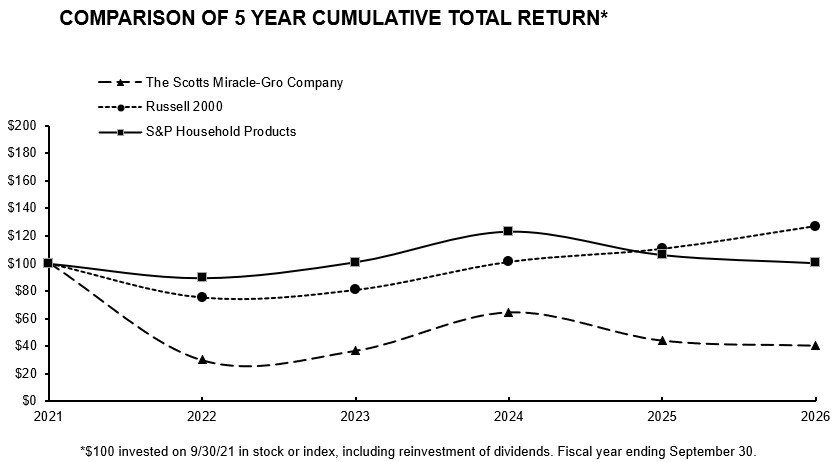
ITEM 6. RESERVED
30
ITEM 7. MANAGEMENT’S DISCUSSION AND ANALYSIS OF FINANCIAL CONDITION AND RESULTS OF OPERATIONS
The purpose of this Management’s Discussion and Analysis of Financial Condition and Results of Operations (“MD&A”) is to provide an understanding of our financial condition and results of operations by focusing on changes in certain key measures from year-to-year. This MD&A includes the following sections:
•Executive summary
•Results of operations
•Segment results
•Liquidity and capital resources
•Regulatory matters
•Critical accounting estimates
Executive Summary
We have three operating segments: U.S. Consumer, Other and Bonnie Plants; and one reportable segment: U.S. Consumer. U.S. Consumer consists of our consumer lawn and garden business in the United States. Other primarily consists of our consumer lawn and garden business in Canada. Bonnie Plants consists of our equity interest in Bonnie Plants, LLC, a joint venture with AFC, that is accounted for using the equity method of accounting. The Other and Bonnie Plants operating segments do not meet any of the quantitative thresholds requiring separate reportable segment disclosures. Corporate consists of general and administrative expenses and certain other income and expense items not allocated to our operating segments. See “SEGMENT RESULTS” below for additional information regarding our evaluation of segment performance.
Through our U.S. Consumer and Other segments, we are the leading marketer of branded consumer lawn and garden products in North America. Our products are marketed under some of the most recognized brand names in the industry. Our key consumer lawn and garden brands include Scotts® Turf Builder® lawn fertilizer and Scotts® grass seed products; Miracle-Gro® soil, plant food and gardening products; Ortho® herbicide and pesticide products; and Tomcat® rodent control and animal repellent products. We are the exclusive agent of Monsanto for the marketing and distribution of certain of Monsanto’s consumer Roundup® branded products within the United States and certain other specified countries. The Bonnie Plants, LLC joint venture is focused on planting, growing, developing, distributing, marketing and selling live plants.
As a leading consumer branded lawn and garden company, our product development and marketing efforts are largely focused on providing innovative and differentiated products and continually increasing brand and product awareness to inspire consumers to create retail demand. We have implemented this model for a number of years by focusing on research and development, advertising and consumer activation programs with our customers to support and promote our consumer lawn and garden products and brands. We continually explore new and innovative ways to communicate with consumers. We believe that we receive a significant benefit from these expenditures and we anticipate continued growth in these investments in the future, with the continuing objective of driving category growth and profitably maintaining and/or increasing market share.
Our consumer lawn and garden business in any year is susceptible to weather conditions in the markets in which our products are sold. These climate conditions may adversely impact the sale of certain products or increase demand for other products thereby making the overall impact of abnormal or extreme weather conditions on us difficult to predict. We believe that our diversified product line and our geographic diversification reduce this risk, although to a lesser extent in a year in which unfavorable weather is geographically widespread and extends across a significant portion of the lawn and garden season. We also believe that weather conditions in any one year, positive or negative, do not materially impact longer-term category growth trends.
Due to the seasonal nature of the consumer lawn and garden business, significant portions of our U.S. Consumer and Other segments’ net sales ship to our retail customers during our second and third fiscal quarters, as noted in the following table. Our annual net sales are further concentrated in the second and third fiscal quarters by retailers who rely on our ability to deliver products closer to when consumers buy our products.
| Percent of Net Sales from Continuing Operations by Quarter | |||||||||||||||||
| 2026 | 2025 | 2024 | |||||||||||||||
| First Quarter | 10.8 | % | 11.3 | % | 10.2 | % | |||||||||||
| Second Quarter | 44.4 | % | 42.7 | % | 44.7 | % | |||||||||||
| Third Quarter | 35.6 | % | 35.6 | % | 34.8 | % | |||||||||||
| Fourth Quarter | 9.2 | % | 10.4 | % | 10.3 | % | |||||||||||
31
Management focuses on a variety of key indicators and operating metrics to monitor the financial condition and performance of the continuing operations of our business. These metrics include consumer purchases (point-of-sale data), market share, category growth, branded sales growth, e-commerce penetration, household penetration, net sales (including unit volume, mix, pricing and other drivers), gross margin, advertising to net sales ratio, income (loss) from operations, net income (loss), earnings per share, earnings before interest, taxes, depreciation and amortization (“EBITDA”), leverage ratio and interest coverage ratio. We also focus on measures to optimize cash flow and return on invested capital, including the management of working capital and capital expenditures.
Recent Events and Trends Affecting Our Business
On June 29, 2026, the Company announced that its Board of Directors had named Nathan E. Baxter as President & Chief Executive Officer of the Company effective June 26, 2026. In addition, the Board of Directors elected Mr. Baxter as a director. Mr. Baxter succeeded James Hagedorn, who served as Chief Executive Officer of the Company since 2001. Mr. Hagedorn, who served as Chairman of the Board since 2003, also resigned from the Board of Directors, and the Board of Directors elected then-current Lead Independent Director Peter Shumlin as Chairman.
Subsequent to the end of fiscal 2026, on October 1, 2026, our U.S. Consumer segment completed the acquisition of the Black Kow® brand asset portfolio, which includes composted cow manure and organic soil products, for total cash consideration of $55.0.
During fiscal 2026, we commenced a multi-year project to transform our IT infrastructure, including replacing our ERP system and implementing complementary software across critical business functions. We plan to invest over $100.0, including capital expenditures and operating expenses, associated with these IT implementations over the course of the project, which is expected to be substantially complete by the end of fiscal 2028.
During the three months ended December 27, 2025, we determined that the Hawthorne business met the criteria to be classified as held for sale, and classified the related assets and liabilities as held for sale in the Consolidated Balance Sheets for all periods presented. We determined this represented a strategic shift, and therefore, effective in the first quarter of fiscal 2026, we classified our results of operations for all periods presented to reflect the Hawthorne business as a discontinued operation. On April 8, 2026, we completed the sale of the Hawthorne business in North America to Vireo in exchange for 7.1 million common shares of Vireo, which represented approximately 14% of Vireo’s total outstanding common shares as of the closing date, and a warrant with a five-year term to acquire 2.7 million additional common shares of Vireo at a strike price of $25.50 per share (collectively, the “Vireo Equity Securities”), all as adjusted for Vireo’s 30-for-1 share consolidation effective June 5, 2026. On the closing date, the Hawthorne business held cash and cash equivalents of $35.0 that was transferred to Vireo as part of the sale. Additionally, in connection with the transaction, we entered into a contract manufacturing agreement and agreed to provide Vireo with up to $20.0 of manufacturing services over a two-year period for no cost. For fiscal 2026, we recorded a pre-tax loss of $106.2 related to the sale of the Hawthorne business in North America. The completion of the sale during fiscal 2026 resulted in an ordinary taxable loss that allowed the realization of deferred tax assets, which reduced cash taxes paid in fiscal 2026 and is expected to further reduce cash taxes paid in fiscal 2027.
We continue to monitor the impacts of macroeconomic conditions, including elevated interest rates, inflationary pressures and consumer behavior, geopolitical uncertainty, including the duration and resolution of ongoing conflicts, potential escalation of tensions and global supply chain disruptions, and ongoing changes to global trade policies, including the imposition of tariffs. As a result of these conditions, we incurred higher costs for certain commodities, including urea and other fertilizer inputs, as well as higher fuel and transportation costs, in fiscal 2026, and we expect these costs to remain elevated in fiscal 2027, resulting in higher costs compared to fiscal 2026. In addition, inventory levels of our products at our largest retailers were higher at the end of fiscal 2026 than at the end of fiscal 2025, which we expect to represent a headwind to our net sales in fiscal 2027. The impact that these events and conditions will have on our operational and financial performance will depend on future developments, which are difficult to predict. For more information about factors that could impact our business, see “ITEM 1A. RISK FACTORS” in this Form 10-K.
In October 2026, in connection with its planned termination, The Scotts Company LLC Associates’ Pension Plan entered into a group annuity buy-in contract funded by a premium of $54.7 paid from plan assets. The pension plans associated with the former business in the United Kingdom entered into buy-in insurance policies during fiscal 2023 and fiscal 2021. We currently expect to convert the U.S. buy-in contract to a buy-out and settle the related plan obligations during fiscal 2027, and to complete buy-outs for the U.K. plans during fiscal 2027 or fiscal 2028. Upon settlement, we expect to recognize non-cash, pre-tax settlement charges, currently estimated at approximately $30.0 for the U.S. plan and $60.0 for the U.K. plans. The timing and amount of the final charges will depend on market conditions and final remeasurements at the time of settlement. Refer to “NOTE 10. RETIREMENT PLANS” of the Notes to Consolidated Financial Statements included in this Form 10-K.
32
Results of Operations
Unless specifically stated, all discussion herein refers to results from our continuing operations. The following table sets forth the components of earnings:
| Year Ended September 30, | |||||||||||||||||
| 2026 | 2025 | 2024 | |||||||||||||||
| Net sales | $ | 3,288.9 | $ | 3,255.8 | $ | 3,268.4 | |||||||||||
| Cost of sales | 2,223.4 | 2,226.1 | 2,367.9 | ||||||||||||||
| Cost of sales—impairment, restructuring and other | 2.5 | 10.1 | 11.7 | ||||||||||||||
| Gross margin | 1,063.0 | 1,019.6 | 888.8 | ||||||||||||||
| % of sales | 32.3 | % | 31.3 | % | 27.2 | % | |||||||||||
| Operating expenses: | |||||||||||||||||
| Selling, general and administrative | 594.7 | 563.8 | 507.6 | ||||||||||||||
| Impairment, restructuring and other | 49.2 | 35.2 | 70.7 | ||||||||||||||
| Other expense, net | 12.4 | 18.6 | 20.8 | ||||||||||||||
| Income from operations | 406.7 | 402.0 | 289.7 | ||||||||||||||
| % of sales | 12.4 | % | 12.3 | % | 8.9 | % | |||||||||||
| Equity in (income) loss of unconsolidated affiliates | (3.0) | 2.8 | 68.1 | ||||||||||||||
| Interest expense | 112.6 | 129.0 | 157.6 | ||||||||||||||
| Other non-operating expense, net | 19.1 | 5.3 | 5.6 | ||||||||||||||
| Income from continuing operations before income taxes | 278.0 | 264.9 | 58.4 | ||||||||||||||
| Income tax expense from continuing operations | 83.1 | 82.8 | 31.1 | ||||||||||||||
| Net income from continuing operations | 194.9 | 182.1 | 27.3 | ||||||||||||||
| Loss from discontinued operations, net of tax | (91.0) | (36.9) | (62.2) | ||||||||||||||
| Net income (loss) | $ | 103.9 | $ | 145.2 | $ | (34.9) | |||||||||||
The sum of the components may not equal the total due to rounding.
Net Sales
Net sales for fiscal 2026 were $3,288.9, an increase of 1.0% from net sales of $3,255.8 for fiscal 2025. Net sales for fiscal 2025 decreased 0.4% from net sales of $3,268.4 for fiscal 2024. Factors contributing to the change in net sales are outlined in the following table:
| Year Ended September 30, | |||||||||||
| 2026 | 2025 | ||||||||||
| Volume and mix | 0.6 | % | 0.4 | % | |||||||
| Pricing | 0.4 | (0.6) | |||||||||
| Foreign exchange rates | — | (0.2) | |||||||||
| Change in net sales | 1.0 | % | (0.4) | % | |||||||
The increase in net sales for fiscal 2026 as compared to fiscal 2025 was primarily driven by:
•favorable mix in our U.S. Consumer segment driven by higher sales of branded products including soils, grass seed, controls and fertilizer products, partially offset by lower sales of mulch products;
•higher net sales associated with the Roundup® marketing agreement; and
•increased pricing in our U.S. Consumer and Other segments.
The decrease in net sales for fiscal 2025 as compared to fiscal 2024 was primarily driven by:
•decreased net sales of 1.4% included within “volume and mix” related to nonrecurring fiscal 2024 sales of bulk raw materials and AeroGarden® products in our U.S. Consumer segment; and
•decreased pricing, primarily driven by additional investments in consumer activation activities in our U.S. Consumer segment;
•partially offset by higher volume in our U.S. Consumer segment driven by soils, mulch, grass seed and spreader products.
33
Cost of Sales
The following table shows the major components of cost of sales:
| Year Ended September 30, | |||||||||||||||||
| 2026 | 2025 | 2024 | |||||||||||||||
| Materials | $ | 1,121.9 | $ | 1,113.7 | $ | 1,256.9 | |||||||||||
| Manufacturing labor and overhead | 522.6 | 557.9 | 547.6 | ||||||||||||||
| Distribution and warehousing | 487.7 | 467.5 | 472.2 | ||||||||||||||
Costs associated with Roundup® marketing agreement | 91.2 | 87.0 | 91.2 | ||||||||||||||
| Cost of sales | 2,223.4 | 2,226.1 | 2,367.9 | ||||||||||||||
| Cost of sales—impairment, restructuring and other | 2.5 | 10.1 | 11.7 | ||||||||||||||
| $ | 2,225.9 | $ | 2,236.2 | $ | 2,379.6 | ||||||||||||
Factors contributing to the change in cost of sales are outlined in the following table:
| Year Ended September 30, | |||||||||||
| 2026 | 2025 | ||||||||||
| Volume, mix and other | $ | (8.3) | $ | (70.7) | |||||||
Costs associated with Roundup® marketing agreement | 4.2 | (4.2) | |||||||||
| Foreign exchange rates | 1.2 | (5.0) | |||||||||
| Material cost changes | 0.2 | (61.9) | |||||||||
| (2.7) | (141.8) | ||||||||||
| Impairment, restructuring and other | (7.6) | (1.6) | |||||||||
| Change in cost of sales | $ | (10.3) | $ | (143.4) | |||||||
The decrease in cost of sales for fiscal 2026 as compared to fiscal 2025 was primarily driven by:
•sales mix in our U.S. Consumer segment driven by lower sales and production volume of mulch products, partially offset by higher sales of branded products;
•flat material costs, driven by supply chain savings initiatives in our U.S. Consumer segment, fully offset by the impact of higher commodity costs; and
•a decrease in impairment, restructuring and other charges;
•partially offset by higher transportation costs included within “volume, mix and other” in our U.S. Consumer segment.
The decrease in cost of sales for fiscal 2025 as compared to fiscal 2024 was primarily driven by:
•lower material costs in our U.S. Consumer segment;
•nonrecurring fiscal 2024 sales of bulk raw materials and AeroGarden® products in our U.S. Consumer segment;
•lower transportation costs included within “volume, mix and other” in our U.S. Consumer segment;
•lower manufacturing costs included within “volume, mix and other” in our U.S. Consumer and Other segments;
•lower inventory write-down charges included within “volume, mix and other” associated with our U.S. Consumer segment; and
•a decrease in impairment, restructuring and other charges;
•partially offset by higher sales volume in our U.S. Consumer segment.
34
Gross Margin
As a percentage of net sales, our gross margin rate was 32.3%, 31.3% and 27.2% for fiscal 2026, fiscal 2025 and fiscal 2024, respectively. Factors contributing to the change in gross margin rate are outlined in the following table:
| Year Ended September 30, | |||||||||||
| 2026 | 2025 | ||||||||||
| Volume, mix and other | 0.4 | % | 2.6 | % | |||||||
Roundup® commissions and reimbursements | 0.2 | 0.1 | |||||||||
| Pricing | 0.2 | (0.5) | |||||||||
| Material costs | — | 1.9 | |||||||||
| 0.8 | 4.1 | ||||||||||
| Impairment, restructuring and other | 0.2 | — | |||||||||
| Change in gross margin rate | 1.0 | % | 4.1 | % | |||||||
The increase in gross margin rate for fiscal 2026 as compared to fiscal 2025 was primarily driven by:
•favorable mix associated with our U.S. Consumer segment;
•increased pricing in our U.S. Consumer and Other segments;
•higher commission associated with the Roundup® marketing agreement;
•flat material costs, driven by supply chain savings initiatives in our U.S. Consumer segment, fully offset by the impact of higher commodity costs; and
•a decrease in impairment, restructuring and other charges;
•partially offset by higher transportation costs included within “volume, mix and other” in our U.S. Consumer segment.
The increase in gross margin rate for fiscal 2025 as compared to fiscal 2024 was primarily driven by:
•lower material costs in our U.S. Consumer segment;
•favorable mix associated with our U.S. Consumer segment;
•lower transportation costs included within “volume, mix and other” in our U.S. Consumer segment;
•lower manufacturing costs included within “volume, mix and other” in our U.S. Consumer and Other segments; and
•lower inventory write-down charges included within “volume, mix and other” associated with our U.S. Consumer segment;
•partially offset by decreased pricing, primarily driven by additional investments in consumer activation activities in our U.S. Consumer segment.
35
Selling, General and Administrative Expenses
The following table sets forth the components of selling, general and administrative expenses (“SG&A”):
| Year Ended September 30, | |||||||||||||||||
| 2026 | 2025 | 2024 | |||||||||||||||
| Advertising | $ | 169.2 | $ | 151.4 | $ | 140.3 | |||||||||||
| Advertising as a percentage of net sales | 5.1 | % | 4.7 | % | 4.3 | % | |||||||||||
| Other marketing | 63.6 | 57.4 | 48.8 | ||||||||||||||
| Share-based compensation | 45.9 | 44.3 | 52.0 | ||||||||||||||
| Research and development | 34.4 | 30.6 | 29.7 | ||||||||||||||
| IT transformation costs | 13.5 | — | — | ||||||||||||||
| Amortization of intangibles | 2.6 | 2.7 | 3.3 | ||||||||||||||
| Other selling, general and administrative | 265.5 | 277.4 | 233.5 | ||||||||||||||
| $ | 594.7 | $ | 563.8 | $ | 507.6 | ||||||||||||
SG&A increased $30.9, or 5.5%, during fiscal 2026 compared to fiscal 2025. Advertising expense increased $17.8, or 11.8%, and other marketing expense increased $6.2, or 10.8%, driven by planned higher spending in our U.S. Consumer segment. During fiscal 2026, we incurred costs of $13.5 associated with the IT transformation project, primarily comprised of third-party consulting and implementation fees, and costs associated with software and other third-party diagnostic tools utilized for scoping and visioning of the project. Other SG&A decreased $11.9, or 4.3%, driven by lower short-term variable cash incentive compensation expense.
SG&A increased $56.2, or 11.1%, during fiscal 2025 compared to fiscal 2024. Advertising expense increased $11.1, or 7.9%, and other marketing expense increased $8.6, or 17.6%, driven by planned higher spending in our U.S. Consumer segment. Share-based compensation expense, which excludes certain advertising expenses paid for in Common Shares, decreased $7.7, or 14.8%, primarily due to lower long-term incentive compensation expense. Other SG&A increased by $43.9, or 18.8%, driven by higher short-term variable cash incentive compensation expense.
Impairment, Restructuring and Other
Activity described herein is classified within the “Cost of sales—impairment, restructuring and other” and “Impairment, restructuring and other” lines in the Consolidated Statements of Operations. The following table details impairment, restructuring and other charges (recoveries) for each of the periods presented:
| Year Ended September 30, | |||||||||||||||||
| 2026 | 2025 | 2024 | |||||||||||||||
| Cost of sales—impairment, restructuring and other: | |||||||||||||||||
| Restructuring and other charges, net | $ | 2.5 | $ | 7.6 | $ | 7.7 | |||||||||||
| Right-of-use asset impairments | — | 2.5 | 2.2 | ||||||||||||||
| Property, plant and equipment impairments | — | — | 1.8 | ||||||||||||||
| Operating expenses—impairment, restructuring and other: | |||||||||||||||||
| Restructuring and other charges, net | 36.6 | 28.2 | 6.0 | ||||||||||||||
| Credit loss / impairments on convertible debt and other investments | 20.1 | — | 64.6 | ||||||||||||||
| Gains on sale of property, plant and equipment | (7.6) | — | — | ||||||||||||||
| Loss on exchange of convertible debt investment | — | 7.0 | — | ||||||||||||||
| Total impairment, restructuring and other | $ | 51.6 | $ | 45.3 | $ | 82.3 | |||||||||||
During fiscal 2026, we recorded employee and executive severance charges of $1.7 in the “Cost of sales—impairment, restructuring and other” line in the Consolidated Statements of Operations primarily related to our U.S. Consumer segment and $26.4 in the “Impairment, restructuring and other” line in the Consolidated Statements of Operations primarily related to Corporate, including executive severance in connection with the Chief Executive Officer transition. During fiscal 2025, we recorded employee and executive severance charges of $21.1, including charges of $6.1 related to our U.S. Consumer segment in the “Cost of sales—impairment, restructuring and other” line, and $2.3 related to our U.S. Consumer segment, $1.1 related to our Other segment and $11.6 at Corporate in the “Impairment, restructuring and other” line in the Consolidated Statements of Operations.
36
During fiscal 2026, we recorded a non-cash charge of $8.7 for expected credit losses related to a seller financing loan in the “Impairment, restructuring and other” line in the Consolidated Statements of Operations.
During fiscal 2026, we recorded a non-cash charge of $7.9 for expected credit losses related to a convertible debt investment in the “Impairment, restructuring and other” line in the Consolidated Statements of Operations.
During fiscal 2026, we recorded pre-tax gains on the sale of land and real estate facilities of $7.6 in the “Impairment, restructuring and other” line in the Consolidated Statements of Operations.
During fiscal 2026 and fiscal 2025, we recorded charges of $4.0 and $7.5, respectively, in the “Impairment, restructuring and other” line in the Consolidated Statements of Operations associated with the resolution of disputes with former shareholders of a business that was acquired in fiscal 2021.
During fiscal 2026, we recorded a non-cash charge of $3.5 related to other investments in the “Impairment, restructuring and other” line in the Consolidated Statements of Operations.
During fiscal 2025, we recorded a non-cash loss of $7.0 in the “Impairment, restructuring and other” line in the Consolidated Statements of Operations related to the exchange of our convertible debt investment in RIV Capital Inc. (“RIV Capital”) for non-voting exchangeable shares of FLUENT Corp. (“FLUENT”) (CSE: FNT.U) (OTCQB: CNTMF). Refer to “NOTE 9. INVESTMENT IN UNCONSOLIDATED AFFILIATES” of the Notes to Consolidated Financial Statements included in this Form 10-K for further details.
During fiscal 2022, we began implementing a series of Company-wide organizational changes and initiatives intended to create operational and management-level efficiencies. As part of this restructuring initiative, which was substantially completed during fiscal 2025, we reduced the size of our supply chain network, reduced staffing levels and implemented other cost-reduction initiatives. We recorded costs of $4.0 and $11.3 in our U.S. Consumer segment in the “Cost of sales—impairment, restructuring and other” line in the Consolidated Statements of Operations during fiscal 2025 and fiscal 2024, respectively, and recorded costs of $1.5 in our U.S. Consumer segment, $1.1 in our Other segment and $2.4 at Corporate in the “Impairment, restructuring and other” line in the Consolidated Statements of Operations during fiscal 2024 associated with this restructuring initiative.
During fiscal 2024, we recorded a non-cash, pre-tax impairment charge related to our convertible debt investments of $64.6 in the “Impairment, restructuring and other” line in the Consolidated Statements of Operations.
Other Expense, net
Other expense is comprised of activities such as the discount on sales of accounts receivable under the Master Receivables Purchase Agreement, royalty income from the licensing of certain of our brand names, gains and losses on long-lived assets and foreign exchange transaction gains and losses. Other expense was $12.4, $18.6 and $20.8 in fiscal 2026, fiscal 2025 and fiscal 2024, respectively.
Income from Operations
Income from operations was $406.7 in fiscal 2026 compared to $402.0 in fiscal 2025. The increase was primarily driven by higher net sales, a higher gross margin rate and lower other expense, partially offset by higher SG&A and higher impairment, restructuring and other charges.
Income from operations was $402.0 in fiscal 2025 compared to $289.7 in fiscal 2024. The increase was primarily driven by a higher gross margin rate and lower impairment, restructuring and other charges, partially offset by lower net sales and higher SG&A.
Equity in (Income) Loss of Unconsolidated Affiliates
Equity in (income) loss of unconsolidated affiliates was $(3.0), $2.8 and $68.1 in fiscal 2026, fiscal 2025 and fiscal 2024, respectively. Equity in (income) loss of unconsolidated affiliates associated with Bonnie Plants, LLC was $(5.6), $(5.4) and $68.1 in fiscal 2026, fiscal 2025 and fiscal 2024, respectively. We recorded a pre-tax impairment charge associated with our investment in Bonnie Plants, LLC of $61.9 during fiscal 2024. During fiscal 2026, our investment balance in FLUENT was reduced to zero, and we discontinued equity method recognition of our proportionate share of FLUENT losses.
Interest Expense
Interest expense was $112.6 in fiscal 2026, a decrease of 12.7% compared to $129.0 in fiscal 2025. The decrease was driven by lower average borrowings of $134.3 and a decrease in our weighted average interest rate, net of the impact of interest rate swaps, of 40 basis points. The decrease in average borrowings was driven by our focus on using available cash flow to reduce our debt. The decrease in our weighted average interest rate was primarily driven by lower borrowing rates under the Seventh A&R Credit Agreement.
37
Interest expense was $129.0 in fiscal 2025, a decrease of 18.1% compared to $157.6 in fiscal 2024. The decrease was driven by lower average borrowings of $301.4 and a decrease in our weighted average interest rate, net of the impact of interest rate swaps, of 50 basis points. The decrease in average borrowings was driven by our focus on using available cash flow to reduce our debt. The decrease in our weighted average interest rate was primarily driven by lower borrowing rates under the credit agreement.
Other Non-Operating Expense, net
Other non-operating expense, net was $19.1, $5.3 and $5.6 in fiscal 2026, fiscal 2025 and fiscal 2024, respectively. The increase during fiscal 2026 was driven by unrealized losses associated with the Vireo Equity Securities of $14.7.
Income Tax Expense from Continuing Operations
Income tax expense from continuing operations was $83.1 in fiscal 2026 compared to $82.8 in fiscal 2025, and the effective tax rate was 29.9% in fiscal 2026 compared to 31.3% in fiscal 2025. The decrease in the effective tax rate was primarily driven by lower state income taxes and lower valuation allowances, partially offset by non-deductible compensation.
Income tax expense from continuing operations was $82.8 in fiscal 2025 compared to $31.1 in fiscal 2024, and the effective tax rate was 31.3% in fiscal 2025 compared to 53.3% in fiscal 2024. The decrease in the effective tax rate was primarily driven by higher income from continuing operations before income taxes in fiscal 2025 as compared to fiscal 2024, which reduced the rate impact of permanent differences and changes in valuation allowances. During fiscal 2025, we recorded a full valuation allowance against deferred tax assets related to $8.2 of equity in loss of unconsolidated affiliates associated with FLUENT and $7.0 of non-cash loss related to the exchange of our convertible debt investment in RIV Capital.
Refer to “NOTE 15. INCOME TAXES” of the Notes to Consolidated Financial Statements included in this Form 10-K for further details, including a reconciliation of the federal statutory income tax rate to our effective tax rate.
Net Income from Continuing Operations
Net income from continuing operations was $194.9, or $3.30 per diluted share, in fiscal 2026 compared to $182.1, or $3.10 per diluted share, in fiscal 2025. The increase was driven by higher net sales, a higher gross margin rate, lower other expense, higher equity in income of unconsolidated affiliates and lower interest expense, partially offset by higher impairment, restructuring and other charges, higher other non-operating expense and higher SG&A.
Diluted average common shares used in the diluted net income per common share calculation were 59.1 million for fiscal 2026 compared to 58.7 million for fiscal 2025, which included dilutive potential common shares of 1.0 million and 1.1 million, respectively. The increase in diluted average common shares was primarily the result of the exercise and issuance of share-based compensation awards.
Net income from continuing operations was $182.1, or $3.10 per diluted share, in fiscal 2025 compared to $27.3, or $0.47 per diluted share, in fiscal 2024. The increase was driven by a higher gross margin rate, lower impairment, restructuring and other charges, lower equity in loss of unconsolidated affiliates and lower interest expense, partially offset by lower net sales, higher income tax expense and higher SG&A.
Diluted average common shares used in the diluted net income per common share calculation were 58.7 million for fiscal 2025 compared to 57.7 million for fiscal 2024, which included dilutive potential common shares of 1.1 million and 0.9 million, respectively. The increase in diluted average common shares was primarily the result of the exercise and issuance of share-based compensation awards.
Loss from Discontinued Operations, net of tax
Loss from discontinued operations, net of tax, associated with our Hawthorne business was $91.0, $36.9 and $62.2 in fiscal 2026, fiscal 2025 and fiscal 2024, respectively. Fiscal 2026 included a pre-tax loss of $106.2 related to the sale of the Hawthorne business in North America. Fiscal 2025 included a non tax-deductible loss of $17.7 related to the divestiture of the Hawthorne professional horticulture business based in the Netherlands. Fiscal 2024 included impairment, restructuring and other charges of $64.0.
38
Segment Results
As a result of the classification of the Hawthorne business as a discontinued operation, our reportable segments for fiscal 2026 differ from prior periods. The prior period amounts have been reclassified to reflect the removal of Hawthorne as a reportable segment. Segment performance is evaluated based on several factors, including income (loss) from continuing operations before income taxes, amortization, impairment, restructuring and certain other charges (“Segment Profit (Loss)”), which is a non-GAAP financial measure. We believe this measure is indicative of performance trends and the overall earnings potential of each segment. In addition, following the change in our chief operating decision maker during fiscal 2026, Bonnie Plants was identified as a non-reportable operating segment.
The following table sets forth net sales by segment:
| Year Ended September 30, | |||||||||||||||||
| 2026 | 2025 | 2024 | |||||||||||||||
| U.S. Consumer reportable segment | $ | 3,017.6 | $ | 2,993.7 | $ | 3,013.7 | |||||||||||
| Other non-reportable operating segment | 271.3 | 262.1 | 254.7 | ||||||||||||||
| Consolidated | $ | 3,288.9 | $ | 3,255.8 | $ | 3,268.4 | |||||||||||
The following table sets forth Segment Profit (Loss) as well as a reconciliation to income (loss) from continuing operations before income taxes, the most directly comparable measure prepared in accordance with U.S. generally accepted accounting principles (“GAAP”):
| Year Ended September 30, | |||||||||||||||||
| 2026 | 2025 | 2024 | |||||||||||||||
| U.S. Consumer Segment Profit (Non-GAAP) | $ | 601.4 | $ | 571.3 | $ | 497.5 | |||||||||||
| Other non-reportable operating segment profit | 19.3 | 13.1 | 2.5 | ||||||||||||||
| Corporate | (146.2) | (134.4) | (123.5) | ||||||||||||||
| IT transformation costs | (13.5) | — | — | ||||||||||||||
| Intangible asset amortization | (2.7) | (2.7) | (4.5) | ||||||||||||||
| Impairment, restructuring and other | (51.6) | (45.3) | (82.3) | ||||||||||||||
Equity in income (loss) of unconsolidated affiliates (a) | 3.0 | (2.8) | (68.1) | ||||||||||||||
| Interest expense | (112.6) | (129.0) | (157.6) | ||||||||||||||
| Other non-operating expense, net | (19.1) | (5.3) | (5.6) | ||||||||||||||
| Income from continuing operations before income taxes (GAAP) | $ | 278.0 | $ | 264.9 | $ | 58.4 | |||||||||||
(a)Equity in income (loss) of unconsolidated affiliates includes equity in income of Bonnie Plants, LLC, a non-reportable operating segment, of $5.6, $5.4 and $(68.1) in fiscal 2026, fiscal 2025 and fiscal 2024, respectively. See “NOTE 21. SEGMENT INFORMATION” of the Notes to Consolidated Financial Statements included in this Form 10-K.
U.S. Consumer
U.S. Consumer segment net sales were $3,017.6 in fiscal 2026, an increase of 0.8% from fiscal 2025 net sales of $2,993.7. The increase was driven by favorable volume and mix of 0.5% and increased pricing of 0.3%. Favorable mix for fiscal 2026 was driven by higher sales of branded products including soils, grass seed, controls and fertilizer products, partially offset by lower sales of mulch products.
U.S. Consumer Segment Profit was $601.4 in fiscal 2026, an increase of 5.3% from fiscal 2025 Segment Profit of $571.3. The increase for fiscal 2026 was primarily due to higher net sales, a higher gross margin rate and lower other expense, partially offset by higher SG&A.
U.S. Consumer segment net sales were $2,993.7 in fiscal 2025, a decrease of 0.7% from fiscal 2024 net sales of $3,013.7. The decrease was driven by nonrecurring fiscal 2024 sales of bulk raw materials and AeroGarden® products of 1.4% and decreased pricing of 0.7%, partially offset by higher sales volume of 1.4%. The increase in sales volume for fiscal 2025 was driven by soils, mulch, grass seed and spreader products. Decreased pricing in fiscal 2025 was due to additional investments in consumer activation activities.
39
U.S. Consumer Segment Profit was $571.3 in fiscal 2025, an increase of 14.8% from fiscal 2024 Segment Profit of $497.5. The increase for fiscal 2025 was primarily due to a higher gross margin rate, partially offset by higher SG&A and lower net sales.
Other
Other segment net sales were $271.3 in fiscal 2026, an increase of 3.5% from fiscal 2025 net sales of $262.1. The increase was driven by higher sales volume of 1.9%, increased pricing of 0.9% and favorable foreign exchange rates of 0.7%.
Other Segment Profit was $19.3 in fiscal 2026, an increase of 47.3% from fiscal 2025 Segment Profit of $13.1. The increase was driven by higher net sales and a higher gross margin rate.
Other segment net sales were $262.1 in fiscal 2025, an increase of 2.9% from fiscal 2024 net sales of $254.7. The increase was driven by higher sales volume of 5.3%, partially offset by unfavorable foreign exchange rates of (2.4)%.
Other Segment Profit was $13.1 in fiscal 2025, an increase of 424.0% from fiscal 2024 Segment Profit of $2.5. The increase was driven by higher net sales and a higher gross margin rate, partially offset by higher SG&A.
Corporate
Corporate expenses were $146.2 in fiscal 2026, an increase of 8.8% from fiscal 2025 expenses of $134.4. The increase was primarily driven by higher costs associated with various corporate functions, partially offset by lower short-term variable incentive compensation expense.
Corporate expenses were $134.4 in fiscal 2025, an increase of 8.8% from fiscal 2024 expenses of $123.5. The increase was primarily driven by higher short-term variable incentive compensation expense, partially offset by lower share-based compensation expense.
Liquidity and Capital Resources
The following table summarizes cash activities for the years ended September 30:
| 2026 | 2025 | 2024 | |||||||||||||||
| Net cash provided by operating activities | $ | 373.0 | $ | 371.3 | $ | 667.5 | |||||||||||
| Net cash used in investing activities | (125.9) | (112.1) | (100.4) | ||||||||||||||
| Net cash used in financing activities | (276.4) | (294.0) | (527.9) | ||||||||||||||
Operating Activities
Cash provided by operating activities totaled $373.0 for fiscal 2026 compared to $371.3 for fiscal 2025. The increase was driven by lower accounts receivable due to lower fourth quarter net sales, higher gross margin, lower interest payments and timing of payments to customers related to promotional programs, partially offset by higher inventory production, higher short-term variable cash incentive compensation payments, higher SG&A and the payment in cash during fiscal 2026 of certain advertising expenses that were paid for in Common Shares in fiscal 2025. Cash outflows associated with cloud based software development costs during fiscal 2026 and fiscal 2025 were $13.3 and $6.9, respectively. We do not expect the absence of cash flows from the Hawthorne business to materially affect our future liquidity.
Cash provided by operating activities totaled $371.3 for fiscal 2025 compared to $667.5 for fiscal 2024. The decrease was driven by higher inventory production, the timing of accounts receivable sales, higher short-term variable cash incentive compensation payments and higher SG&A, partially offset by higher gross margin and lower interest payments. Accounts receivable sale timing was driven by our entry into the Master Receivables Purchase Agreement during fiscal 2024.
The seasonal nature of our business generally requires cash to fund significant increases in inventories during the first half of the fiscal year. Receivables and payables also build substantially in our second quarter of the fiscal year in line with the timing of sales to support our retailers’ spring selling season.
40
Investing Activities
Cash used in investing activities totaled $125.9 for fiscal 2026, an increase of $13.8 compared to $112.1 for fiscal 2025. Cash used for investments in property, plant and equipment during fiscal 2026 and fiscal 2025 was $94.6 and $97.4, respectively. On April 8, 2026, we completed the sale of our Hawthorne business in North America to Vireo in exchange for non-cash consideration. On the closing date, the Hawthorne business held cash and cash equivalents of $35.0 that was transferred to Vireo as part of the sale, which was classified as an investing activity in the “Net cash disposed of on sale of business” line in the Consolidated Statements of Cash Flows. During fiscal 2026, we received $17.0 in proceeds from the sale of certain land and real estate facilities. We also had other investing cash outflows of $13.3 during fiscal 2026.
Cash used in investing activities totaled $112.1 for fiscal 2025, an increase of $11.7 compared to $100.4 for fiscal 2024. Cash used for investments in property, plant and equipment during fiscal 2025 and fiscal 2024 was $97.4 and $84.0, respectively, driven by higher spending on capital projects in fiscal 2025. On September 30, 2025, we completed the divestiture of our Hawthorne professional horticulture business based in the Netherlands for $8.5, which was financed by us in the form of an interest bearing loan that was classified as an investing activity in the “Other investing, net” line in the Consolidated Statements of Cash Flows. Other investing cash outflows totaled $12.2 during fiscal 2025.
During fiscal 2026, total capital spending was $107.9, consisting of investments in property, plant and equipment of $94.6, which are classified within investing activities in the Consolidated Statements of Cash Flows, and costs to implement cloud computing arrangements of $13.3, which are classified within operating activities in the Consolidated Statements of Cash Flows.
For the three fiscal years ended September 30, 2026, we allocated our capital spending as follows: 57% for maintenance of existing productive assets; 31% for cost savings projects, focused primarily on supply chain and information technology; and 12% for innovation and expansion.
We expect fiscal 2027 total capital spending to be approximately $130.0, consisting of investments in property, plant and equipment and costs to implement cloud computing arrangements. We expect to allocate approximately 50% to maintenance of existing productive assets, 30% to innovation and expansion projects and 20% to cost savings projects.
Financing Activities
Cash used in financing activities totaled $276.4 for fiscal 2026 compared to $294.0 for fiscal 2025. During fiscal 2026, we had net debt repayments of $80.7, including the September 11, 2026 redemption of all $250.0 aggregate principal amount of our 5.250% Senior Notes, which we funded through a combination of cash flows from operations and borrowings under the Seventh A&R Credit Agreement. We also paid dividends of $154.8, paid financing and issuance fees of $8.9 in connection with the Seventh A&R Credit Agreement and repurchased Common Shares for $37.7 (which includes $25.0 of repurchases under our share repurchase program and $12.7 of cash paid to tax authorities to satisfy statutory income tax withholding obligations related to share-based compensation). In addition, we received cash from the exercise of stock options of $5.6 (which also includes amounts received from employee purchases under the employee stock purchase plan) during fiscal 2026.
Cash used in financing activities totaled $294.0 for fiscal 2025 compared to $527.9 for fiscal 2024. During fiscal 2025, we had net debt repayments of $122.1, paid dividends of $154.3 and repurchased Common Shares for $18.4 (which includes cash paid to tax authorities to satisfy statutory income tax withholding obligations related to share-based compensation). In addition, we received cash from the exercise of stock options of $11.9 (which also includes amounts received from employee purchases under the employee stock purchase plan) during fiscal 2025. We also had other financing cash outflows of $11.1 during fiscal 2025 primarily related to fiscal 2024 collections of previously sold accounts receivable that were submitted to the buyer in fiscal 2025.
Share Repurchases
On December 19, 2025, the Board of Directors authorized a share repurchase program, with no expiration date, for the repurchase of up to $500.0 of Common Shares. During fiscal 2026, we repurchased 0.4 million Common Shares under this share repurchase authorization for $25.0.
41
Accounts Receivable Sales
We are party to a Master Receivables Purchase Agreement, which is uncommitted and expires on August 31, 2027, under which we may sell up to $750.0 of available and eligible outstanding customer accounts receivable generated by sales to five specified customers. Transactions under the Master Receivables Purchase Agreement are accounted for as sales of accounts receivable, and the receivables sold are removed from the Consolidated Balance Sheets at the time of the sales transaction. Proceeds received from the sales of accounts receivable are classified as operating cash flows and collections of previously sold accounts receivable not yet submitted to the buyer are classified as financing cash flows in the Consolidated Statements of Cash Flows. We record the discount on sales in the “Other expense, net” line in the Consolidated Statements of Operations. At September 30, 2026 and 2025, net receivables derecognized were $158.9 and $163.3, respectively. During fiscal 2026 and fiscal 2025, proceeds from the sale of receivables under the Master Receivables Purchase Agreement totaled $1,848.9 and $1,906.1, respectively, and the total discount recorded on sales was $18.6 and $20.7, respectively.
Supplier Finance Program
We maintain a supplier finance program which facilitates participating suppliers’ ability to finance our payment obligations with a designated third-party financial institution. Participating suppliers may, at their sole discretion, elect to finance our payment obligations prior to their scheduled due dates at a discounted price to the participating financial institution. Our obligations to our suppliers, including amounts due and scheduled payment dates, are not impacted by suppliers’ decisions to finance amounts under this arrangement. The payment terms that we negotiate with our suppliers are consistent, regardless of whether a supplier participates in the program. Our current payment terms with a majority of our suppliers generally range from 30 to 60 days, which we deem to be commercially reasonable. Our outstanding payment obligations under our supplier finance program are recorded within accounts payable in the Consolidated Balance Sheets and the associated payments are classified as operating activities in the Consolidated Statements of Cash Flows.
Cash and Cash Equivalents
Our cash and cash equivalents were held in cash depository accounts with major financial institutions around the world or invested in high-quality, short-term liquid investments having original maturities of three months or less. The cash and cash equivalents balances, including cash and cash equivalents classified within current assets held for sale, of $7.4 and $36.6 at September 30, 2026 and 2025, respectively, included $3.5 and $4.2, respectively, held by controlled foreign corporations. As of September 30, 2026, we maintain our assertion of indefinite reinvestment of the earnings of all material foreign subsidiaries.
Borrowing Agreements
Credit Facilities
Our primary sources of liquidity are cash generated by operations and borrowings under our credit facilities, which are guaranteed by substantially all of Scotts Miracle-Gro’s domestic subsidiaries. On November 21, 2025, we entered into the Seventh A&R Credit Agreement, providing the Company and certain of its subsidiaries with five-year senior secured loan facilities in the aggregate principal amount of $2,000.0, comprised of a revolving credit facility of $1,500.0 and a term loan in the original principal amount of $500.0. The Seventh A&R Credit Agreement also provides us with the right to seek additional committed credit under the agreement in an aggregate amount of up to $500.0 plus an unlimited additional amount, subject to certain specified financial and other conditions. The Seventh A&R Credit Agreement provides for the issuance of letters of credit up to $100.0 and will terminate on November 21, 2030. The terms of the Seventh A&R Credit Agreement include customary representations and warranties, affirmative and negative covenants, financial covenants and events of default.
Borrowings under the Seventh A&R Credit Agreement bear interest at variable rates derived from the prevailing U.S. Prime Rate, Federal Reserve Bank of New York Rate, Secured Overnight Financing Rate, Euro Interbank Offered Rate, Canadian Prime Rate or Canadian Overnight Repo Rate Average (all as defined in the Seventh A&R Credit Agreement), based on our election, plus a spread that depends on our quarterly-tested leverage ratio.
At September 30, 2026, we had letters of credit outstanding in the aggregate principal amount of $93.2, and had $1,220.2 of borrowing availability under the Seventh A&R Credit Agreement. The weighted average interest rates on average borrowings under the credit facilities, excluding the impact of interest rate swaps, were 6.7%, 7.9% and 9.1% for fiscal 2026, fiscal 2025 and fiscal 2024, respectively.
42
The Seventh A&R Credit Agreement contains, among other obligations, an affirmative covenant regarding our leverage ratio determined as of the end of each of our fiscal quarters, calculated as average total indebtedness divided by earnings before interest, taxes, depreciation and amortization, as adjusted pursuant to the terms of the Seventh A&R Credit Agreement (“Adjusted EBITDA”). The maximum permitted leverage ratio is 5.00. Our leverage ratio was 3.89 at September 30, 2026. The Seventh A&R Credit Agreement also contains an affirmative covenant regarding our interest coverage ratio determined as of the end of each of our fiscal quarters, calculated as Adjusted EBITDA divided by interest expense, as described in the Seventh A&R Credit Agreement. The minimum required interest coverage ratio is (i) 3.00 for each of the fiscal quarters within fiscal 2026, (ii) 3.25 for each of the fiscal quarters within fiscal 2027 and (iii) 3.50 for fiscal quarters thereafter. Our interest coverage ratio was 5.46 at September 30, 2026.
The Seventh A&R Credit Agreement allows us to make unlimited restricted payments (as defined in the Seventh A&R Credit Agreement), including dividend payments on, and repurchases of, Common Shares, as long as the leverage ratio resulting from the making of such restricted payments is 4.00 or less. Otherwise, we are limited to restricted payments in an aggregate amount for each fiscal year not to exceed $225.0.
Senior Notes
On October 22, 2019, Scotts Miracle-Gro issued $450.0 aggregate principal amount of 4.500% Senior Notes due 2029. The 4.500% Senior Notes represent general unsecured senior obligations and rank equal in right of payment with our existing and future unsecured senior debt. The 4.500% Senior Notes have interest payment dates of April 15 and October 15 of each year.
On March 17, 2021, Scotts Miracle-Gro issued $500.0 aggregate principal amount of 4.000% Senior Notes due 2031. The 4.000% Senior Notes represent general unsecured senior obligations and rank equal in right of payment with our existing and future unsecured senior debt. The 4.000% Senior Notes have interest payment dates of April 1 and October 1 of each year.
On August 13, 2021, Scotts Miracle-Gro issued $400.0 aggregate principal amount of 4.375% Senior Notes due 2032. The 4.375% Senior Notes represent general unsecured senior obligations and rank equal in right of payment with our existing and future unsecured senior debt. The 4.375% Senior Notes have interest payment dates of February 1 and August 1 of each year.
On September 11, 2026, Scotts Miracle-Gro redeemed all $250.0 aggregate principal amount of its outstanding 5.250% Senior Notes due 2026 at a redemption price equal to the aggregate principal amount of the 5.250% Senior Notes.
Substantially all of Scotts Miracle-Gro’s directly and indirectly owned domestic subsidiaries serve as guarantors of the 4.500% Senior Notes, the 4.000% Senior Notes and the 4.375% Senior Notes.
Interest Rate Swap Agreements
We enter into interest rate swap agreements with major financial institutions that effectively convert a portion of our variable-rate debt to a fixed rate. Interest payments made between the effective date and expiration date are hedged by the swap agreements. Swap agreements that were hedging interest payments as of September 30, 2026 and 2025 had maximum total U.S. dollar equivalent notional amounts of $375.0 and $450.0, respectively. During fiscal 2024, we terminated an interest rate swap agreement in exchange for a cash payment of $11.0. The notional amount, effective date, expiration date and rate of each of the swap agreements outstanding at September 30, 2026 are shown in the table below:
| Notional Amount ($) | Effective Date (a) | Expiration Date | Fixed Rate | |||||||||||||||||
| 150 | 6/7/2023 | 4/7/2027 | 3.37 | % | ||||||||||||||||
| 50 | 6/7/2023 | 4/7/2027 | 3.34 | % | ||||||||||||||||
| 100 | (b) | 11/20/2023 | 3/22/2027 | 4.74 | % | |||||||||||||||
| 75 | (b) | 9/20/2024 | 9/20/2029 | 4.25 | % | |||||||||||||||
| 100 | 3/22/2027 | 4/7/2030 | 4.25 | % | ||||||||||||||||
| 100 | 4/8/2027 | 4/8/2030 | 3.40 | % | ||||||||||||||||
(a)The effective date refers to the date on which interest payments are first hedged by the applicable swap agreement.
(b)Notional amount adjusts in accordance with a specified seasonal schedule. This represents the maximum notional amount at any future point in time.
43
Subsequent to September 30, 2026, we entered into interest rate swap agreements with maximum total U.S. dollar equivalent notional amounts of $200.0, which are effective on December 7, 2026, expire on January 7, 2030 and have a fixed rate of 4.52%.
Availability and Use of Cash
We believe that our cash flows from operations and borrowings under our agreements described herein will be sufficient to meet debt service, capital expenditures, working capital needs and other material cash requirements during the next 12 months and over the longer term. However, we cannot ensure that our business will generate sufficient cash flow from operations or that future borrowings will be available under our borrowing agreements in amounts sufficient to pay indebtedness or fund other liquidity needs. Actual results of operations will depend on numerous factors, many of which are beyond our control as further discussed in “ITEM 1A. RISK FACTORS — Risks Related to Our M&A, Lending and Financing Activities — Our indebtedness could limit our flexibility and adversely affect our financial condition” of this Form 10-K.
Financial Disclosures About Guarantors and Issuers of Guaranteed Securities
The 4.500% Senior Notes, 4.000% Senior Notes and 4.375% Senior Notes were issued by Scotts Miracle-Gro on October 22, 2019, March 17, 2021 and August 13, 2021, respectively. The Senior Notes are guaranteed by certain consolidated domestic subsidiaries of Scotts Miracle-Gro (collectively, the “Guarantors”) and, therefore, we report summarized financial information in accordance with SEC Regulation S-X, Rule 13-01, “Guarantors and Issuers of Guaranteed Securities Registered or Being Registered.”
The guarantees are “full and unconditional,” as those terms are used in Regulation S-X, Rule 3-10(b)(3), except that a Guarantor’s guarantee will be released in certain circumstances set forth in the indentures governing the Senior Notes, such as: (i) upon any sale or other disposition of all or substantially all of the assets of the Guarantor (including by way of merger or consolidation) to any person other than Scotts Miracle-Gro or any “restricted subsidiary” under the applicable indenture; (ii) if the Guarantor merges with and into Scotts Miracle-Gro, with Scotts Miracle-Gro surviving such merger; (iii) if the Guarantor is designated an “unrestricted subsidiary” in accordance with the applicable indenture or otherwise ceases to be a “restricted subsidiary” (including by way of liquidation or dissolution) in a transaction permitted by such indenture; (iv) upon legal or covenant defeasance; (v) at the election of Scotts Miracle-Gro following the Guarantor’s release as a guarantor under the Seventh A&R Credit Agreement, except a release by or as a result of the repayment of the Seventh A&R Credit Agreement; or (vi) if the Guarantor ceases to be a “restricted subsidiary” and the Guarantor is not otherwise required to provide a guarantee of the Senior Notes pursuant to the applicable indenture.
Our foreign subsidiaries and certain of our domestic subsidiaries are not guarantors (collectively, the “Non-Guarantors”) of the Senior Notes. Payments on the Senior Notes are only required to be made by Scotts Miracle-Gro and the Guarantors. As a result, no payments are required to be made from the assets of the Non-Guarantors, unless those assets are transferred by dividend or otherwise to Scotts Miracle-Gro or a Guarantor. In the event of a bankruptcy, insolvency, liquidation or reorganization of any of the Non-Guarantors, holders of their indebtedness, including their trade creditors and other obligations, will be entitled to payment of their claims from the assets of the Non-Guarantors before any assets are made available for distribution to Scotts Miracle-Gro or the Guarantors. As a result, the Senior Notes are effectively subordinated to all the liabilities of the Non-Guarantors.
The guarantees may be subject to review under federal bankruptcy laws or relevant state fraudulent conveyance or fraudulent transfer laws. In certain circumstances, the court could void the guarantee, subordinate the amounts owing under the guarantee, or take other actions detrimental to the holders of the Senior Notes.
As a general matter, value is given for a transfer or an obligation if, in exchange for the transfer or obligation, property is transferred or a valid antecedent debt is satisfied. A court would likely find that a Guarantor did not receive reasonably equivalent value or fair consideration for its guarantee to the extent such Guarantor did not obtain a reasonably equivalent benefit from the issuance of the Senior Notes.
The measure of insolvency varies depending upon the law of the jurisdiction that is being applied. Regardless of the measure being applied, a court could determine that a Guarantor was insolvent on the date the guarantee was issued, so that payments to the holders of the Senior Notes would constitute a preference, fraudulent transfer or conveyances on other grounds. If a guarantee is voided as a fraudulent conveyance or is found to be unenforceable for any other reason, the holders of the Senior Notes will not have a claim against the Guarantor.
44
Each guarantee contains a provision intended to limit the Guarantor’s liability to the maximum amount that it could incur without causing the incurrence of obligations under its guarantee to be a fraudulent conveyance. However, there can be no assurance as to what standard a court will apply in making a determination of the maximum liability of each Guarantor. Moreover, this provision may not be effective to protect the guarantees from being voided under fraudulent conveyance laws. There is a possibility that the entire guarantee may be set aside, in which case the Guarantor’s liability under that guarantee may be extinguished.
The following tables present summarized financial information on a combined basis for Scotts Miracle-Gro and the Guarantors. Transactions between Scotts Miracle-Gro and the Guarantors have been eliminated and the summarized financial information does not reflect investments by Scotts Miracle-Gro and the Guarantors in the Non-Guarantor subsidiaries.
| September 30, 2026 | |||||
| Current assets | $ | 778.8 | |||
Non-current assets (a) | 1,784.5 | ||||
| Current liabilities | 639.7 | ||||
| Non-current liabilities | 2,374.0 | ||||
(a)Includes amounts due from Non-Guarantors of $111.1.
| Year Ended | |||||
| September 30, 2026 | |||||
| Net sales | $ | 3,040.1 | |||
| Gross margin | 1,016.7 | ||||
| Net income from continuing operations | 217.5 | ||||
Net income (a) | 143.4 | ||||
(a)Includes intercompany income from Non-Guarantors of $6.5.
Judicial and Administrative Proceedings
We are party to various pending judicial and administrative proceedings and claims arising in the ordinary course of business relating to, among others, product and general liabilities, workers’ compensation, property losses and other liabilities for which we are self-insured or retain a high exposure limit. We have reviewed these pending judicial and administrative proceedings, including the probable outcomes, reasonably anticipated costs and expenses and the availability and limits of our insurance coverage, and have established what we believe to be appropriate accruals. We believe that our assessment of contingencies is reasonable and related accruals are adequate, both individually and in the aggregate; however, there can be no assurance that final resolution of these matters will not have a material effect on our financial condition, results of operations or cash flows.
Contractual Obligations
The following table summarizes our future cash outflows for contractual obligations as of September 30, 2026:
| Payments Due by Period | ||||||||||||||||||||||||||||||||
| Contractual Cash Obligations | Total | Less Than 1 Year | 1-3 Years | 3-5 Years | More Than 5 Years | |||||||||||||||||||||||||||
| Debt obligations | $ | 2,026.4 | $ | 33.5 | $ | 50.0 | $ | 1,542.9 | $ | 400.0 | ||||||||||||||||||||||
| Interest expense on debt obligations | 413.1 | 100.6 | 197.0 | 109.6 | 5.9 | |||||||||||||||||||||||||||
| Finance lease obligations | 15.0 | 2.5 | 3.8 | 3.4 | 5.3 | |||||||||||||||||||||||||||
| Operating lease obligations | 517.4 | 86.3 | 142.6 | 90.5 | 198.0 | |||||||||||||||||||||||||||
| Purchase obligations | 693.2 | 295.5 | 318.7 | 47.5 | 31.5 | |||||||||||||||||||||||||||
| Other, primarily retirement plan obligations | 27.3 | 7.0 | 5.0 | 4.8 | 10.5 | |||||||||||||||||||||||||||
| Total contractual cash obligations | $ | 3,692.4 | $ | 525.4 | $ | 717.1 | $ | 1,798.7 | $ | 651.2 | ||||||||||||||||||||||
We had long-term debt obligations and interest payments due primarily under the 4.500% Senior Notes, 4.000% Senior Notes, 4.375% Senior Notes and our credit facilities. Amounts in the table represent scheduled future maturities of debt principal for the periods indicated.
The interest payments for our credit facilities are based on outstanding borrowings as of September 30, 2026. Actual interest expense will likely be higher due to the seasonality of our business and associated higher average borrowings.
45
Purchase obligations primarily represent commitments for materials used in our manufacturing processes, including urea and packaging, as well as commitments for grass seed, marketing services, sponsorships and information technology services which comprise the unconditional purchase obligations disclosed in “NOTE 19. COMMITMENTS” of the Notes to Consolidated Financial Statements included in this Form 10-K.
Other obligations include actuarially determined retiree benefit payments and pension funding to comply with local funding requirements. These amounts represent expected payments through 2036. Based on the accounting rules for defined benefit pension plans and retirement health care plans, the liabilities reflected in our Consolidated Balance Sheets differ from these expected future payments (see “NOTE 10. RETIREMENT PLANS” and “NOTE 11. ASSOCIATE MEDICAL BENEFITS” of the Notes to Consolidated Financial Statements included in this Form 10-K). The above table excludes liabilities for unrecognized tax benefits and insurance accruals as we are unable to estimate the timing of payments for these items.
Regulatory Matters
We are subject to local, state, federal and foreign environmental protection laws and regulations with respect to our business operations and believe we are operating in substantial compliance, or taking actions aimed at ensuring compliance with, such laws and regulations. We are involved in several legal actions with various governmental agencies related to environmental matters. While it is difficult to quantify the potential financial impact of actions involving these environmental matters, particularly remediation costs at waste disposal sites and future capital expenditures for environmental control equipment, in the opinion of management, the ultimate liability arising from such environmental matters, taking into account established accruals, is not expected to have a material effect on our financial condition, results of operations or cash flows. However, there can be no assurance that the resolution of these matters will not materially affect our future quarterly or annual results of operations, financial condition or cash flows. Additional information on environmental matters affecting us is provided in “ITEM 1. BUSINESS — Regulatory Considerations” and “ITEM 3. LEGAL PROCEEDINGS” of this Form 10-K.
Critical Accounting Estimates
Our audited consolidated financial statements have been prepared in accordance with GAAP. The preparation of financial statements and related disclosures in accordance with GAAP requires management to use judgment and make estimates that affect the reported amounts of assets, liabilities, revenues and expenses and related disclosures of contingent assets and liabilities. We evaluate our estimates on an ongoing basis. By their nature, these judgments are subject to uncertainty. We base our estimates on historical experience, current trends and other factors that we believe to be relevant under the circumstances at the time the estimate was made. Certain accounting estimates are particularly significant, including those related to revenue recognition and promotional allowances, income taxes and goodwill and indefinite-lived intangible assets.
We believe that our estimates, assumptions and judgments are reasonable in that they were based on information available when the estimates, assumptions and judgments were made. However, because future events and their effects cannot be determined with certainty, actual results could differ materially from those implied by our assumptions and estimates.
The Audit Committee of the Board of Directors reviews our critical accounting estimates on an ongoing basis, including those related to revenue recognition and promotional allowances, income taxes and goodwill and indefinite-lived intangible assets.
Revenue Recognition and Promotional Allowances
Our revenue is primarily generated from sales of branded and private label lawn and garden care products. Product sales are recognized at a point in time when control of products transfers to customers and we have no further obligation to provide services related to such products. Sales are typically recognized when products are delivered to or picked up by the customer. We are generally the principal in a transaction and, therefore, primarily record revenue on a gross basis. Revenue for product sales is recorded net of sales returns and allowances. Revenues are measured based on the amount of consideration that we expect to receive as derived from a list price, reduced by estimates for variable consideration. Variable consideration includes the cost of current and continuing promotional programs and expected sales returns.
46
Our promotional programs primarily include rebates based on sales volumes, in-store promotional allowances, cooperative advertising programs, direct consumer rebate programs and special purchasing incentives. The cost of promotional programs is estimated considering all reasonably available information, including current expectations and historical experience. Promotional costs (including allowances and rebates) incurred during the year are expensed to interim periods in relation to revenues and are recorded as a reduction of net sales. Provisions for estimated returns and allowances are recorded at the time revenue is recognized based on historical rates and are periodically adjusted for known changes in return levels. Shipping and handling costs are accounted for as contract fulfillment costs and included in the “Cost of sales” line in the Consolidated Statements of Operations. We exclude from revenue any amounts collected from customers for sales or other taxes.
Income Taxes
Our annual effective tax rate is established based on our pre-tax income (loss), statutory tax rates and the tax impacts of items treated differently for tax purposes than for financial reporting purposes. We record income tax liabilities utilizing known obligations and estimates of potential obligations. A deferred tax asset or liability is recognized whenever there are future tax effects from existing temporary differences and operating loss and tax credit carryforwards. Valuation allowances are used to reduce deferred tax assets to the balances that are more likely than not to be realized. In determining whether a valuation allowance is warranted, we take into account many factors, including the specific tax jurisdiction, both historical and projected future earnings, carryback and carryforward periods and tax planning strategies. Many of the judgments made in adjusting valuation allowances involve assumptions and estimates that are highly subjective. When we determine that deferred tax assets could be realized in greater or lesser amounts than recorded, the asset balance and Consolidated Statements of Operations reflect the change in the period such determination is made. Due to changes in facts and circumstances and the estimates and judgments involved in determining the proper valuation allowances, differences between actual future events and prior estimates and judgments could result in adjustments to these valuation allowances.
We also establish a liability for tax return positions in which there is uncertainty as to whether or not the position will ultimately be sustained. These uncertain tax positions are adjusted as a result of changes in factors such as tax legislation, interpretations of laws by courts, rulings by tax authorities, new audit developments, changes in estimates and the expiration of the statute of limitations. Amounts for uncertain tax positions are adjusted in quarters when new information becomes available or when positions are effectively settled. Many of the judgments made in adjusting uncertain tax positions involve assumptions and estimates regarding audit outcomes and the timing of audit settlements, which are often uncertain and subject to change.
Goodwill and Indefinite-Lived Intangible Assets
We have significant investments in intangible assets and goodwill. We perform our annual goodwill and indefinite-lived intangible asset testing as of the first day of our fiscal fourth quarter or more frequently if circumstances indicate potential impairment. In our evaluation of impairment for goodwill and indefinite-lived intangible assets, we perform either a qualitative or quantitative evaluation for each of our reporting units and indefinite-lived intangible assets. Factors considered in the qualitative test include operating results as well as new events and circumstances impacting the operations or cash flows of the reporting unit or indefinite-lived intangible assets. For the quantitative test, the review for impairment of goodwill and indefinite-lived intangible assets is based on an income-based approach, including the relief-from-royalty method for indefinite-lived trade names. If it is determined that an impairment has occurred, an impairment loss is recognized in earnings for the amount by which the carrying value of the reporting unit or intangible asset exceeds its estimated fair value.
Under the income-based approach, we determine fair value using a discounted cash flow approach that requires significant judgment with respect to revenue and profitability growth rates, based upon annual budgets and longer-range strategic plans, and the selection of an appropriate discount rate. These budgets and plans are used for internal purposes and are also the basis for communication with outside parties about future business trends. Fair value estimates employed in our annual impairment review of indefinite-lived intangible assets and goodwill were determined using models involving several assumptions. Changes in our assumptions could materially impact our fair value estimates. Assumptions critical to our fair value estimates were: (i) discount rates; (ii) royalty rates used in our intangible asset valuations; (iii) projected future revenues and profitability; and (iv) projected long-term growth rates used in the derivation of terminal year values. These and other assumptions are impacted by economic conditions and expectations of management and may change in the future based on period specific facts and circumstances. While we believe the assumptions we used to estimate future cash flows are reasonable, there can be no assurance that the expected future cash flows will be realized. As a result, impairment charges that possibly would have been recognized in earlier periods may not be recognized until later periods if actual results deviate unfavorably from earlier estimates. The use of different assumptions would increase or decrease discounted cash flows or earnings projections and, therefore, could change impairment determinations.
47
At September 30, 2026, goodwill totaled $243.9, all of which was associated with our U.S. Consumer segment. Based on the results of the annual quantitative evaluation for fiscal 2026, the fair value of our U.S. Consumer segment reporting unit substantially exceeded its carrying value. A 100 basis point change in the discount rate would not have resulted in an impairment for this reporting unit.
At September 30, 2026, indefinite-lived intangible assets consisted of trade names of $168.2 and the Roundup® marketing agreement amendment of $155.7, all of which were associated with our U.S. Consumer segment. Based on the results of the annual quantitative evaluation for fiscal 2026, the fair values of our indefinite-lived intangible assets substantially exceeded their respective carrying values. A 100 basis point change in the discount rate would not have resulted in an impairment of any of our indefinite-lived intangible assets.
Other Significant Accounting Policies
Other significant accounting policies, primarily those with lower levels of uncertainty than those discussed above, are also critical to understanding the consolidated financial statements. The Notes to Consolidated Financial Statements included in this Form 10-K contain additional information related to our accounting policies, including recent accounting pronouncements, and should be read in conjunction with this discussion.
ITEM 7A. QUANTITATIVE AND QUALITATIVE DISCLOSURES ABOUT MARKET RISK
As part of our ongoing business, we are exposed to certain market risks, including fluctuations in interest rates, foreign currency exchange rates and commodity prices. Financial derivatives and other instruments are used to manage these risks. These instruments are not used for trading or speculative purposes. We are also exposed to equity price risk associated with the Vireo Equity Securities, which we hold as a non-core investment and measure at fair value.
Interest Rate Risk
The following table summarizes information about our debt instruments and derivative financial instruments that are sensitive to changes in interest rates as of September 30, 2026 and 2025. For debt instruments, the table presents principal cash flows and related weighted-average interest rates by expected maturity dates. For interest rate swap agreements, the table presents expected cash flows based on notional amounts and weighted-average interest rates by contractual maturity dates. We have outstanding interest rate swap agreements with major financial institutions that effectively convert a portion of the Company’s variable-rate debt to a fixed rate. The swap agreements had a maximum total U.S. dollar equivalent notional amount of $375.0 and $450.0 at September 30, 2026 and 2025, respectively. Weighted-average variable rates are based on rates in effect at September 30, 2026 and 2025. Assuming average unhedged variable interest rate borrowing levels during fiscal 2026 of $400.0, a change in our variable interest rate of 100 basis points for a full twelve-month period would have an impact of $4.0 on interest expense.
| Expected Maturity Date (Fiscal Year) | Total | Fair Value | ||||||||||||||||||||||||||||||||||||||||||||||||
| 2026 | 2027 | 2028 | 2029 | 2030 | 2031 | After | ||||||||||||||||||||||||||||||||||||||||||||
| Long-term debt: | ||||||||||||||||||||||||||||||||||||||||||||||||||
| Fixed rate debt | $ | — | $ | — | $ | — | $ | 450.0 | $ | 500.0 | $ | 400.0 | $ | 1,350.0 | $ | 1,238.8 | ||||||||||||||||||||||||||||||||||
| Average rate | — | — | — | 4.5 | % | 4.0 | % | 4.4 | % | 4.3 | % | — | ||||||||||||||||||||||||||||||||||||||
| Variable rate debt | $ | 25.0 | $ | 25.0 | $ | 25.0 | $ | 25.0 | $ | 567.9 | $ | — | $ | 667.9 | $ | 667.9 | ||||||||||||||||||||||||||||||||||
| Average rate | 5.7 | % | 5.7 | % | 5.7 | % | 5.7 | % | 5.7 | % | — | 5.7 | % | — | ||||||||||||||||||||||||||||||||||||
| Interest rate derivatives: | ||||||||||||||||||||||||||||||||||||||||||||||||||
| Interest rate swaps | $ | 1.9 | $ | 2.1 | $ | 2.1 | $ | 0.9 | $ | — | $ | — | $ | 7.0 | $ | 7.0 | ||||||||||||||||||||||||||||||||||
| Average rate | 3.9 | % | 3.9 | % | 3.9 | % | 3.8 | % | — | — | 3.9 | % | — | |||||||||||||||||||||||||||||||||||||
48
| Expected Maturity Date (Fiscal Year) | Total | Fair Value | ||||||||||||||||||||||||||||||||||||||||||||||||
| 2025 | 2026 | 2027 | 2028 | 2029 | 2030 | After | ||||||||||||||||||||||||||||||||||||||||||||
| Long-term debt: | ||||||||||||||||||||||||||||||||||||||||||||||||||
| Fixed rate debt | $ | — | $ | 250.0 | $ | — | $ | — | $ | 450.0 | $ | 900.0 | $ | 1,600.0 | $ | 1,512.9 | ||||||||||||||||||||||||||||||||||
| Average rate | — | 5.3 | % | — | — | 4.5 | % | 4.2 | % | 4.4 | % | — | ||||||||||||||||||||||||||||||||||||||
| Variable rate debt | $ | 50.0 | $ | 450.0 | $ | — | $ | — | $ | — | $ | — | $ | 500.0 | $ | 500.0 | ||||||||||||||||||||||||||||||||||
| Average rate | 6.0 | % | 6.0 | % | — | — | — | — | 6.0 | % | — | |||||||||||||||||||||||||||||||||||||||
| Interest rate derivatives: | ||||||||||||||||||||||||||||||||||||||||||||||||||
| Interest rate swaps | $ | (0.8) | $ | (1.1) | $ | (0.8) | $ | (0.8) | $ | — | $ | — | $ | (3.5) | $ | (3.5) | ||||||||||||||||||||||||||||||||||
| Average rate | 3.7 | % | 3.8 | % | 3.8 | % | 3.8 | % | — | — | 3.7 | % | — | |||||||||||||||||||||||||||||||||||||
Excluded from the information provided above are miscellaneous debt instruments of $8.5 and $5.2 and finance lease obligations of $12.6 and $14.5 at September 30, 2026 and 2025, respectively.
Other Market Risks
We are subject to market risk from fluctuations in foreign currency exchange rates and fluctuating prices of certain raw materials, including urea and other fertilizer inputs, resins, diesel, gasoline, natural gas, sphagnum peat, bark and grass seed. Refer to “NOTE 16. DERIVATIVE INSTRUMENTS AND HEDGING ACTIVITIES” of the Notes to Consolidated Financial Statements included in this Form 10-K for discussion of these market risks and the derivatives used to manage these risks.
Equity Price Risk
We are exposed to equity price risk on the Vireo Equity Securities, which we measure at fair value with changes in fair value recognized in the “Other non-operating expense, net” line in the Consolidated Statements of Operations. At September 30, 2026, the fair value of the Vireo common shares was $68.1 and the fair value of the warrant was $13.6. A hypothetical 10% decrease in the market price of Vireo’s common shares would have reduced the fair value of the common shares by approximately $6.8 and the fair value of the warrant by approximately $1.8, with a corresponding pre-tax charge to earnings. Refer to “NOTE 17. FAIR VALUE MEASUREMENTS” of the Notes to Consolidated Financial Statements included in this Form 10-K.
ITEM 8. FINANCIAL STATEMENTS AND SUPPLEMENTARY DATA
The financial statements and other information required by this Item are contained in the Consolidated Financial Statements, Notes to Consolidated Financial Statements and Schedules Supporting the Consolidated Financial Statements listed in the “Index to Consolidated Financial Statements and Financial Statement Schedules” on page 56 of this Form 10-K.
ITEM 9. CHANGES IN AND DISAGREEMENTS WITH ACCOUNTANTS ON ACCOUNTING AND FINANCIAL DISCLOSURE
None.
49
ITEM 9A. CONTROLS AND PROCEDURES
Evaluation of Disclosure Controls and Procedures
With the participation of the principal executive officer and the principal financial officer of The Scotts Miracle-Gro Company (the “Registrant”), the Registrant’s management has evaluated the effectiveness of the Registrant’s disclosure controls and procedures (as defined in Rule 13a-15(e) under the Exchange Act), as of the end of the fiscal year covered by this Form 10-K. Based upon that evaluation, the Registrant’s principal executive officer and principal financial officer have concluded that the Registrant’s disclosure controls and procedures were effective as of the end of the fiscal year covered by this Form 10-K.
Management’s Annual Report on Internal Control Over Financial Reporting
The “Annual Report of Management on Internal Control Over Financial Reporting” required by Item 308(a) of SEC Regulation S-K is included on page 57 of this Form 10-K.
Attestation Report of Independent Registered Public Accounting Firm
The “Report of Independent Registered Public Accounting Firm” required by Item 308(b) of SEC Regulation S-K is included on page 58 of this Form 10-K.
Changes in Internal Control Over Financial Reporting
No changes in the Registrant’s internal control over financial reporting (as defined in Rule 13a-15(f) under the Exchange Act) occurred during the Registrant’s fiscal quarter ended September 30, 2026, that have materially affected, or are reasonably likely to materially affect, the Registrant’s internal control over financial reporting.
On August 24, 2026 , the Hagedorn Partnership, L.P. adopted a Rule 10b5-1 plan providing for, among other things, the sale of up to 130,000 Common Shares on behalf of Katherine Littlefield, a member of the Board of Directors . Pursuant to this plan, the Hagedorn Partnership, L.P. may sell Common Shares beginning December 21, 2026 and ending December 30, 2027, if certain price targets are met. The trading arrangement is intended to satisfy the affirmative defense conditions of Rule 10b5-1(c) under the Exchange Act.
ITEM 9C. DISCLOSURE REGARDING FOREIGN JURISDICTIONS THAT PREVENT INSPECTIONS
Not applicable.
50
PART III
ITEM 10. DIRECTORS, EXECUTIVE OFFICERS AND CORPORATE GOVERNANCE
Directors, Executive Officers and Persons Nominated or Chosen to Become Directors or Executive Officers
The information required by Item 401 of SEC Regulation S-K concerning the directors of Scotts Miracle-Gro and the nominees for election or re-election as directors of Scotts Miracle-Gro at its Annual Meeting of Shareholders to be held on January 25, 2027 (the “2027 Annual Meeting”) is incorporated herein by reference from the disclosure which will be included under the caption “PROPOSAL NUMBER 1 — ELECTION OF DIRECTORS” in Scotts Miracle-Gro’s definitive Proxy Statement relating to the 2027 Annual Meeting (the “Proxy Statement”), which will be filed pursuant to SEC Regulation 14A not later than 120 days after the end of Scotts Miracle-Gro’s fiscal year ended September 30, 2026.
The information required by Item 401 of SEC Regulation S-K concerning the executive officers of Scotts Miracle-Gro is incorporated herein by reference from the disclosure included under the caption “SUPPLEMENTAL ITEM. EXECUTIVE OFFICERS OF THE REGISTRANT” in Part II of this Form 10-K.
Compliance with Section 16(a) of the Securities Exchange Act of 1934
The information required by Item 405 of SEC Regulation S-K is incorporated herein by reference from the disclosure which will be included under the caption “DELINQUENT SECTION 16(a) REPORTS” in its Proxy Statement.
Procedures for Recommending Director Nominees
Information concerning the procedures by which shareholders of Scotts Miracle-Gro may recommend nominees to the Board of Directors is incorporated herein by reference from the disclosures which will be included under the captions “CORPORATE GOVERNANCE — Nominations of Directors” and “MEETINGS AND COMMITTEES OF THE BOARD — Committees of the Board — Nominating and Governance Committee” in the Proxy Statement. These procedures have not materially changed from those described in Scotts Miracle-Gro’s definitive Proxy Statement for the 2026 Annual Meeting of Shareholders held on January 26, 2026.
Audit Committee
The information required by Items 407(d)(4) and 407(d)(5) of SEC Regulation S-K is incorporated herein by reference from the disclosure which will be included under the caption “MEETINGS AND COMMITTEES OF THE BOARD — Committees of the Board” in the Proxy Statement.
Committee Charters; Code of Business Conduct & Ethics; Corporate Governance Guidelines
The Board of Directors has adopted charters for each of the Audit Committee, the Nominating and Governance Committee, the Compensation and Organization Committee and the Innovation Committee, as well as Corporate Governance Guidelines, as contemplated by the applicable sections of the New York Stock Exchange Listed Company Manual.
In accordance with the requirements of Section 303A.10 of the New York Stock Exchange Listed Company Manual and Item 406 of SEC Regulation S-K, the Board of Directors has adopted a Code of Business Conduct & Ethics covering the members of the Board of Directors and associates of the Company, including, without limitation, Scotts Miracle-Gro’s principal executive officer, principal financial officer and principal accounting officer. Scotts Miracle-Gro intends to disclose the following events, if they occur, on its Internet website located at http://investor.scotts.com within four business days following their occurrence: (A) the date and nature of any amendment to a provision of Scotts Miracle-Gro’s Code of Business Conduct & Ethics that (i) applies to Scotts Miracle-Gro’s principal executive officer, principal financial officer, principal accounting officer or controller or persons performing similar functions, (ii) relates to any element of the code of ethics definition enumerated in Item 406(b) of SEC Regulation S-K and (iii) is not a technical, administrative or other non-substantive amendment; and (B) a description of any waiver (including the nature of the waiver, the name of the person to whom the waiver was granted and the date of the waiver), including an implicit waiver, from a provision of the Code of Business Conduct & Ethics granted to Scotts Miracle-Gro’s principal executive officer, principal financial officer, principal accounting officer or controller or persons performing similar functions, that relates to one or more of the elements of the code of ethics definition enumerated in Item 406(b) of SEC Regulation S-K. In addition, Scotts Miracle-Gro will disclose any waivers from the provisions of the Code of Business Conduct & Ethics granted to an executive officer or a director of Scotts Miracle-Gro on Scotts Miracle-Gro’s Internet website located at http://investor.scotts.com within four business days of the determination to grant any such waiver.
51
The text of Scotts Miracle-Gro’s Code of Business Conduct & Ethics, Scotts Miracle-Gro’s Corporate Governance Guidelines, the Audit Committee charter, the Nominating and Governance Committee charter, the Compensation and Organization Committee charter and the Innovation Committee charter are posted under the “Corporate Governance” link on Scotts Miracle-Gro’s Internet website located at http://investor.scotts.com. Interested persons and shareholders of Scotts Miracle-Gro may also obtain copies of each of these documents without charge by writing to The Scotts Miracle-Gro Company, Attention: Corporate Secretary, 14111 Scottslawn Road, Marysville, Ohio 43041.
Insider Trading Policy
The information required by Item 408(b) of SEC Regulation S-K is incorporated herein by reference from the disclosure which will be included under the caption “EXECUTIVE COMPENSATION — Other Executive Compensation Policies, Practices and Guidelines — Insider Trading Policy and Anti-Hedging Policy” in the Proxy Statement.
ITEM 11. EXECUTIVE COMPENSATION
The information required by Item 402 of SEC Regulation S-K is incorporated herein by reference from the disclosures which will be included under the captions “EXECUTIVE COMPENSATION,” “NON-EMPLOYEE DIRECTOR COMPENSATION,” “EXECUTIVE COMPENSATION TABLES,” “SEVERANCE AND CHANGE IN CONTROL (CIC) ARRANGEMENTS,” “PAYMENTS ON TERMINATION OF EMPLOYMENT AND/OR CHANGE IN CONTROL” and “CEO PAY RATIO DISCLOSURE” in the Proxy Statement.
The information required by Item 407(e)(4) of SEC Regulation S-K is incorporated herein by reference from the disclosure which will be included under the caption “MEETINGS AND COMMITTEES OF THE BOARD — Compensation and Organization Committee Interlocks and Insider Participation” in the Proxy Statement.
The information required by Item 407(e)(5) of SEC Regulation S-K is incorporated herein by reference from the disclosure which will be included under the caption “COMPENSATION COMMITTEE REPORT” in the Proxy Statement.
ITEM 12. SECURITY OWNERSHIP OF CERTAIN BENEFICIAL OWNERS AND MANAGEMENT AND RELATED STOCKHOLDER MATTERS
Ownership of Common Shares of Scotts Miracle-Gro
The information required by Item 403 of SEC Regulation S-K is incorporated herein by reference from the disclosure which will be included under the caption “SECURITY OWNERSHIP OF CERTAIN BENEFICIAL OWNERS AND MANAGEMENT” in the Proxy Statement.
Equity Compensation Plan Information
The information required by Item 201(d) of SEC Regulation S-K is incorporated herein by reference from the disclosure which will be included under the caption “EQUITY COMPENSATION PLAN INFORMATION” in the Proxy Statement.
ITEM 13. CERTAIN RELATIONSHIPS AND RELATED TRANSACTIONS, AND DIRECTOR INDEPENDENCE
Certain Relationships and Related Person Transactions
The information required by Item 404 of SEC Regulation S-K is incorporated herein by reference from the disclosures which will be included under the caption “CERTAIN RELATIONSHIPS AND RELATED TRANSACTIONS” in the Proxy Statement.
Director Independence
The information required by Item 407(a) of SEC Regulation S-K is incorporated herein by reference from the disclosures which will be included under the captions “CORPORATE GOVERNANCE — Director Independence” and “MEETINGS AND COMMITTEES OF THE BOARD” in the Proxy Statement.
52
ITEM 14. PRINCIPAL ACCOUNTANT FEES AND SERVICES
The information required by this Item 14 is incorporated herein by reference from the disclosures which will be included under the captions “AUDIT COMMITTEE MATTERS — Fees of the Independent Registered Public Accounting Firm” and “AUDIT COMMITTEE MATTERS — Pre-Approval of Services Performed by the Independent Registered Public Accounting Firm” in the Proxy Statement.
PART IV
ITEM 15. EXHIBITS AND FINANCIAL STATEMENT SCHEDULES
(a) LIST OF DOCUMENTS FILED AS PART OF THIS REPORT
1 and 2. Financial Statements and Financial Statement Schedules:
The response to this portion of Item 15 is submitted as a separate section of this Form 10-K. Reference is made to the “Index to Consolidated Financial Statements and Financial Statement Schedules” on page 56 of this Form 10-K.
(b) EXHIBITS
The exhibits listed on the “Index to Exhibits” beginning on page 109 of this Form 10-K are filed or furnished with this Form 10-K or incorporated herein by reference as noted in the “Index to Exhibits.”
(c) FINANCIAL STATEMENT SCHEDULES
The financial statement schedule filed with this Form 10-K is submitted in a separate section hereof. For a description of such financial statement schedules, see “Index to Consolidated Financial Statements and Financial Statement Schedules” on page 56 of this Form 10-K.
ITEM 16. FORM 10-K SUMMARY
None.
53
SIGNATURES
Pursuant to the requirements of Section 13 or 15(d) of the Securities Exchange Act of 1934, the Registrant has duly caused this Report to be signed on its behalf by the undersigned, thereunto duly authorized.
| THE SCOTTS MIRACLE-GRO COMPANY | |||||||||||
| By: | /s/ NATHAN E. BAXTER | ||||||||||
Nathan E. Baxter, President & Chief Executive Officer | |||||||||||
Dated: November 24, 2026
Pursuant to the requirements of the Securities Exchange Act of 1934, this Report has been signed below by the following persons on behalf of the Registrant and in the capacities and on the dates indicated.
| Signature | Title | Date | ||||||||||||
/s/ NATHAN E. BAXTER | President & Chief Executive Officer & Director | November 24, 2026 | ||||||||||||
Nathan E. Baxter | (Principal Executive Officer) | |||||||||||||
/s/ MARK J. SCHEIWER | Executive Vice President, Chief Financial Officer & Chief Accounting Officer | November 24, 2026 | ||||||||||||
Mark J. Scheiwer | (Principal Financial Officer and Principal Accounting Officer) | |||||||||||||
/s/ PETER E. SHUMLIN* | Chairman & Director | November 24, 2026 | ||||||||||||
Peter E. Shumlin | ||||||||||||||
/s/ EDITH AVILÉS* | Director | November 24, 2026 | ||||||||||||
Edith Avilés | ||||||||||||||
/s/ ROBERTO CANDELINO* | Director | November 24, 2026 | ||||||||||||
Roberto Candelino | ||||||||||||||
/s/ DAVID C. EVANS* | Director | November 24, 2026 | ||||||||||||
David C. Evans | ||||||||||||||
/s/ STEPHEN L. JOHNSON* | Director | November 24, 2026 | ||||||||||||
Stephen L. Johnson | ||||||||||||||
/s/ MARK D. KINGDON* | Director | November 24, 2026 | ||||||||||||
Mark D. Kingdon | ||||||||||||||
/s/ KATHERINE HAGEDORN LITTLEFIELD* | Director | November 24, 2026 | ||||||||||||
Katherine Hagedorn Littlefield | ||||||||||||||
54
| Signature | Title | Date | ||||||||||||
/s/ AUSTIN SCOTT MILLER* | Director | November 24, 2026 | ||||||||||||
Austin Scott Miller | ||||||||||||||
/s/ BRIAN E. SANDOVAL* | Director | November 24, 2026 | ||||||||||||
Brian E. Sandoval | ||||||||||||||
| * | The undersigned, by signing his name hereto, does hereby sign this Report on behalf of each of the directors of the Registrant identified above pursuant to Powers of Attorney executed by the directors identified above, which Powers of Attorney are filed with this Report as exhibits. | ||||
| By: | /s/ MARK J. SCHEIWER | |||||||
Mark J. Scheiwer, Attorney-in-Fact | ||||||||
55
THE SCOTTS MIRACLE-GRO COMPANY
INDEX TO CONSOLIDATED FINANCIAL STATEMENTS
AND FINANCIAL STATEMENT SCHEDULES
| Page | |||||
| Consolidated Financial Statements of The Scotts Miracle-Gro Company and Subsidiaries: | |||||
| Schedules Supporting the Consolidated Financial Statements: | |||||
All other financial statement schedules for which provision is made in the applicable accounting regulations of the Securities and Exchange Commission are omitted because they are not required or are not applicable, or the required information has been presented in the Consolidated Financial Statements or Notes thereto.
56
ANNUAL REPORT OF MANAGEMENT ON INTERNAL
CONTROL OVER FINANCIAL REPORTING
Management is responsible for establishing and maintaining adequate internal control over financial reporting to provide reasonable assurance regarding the reliability of our financial reporting and the preparation of financial statements for external purposes in accordance with accounting principles generally accepted in the United States of America. Internal control over financial reporting includes those policies and procedures that (i) pertain to the maintenance of records that, in reasonable detail, accurately and fairly reflect the transactions and dispositions of the assets of The Scotts Miracle-Gro Company and our consolidated subsidiaries; (ii) provide reasonable assurance that transactions are recorded as necessary to permit preparation of financial statements in accordance with accounting principles generally accepted in the United States of America, and that receipts and expenditures of The Scotts Miracle-Gro Company and our consolidated subsidiaries are being made only in accordance with authorizations of management and directors of The Scotts Miracle-Gro Company and our consolidated subsidiaries, as appropriate; and (iii) provide reasonable assurance regarding prevention or timely detection of unauthorized acquisition, use or disposition of the assets of The Scotts Miracle-Gro Company and our consolidated subsidiaries that could have a material effect on our consolidated financial statements.
Management, with the participation of our principal executive officer and principal financial officer, assessed the effectiveness of our internal control over financial reporting as of September 30, 2026, the end of our fiscal year. Management based its assessment on criteria established in Internal Control — Integrated Framework (2013) issued by the Committee of Sponsoring Organizations of the Treadway Commission. Management’s assessment included evaluation of such elements as the design and operating effectiveness of key financial reporting controls, process documentation, accounting policies and our overall control environment. This assessment is supported by testing and monitoring performed under the direction of management.
Because of its inherent limitations, internal control over financial reporting may not prevent or detect misstatements. Also, projections of any evaluations of effectiveness to future periods are subject to the risk that controls may become inadequate because of changes in conditions, or that the degree of compliance with the policies or procedures may deteriorate. Accordingly, even an effective system of internal control over financial reporting will provide only reasonable assurance with respect to financial statement preparation.
Based on our assessment, management has concluded that our internal control over financial reporting was effective as of September 30, 2026, to provide reasonable assurance regarding the reliability of financial reporting and the preparation of financial statements for external reporting purposes in accordance with accounting principles generally accepted in the United States of America. We reviewed the results of management’s assessment with the Audit Committee of the Board of Directors.
Our independent registered public accounting firm, Deloitte & Touche LLP, independently audited our internal control over financial reporting as of September 30, 2026 and has issued their attestation report which appears herein.
/s/ NATHAN E. BAXTER | /s/ MARK J. SCHEIWER | |||||||||||||
| Nathan E. Baxter | Mark J. Scheiwer | |||||||||||||
| President & Chief Executive Officer | Executive Vice President, Chief Financial Officer & Chief Accounting Officer | |||||||||||||
| Dated: | November 24, 2026 | Dated: | November 24, 2026 | |||||||||||
57
REPORT OF INDEPENDENT REGISTERED PUBLIC ACCOUNTING FIRM
To the shareholders and the Board of Directors of The Scotts Miracle-Gro Company
Opinion on the Financial Statements
We have audited the accompanying consolidated balance sheets of The Scotts Miracle‐Gro Company and subsidiaries (the “Company”) as of September 30, 2026 and 2025, the related consolidated statements of operations, comprehensive income (loss), shareholders’ equity (deficit), and cash flows, for each of the three years in the period ended September 30, 2026, and the related notes and the schedules listed in the Index at Item 15 (collectively referred to as the “financial statements”). In our opinion, the financial statements present fairly, in all material respects, the financial position of the Company as of September 30, 2026 and 2025, and the results of its operations and its cash flows for each of the three years in the period ended September 30, 2026, in conformity with accounting principles generally accepted in the United States of America.
We have also audited, in accordance with the standards of the Public Company Accounting Oversight Board (United States) (“PCAOB”), the Company’s internal control over financial reporting as of September 30, 2026, based on criteria established in Internal Control—Integrated Framework (2013) issued by the Committee of Sponsoring Organizations of the Treadway Commission and our report dated November 24, 2026, expressed an unqualified opinion on the Company’s internal control over financial reporting.
Basis for Opinion
These financial statements are the responsibility of the Company’s management. Our responsibility is to express an opinion on the Company’s financial statements based on our audits. We are a public accounting firm registered with the PCAOB and are required to be independent with respect to the Company in accordance with the U.S. federal securities laws and the applicable rules and regulations of the Securities and Exchange Commission and the PCAOB.
We conducted our audits in accordance with the standards of the PCAOB. Those standards require that we plan and perform the audit to obtain reasonable assurance about whether the financial statements are free of material misstatement, whether due to error or fraud. Our audits included performing procedures to assess the risks of material misstatement of the financial statements, whether due to error or fraud, and performing procedures that respond to those risks. Such procedures included examining, on a test basis, evidence regarding the amounts and disclosures in the financial statements. Our audits also included evaluating the accounting principles used and significant estimates made by management, as well as evaluating the overall presentation of the financial statements. We believe that our audits provide a reasonable basis for our opinion.
Critical Audit Matter
The critical audit matter communicated below is a matter arising from the current-period audit of the financial statements that was communicated or required to be communicated to the audit committee and that (1) relates to accounts or disclosures that are material to the financial statements and (2) involved our especially challenging, subjective or complex judgments. The communication of critical audit matters does not alter in any way our opinion on the financial statements, taken as a whole, and we are not, by communicating the critical audit matter below, providing a separate opinion on the critical audit matter or on the accounts or disclosures to which it relates.
58
Promotional Programs and Allowances — Refer to Note 2 to the financial statements.
Critical Audit Matter Description
The Company offers various promotional programs to customers, which include rebates based on sales volumes, other promotional programs and special purchasing incentives. The cost of promotional programs is estimated considering all reasonably available information, including current expectations and historical experience. Promotional costs (including allowances and rebates) incurred during the year are expensed in relation to revenues and are recorded as a reduction of net sales. Accruals for expected payouts under these programs are included in the “Other current liabilities” line in the Consolidated Balance Sheets.
We identified the promotional programs and allowances as a critical audit matter because of the complexity and volume of the Company’s activities related to promotional programs. This required significant audit effort due to the various types of promotional programs and data utilized to track and record promotional activities.
How the Critical Audit Matter Was Addressed in the Audit
Our audit procedures related to promotional programs and allowances included the following, among others:
•We tested the effectiveness of relevant controls over promotional programs, including automated controls within relevant systems.
•We evaluated the appropriateness of management promotional program processes and methodology by performing a lookback analysis on prior year accrual estimates, comparing management’s previously recorded accrual as of September 30, 2025 to actual customer settlements during the year-ended September 30, 2026.
•We selected a sample of customer settlements during the year-ended September 30, 2026 and traced them to promotional program transaction support.
•We performed a retrospective review of customer settlements after September 30, 2026, and compared them to management’s promotional program accrual as of September 30, 2026.
•We developed an expectation of the reduction to net sales associated with promotional programs for the year-ended September 30, 2026 and the related accrual as of September 30, 2026, and compared each to the recorded balances.
•We obtained and evaluated external confirmations from selected customers to independently evaluate the completeness of promotional programs, including assessing the reliability of responses and performing appropriate follow-up and alternative procedures on non-responses.
| /s/ DELOITTE & TOUCHE LLP | |||||
| Columbus, Ohio | |||||
| November 24, 2026 | |||||
| We have served as the Company’s auditor since 2005. | |||||
59
REPORT OF INDEPENDENT REGISTERED PUBLIC ACCOUNTING FIRM
To the shareholders and the Board of Directors of The Scotts Miracle-Gro Company
Opinion on Internal Control over Financial Reporting
We have audited the internal control over financial reporting of The Scotts Miracle-Gro Company and subsidiaries (the “Company”) as of September 30, 2026, based on criteria established in Internal Control — Integrated Framework (2013) issued by the Committee of Sponsoring Organizations of the Treadway Commission (“COSO”). In our opinion, the Company maintained, in all material respects, effective internal control over financial reporting as of September 30, 2026, based on criteria established in Internal Control—Integrated Framework (2013) issued by COSO.
We have also audited, in accordance with the standards of the Public Company Accounting Oversight Board (United States) (“PCAOB”), the consolidated financial statements as of and for the year ended September 30, 2026, of the Company and our report dated November 24, 2026, expressed an unqualified opinion on those financial statements.
Basis for Opinion
The Company’s management is responsible for maintaining effective internal control over financial reporting and for its assessment of the effectiveness of internal control over financial reporting, included in the accompanying Annual Report of Management on Internal Control Over Financial Reporting. Our responsibility is to express an opinion on the Company’s internal control over financial reporting based on our audit. We are a public accounting firm registered with the PCAOB and are required to be independent with respect to the Company in accordance with the U.S. federal securities laws and the applicable rules and regulations of the Securities and Exchange Commission and the PCAOB.
We conducted our audit in accordance with the standards of the PCAOB. Those standards require that we plan and perform the audit to obtain reasonable assurance about whether effective internal control over financial reporting was maintained in all material respects. Our audit included obtaining an understanding of internal control over financial reporting, assessing the risk that a material weakness exists, testing and evaluating the design and operating effectiveness of internal control based on the assessed risk, and performing such other procedures as we considered necessary in the circumstances. We believe that our audit provides a reasonable basis for our opinion.
Definition and Limitations of Internal Control over Financial Reporting
A company’s internal control over financial reporting is a process designed to provide reasonable assurance regarding the reliability of financial reporting and the preparation of financial statements for external purposes in accordance with generally accepted accounting principles. A company’s internal control over financial reporting includes those policies and procedures that (1) pertain to the maintenance of records that, in reasonable detail, accurately and fairly reflect the transactions and dispositions of the assets of the company; (2) provide reasonable assurance that transactions are recorded as necessary to permit preparation of financial statements in accordance with generally accepted accounting principles, and that receipts and expenditures of the company are being made only in accordance with authorizations of management and directors of the company; and (3) provide reasonable assurance regarding prevention or timely detection of unauthorized acquisition, use or disposition of the company’s assets that could have a material effect on the financial statements.
Because of its inherent limitations, internal control over financial reporting may not prevent or detect misstatements. Also, projections of any evaluation of effectiveness to future periods are subject to the risk that controls may become inadequate because of changes in conditions, or that the degree of compliance with the policies or procedures may deteriorate.
/s/ | |||||
| November 24, 2026 | |||||
60
THE SCOTTS MIRACLE-GRO COMPANY
Consolidated Statements of Operations
(In millions, except per share data)
| Year Ended September 30, | |||||||||||||||||
| 2026 | 2025 | 2024 | |||||||||||||||
| Net sales | $ | $ | $ | ||||||||||||||
| Cost of sales | |||||||||||||||||
| Cost of sales—impairment, restructuring and other | |||||||||||||||||
| Gross margin | |||||||||||||||||
| Operating expenses: | |||||||||||||||||
| Selling, general and administrative | |||||||||||||||||
| Impairment, restructuring and other | |||||||||||||||||
| Other expense, net | |||||||||||||||||
| Income from operations | |||||||||||||||||
| Equity in (income) loss of unconsolidated affiliates | ( | ||||||||||||||||
| Interest expense | |||||||||||||||||
| Other non-operating expense, net | |||||||||||||||||
| Income from continuing operations before income taxes | |||||||||||||||||
| Income tax expense from continuing operations | |||||||||||||||||
| Net income from continuing operations | |||||||||||||||||
| Loss from discontinued operations, net of tax | ( | ( | ( | ||||||||||||||
| Net income (loss) | $ | $ | $ | ( | |||||||||||||
| Basic net income (loss) per common share | |||||||||||||||||
| Continuing operations | $ | $ | $ | ||||||||||||||
| Discontinued operations | ( | ( | ( | ||||||||||||||
| Basic net income (loss) per common share | $ | $ | $ | ( | |||||||||||||
| Diluted net income (loss) per common share | |||||||||||||||||
| Continuing operations | $ | $ | $ | ||||||||||||||
| Discontinued operations | ( | ( | ( | ||||||||||||||
| Diluted net income (loss) per common share | $ | $ | $ | ( | |||||||||||||
See Notes to Consolidated Financial Statements.
61
THE SCOTTS MIRACLE-GRO COMPANY
Consolidated Statements of Comprehensive Income (Loss)
(In millions)
| Year Ended September 30, | |||||||||||||||||
| 2026 | 2025 | 2024 | |||||||||||||||
| Net income (loss) | $ | $ | $ | ( | |||||||||||||
| Other comprehensive income (loss): | |||||||||||||||||
| Net foreign currency translation adjustment | ( | ||||||||||||||||
| Net unrealized gain (loss) on derivative instruments, net of tax | ( | ||||||||||||||||
| Reclassification of net unrealized gain on derivative instruments to net income (loss), net of tax | ( | ( | ( | ||||||||||||||
| Net unrealized loss on securities, net of tax | ( | ( | ( | ||||||||||||||
| Reclassification of net unrealized loss on securities to net income (loss), net of tax | |||||||||||||||||
| Net unrealized gain (loss) on pension and other post-retirement benefits, net of tax | ( | ( | |||||||||||||||
| Pension and other post-retirement benefit adjustments, net of tax | ( | ||||||||||||||||
| Total other comprehensive income (loss) | ( | ||||||||||||||||
| Comprehensive income (loss) | $ | $ | $ | ( | |||||||||||||
See Notes to Consolidated Financial Statements.
62
THE SCOTTS MIRACLE-GRO COMPANY
Consolidated Statements of Cash Flows
(In millions)
| Year Ended September 30, | |||||||||||||||||
| 2026 | 2025 | 2024 | |||||||||||||||
| OPERATING ACTIVITIES | |||||||||||||||||
| Net income (loss) | $ | $ | $ | ( | |||||||||||||
| Adjustments to reconcile net income (loss) to net cash provided by operating activities: | |||||||||||||||||
| Impairment, restructuring and other | |||||||||||||||||
| Share-based compensation expense | |||||||||||||||||
| Depreciation | |||||||||||||||||
| Amortization | |||||||||||||||||
| Deferred taxes | |||||||||||||||||
| Loss on sale of business | |||||||||||||||||
| Unrealized loss on investments | |||||||||||||||||
| Equity in (income) loss of unconsolidated affiliates | ( | ||||||||||||||||
| Changes in assets and liabilities, net of acquisitions and dispositions: | |||||||||||||||||
| Accounts receivable | ( | ||||||||||||||||
| Inventories | ( | ( | |||||||||||||||
| Prepaid and other current assets | ( | ( | |||||||||||||||
| Accounts payable | ( | ( | |||||||||||||||
| Other current liabilities | ( | ( | |||||||||||||||
| Other non-current items | ( | ( | ( | ||||||||||||||
| Other, net | ( | ( | |||||||||||||||
| Net cash provided by operating activities | |||||||||||||||||
| INVESTING ACTIVITIES | |||||||||||||||||
| Proceeds from sale of long-lived assets | |||||||||||||||||
| Investments in property, plant and equipment | ( | ( | ( | ||||||||||||||
| Investments in unconsolidated affiliates | ( | ||||||||||||||||
| Net cash disposed of on sale of business | ( | ( | |||||||||||||||
| Other investing, net | ( | ( | |||||||||||||||
| Net cash used in investing activities | ( | ( | ( | ||||||||||||||
| FINANCING ACTIVITIES | |||||||||||||||||
| Borrowings under revolving and bank lines of credit and term loans | |||||||||||||||||
| Repayments under revolving and bank lines of credit and term loans | ( | ( | ( | ||||||||||||||
Repayment of | ( | ||||||||||||||||
| Financing and issuance fees | ( | ||||||||||||||||
| Dividends paid | ( | ( | ( | ||||||||||||||
| Purchase of Common Shares | ( | ( | ( | ||||||||||||||
| Cash received from exercise of stock options | |||||||||||||||||
| Other financing, net | ( | ||||||||||||||||
| Net cash used in financing activities | ( | ( | ( | ||||||||||||||
| Effect of exchange rate changes on cash | ( | ||||||||||||||||
| Net increase (decrease) in cash and cash equivalents, including cash and cash equivalents classified within current assets held for sale | ( | ( | |||||||||||||||
| Less: Net decrease in cash and cash equivalents classified within current assets held for sale | ( | ( | ( | ||||||||||||||
| Net increase (decrease) in cash and cash equivalents | ( | ( | |||||||||||||||
| Cash and cash equivalents at beginning of year | |||||||||||||||||
| Cash and cash equivalents at end of year | $ | $ | $ | ||||||||||||||
See Notes to Consolidated Financial Statements.
63
THE SCOTTS MIRACLE-GRO COMPANY
Consolidated Balance Sheets
(In millions, except per share data)
| September 30, | |||||||||||
| 2026 | 2025 | ||||||||||
| ASSETS | |||||||||||
| Current assets: | |||||||||||
| Cash and cash equivalents | $ | $ | |||||||||
Accounts receivable, less allowances of $ | |||||||||||
| Inventories | |||||||||||
| Current assets held for sale | |||||||||||
| Prepaid and other current assets | |||||||||||
| Total current assets | |||||||||||
| Investment in unconsolidated affiliates | |||||||||||
| Property, plant and equipment, net | |||||||||||
| Goodwill | |||||||||||
| Intangible assets, net | |||||||||||
| Noncurrent assets held for sale | |||||||||||
| Other assets | |||||||||||
| Total assets | $ | $ | |||||||||
| LIABILITIES AND EQUITY (DEFICIT) | |||||||||||
| Current liabilities: | |||||||||||
| Current portion of debt | $ | $ | |||||||||
| Accounts payable | |||||||||||
| Current liabilities held for sale | |||||||||||
| Other current liabilities | |||||||||||
| Total current liabilities | |||||||||||
| Long-term debt | |||||||||||
| Noncurrent liabilities held for sale | |||||||||||
| Other liabilities | |||||||||||
| Total liabilities | |||||||||||
| Commitments and contingencies (Notes 18, 19 and 20) | |||||||||||
| Equity (deficit): | |||||||||||
Common shares and capital in excess of $ | |||||||||||
| Retained earnings | |||||||||||
Treasury shares, at cost; | ( | ( | |||||||||
| Accumulated other comprehensive loss | ( | ( | |||||||||
| Total equity (deficit) | ( | ( | |||||||||
| Total liabilities and equity (deficit) | $ | $ | |||||||||
See Notes to Consolidated Financial Statements.
64
THE SCOTTS MIRACLE-GRO COMPANY
Consolidated Statements of Shareholders’ Equity (Deficit)
(In millions, except per share data)
| Common Shares | Capital in Excess of Stated Value | Retained Earnings | Treasury Shares | Accumulated Other Comprehensive Income (Loss) | Total Equity (Deficit) | ||||||||||||||||||||||||||||||||||||||||||
| Shares | Amount | Shares | Amount | ||||||||||||||||||||||||||||||||||||||||||||
| Balance at September 30, 2023 | $ | $ | $ | $ | ( | $ | ( | $ | ( | ||||||||||||||||||||||||||||||||||||||
| Net income (loss) | — | — | — | ( | — | — | — | ( | |||||||||||||||||||||||||||||||||||||||
| Other comprehensive income (loss) | — | — | — | — | — | — | |||||||||||||||||||||||||||||||||||||||||
| Share-based compensation | — | — | — | — | — | — | |||||||||||||||||||||||||||||||||||||||||
Dividends declared ($ | — | — | — | ( | — | — | — | ( | |||||||||||||||||||||||||||||||||||||||
| Treasury share purchases | — | — | — | — | ( | — | ( | ||||||||||||||||||||||||||||||||||||||||
| Treasury share issuances | — | — | ( | — | ( | — | |||||||||||||||||||||||||||||||||||||||||
| Balance at September 30, 2024 | ( | ( | ( | ||||||||||||||||||||||||||||||||||||||||||||
| Net income (loss) | — | — | — | — | — | — | |||||||||||||||||||||||||||||||||||||||||
| Other comprehensive income (loss) | — | — | — | — | — | — | ( | ( | |||||||||||||||||||||||||||||||||||||||
| Share-based compensation | — | — | — | — | — | — | |||||||||||||||||||||||||||||||||||||||||
Dividends declared ($ | — | — | — | ( | — | — | — | ( | |||||||||||||||||||||||||||||||||||||||
| Treasury share purchases | — | — | — | — | ( | — | ( | ||||||||||||||||||||||||||||||||||||||||
| Treasury share issuances | — | — | ( | — | ( | — | |||||||||||||||||||||||||||||||||||||||||
| Balance at September 30, 2025 | ( | ( | ( | ||||||||||||||||||||||||||||||||||||||||||||
| Net income (loss) | — | — | — | — | — | — | |||||||||||||||||||||||||||||||||||||||||
| Other comprehensive income (loss) | — | — | — | — | — | — | |||||||||||||||||||||||||||||||||||||||||
| Share-based compensation | — | — | — | — | — | — | |||||||||||||||||||||||||||||||||||||||||
Dividends declared ($ | — | — | — | ( | — | — | — | ( | |||||||||||||||||||||||||||||||||||||||
| Treasury share purchases | — | — | — | — | ( | — | ( | ||||||||||||||||||||||||||||||||||||||||
| Treasury share issuances | — | — | ( | — | ( | — | |||||||||||||||||||||||||||||||||||||||||
| Balance at September 30, 2026 | $ | $ | $ | $ | ( | $ | ( | $ | ( | ||||||||||||||||||||||||||||||||||||||
The sum of the components may not equal the total due to rounding.
See Notes to Consolidated Financial Statements.
65
THE SCOTTS MIRACLE-GRO COMPANY NOTES TO CONSOLIDATED FINANCIAL STATEMENTS (Dollars in millions, except per share data) | ||||||||
NOTE 1. SUMMARY OF SIGNIFICANT ACCOUNTING POLICIES
Nature of Operations
The Scotts Miracle-Gro Company (“Scotts Miracle-Gro”) and its subsidiaries (collectively, with Scotts Miracle-Gro, the “Company”) are engaged in the manufacturing, marketing and sale of products for lawn and garden care. The Company’s products are primarily sold in North America. The Company’s business is highly seasonal, with more than 75 % of its annual net sales occurring in the second and third fiscal quarters.
Prior to April 8, 2026, the Company operated the Hawthorne segment, which provided nutrients, lighting and other materials used for indoor and hydroponic gardening. The Company completed the sale of its Hawthorne business in North America on April 8, 2026 and its Hawthorne business based in the Netherlands on September 30, 2025. During the three months ended December 27, 2025, the Company determined that the Hawthorne business met the criteria to be classified as held for sale, and classified the related assets and liabilities as held for sale in the Consolidated Balance Sheets for all periods presented. The Company determined this represented a strategic shift, and therefore, effective in the first quarter of fiscal 2026, the Company classified its results of operations for all periods presented to reflect the Hawthorne business as a discontinued operation. See “NOTE 3. DISCONTINUED OPERATIONS” for further details.
Organization and Basis of Presentation
The Company’s consolidated financial statements are presented in accordance with accounting principles generally accepted in the United States of America (“GAAP”). The consolidated financial statements include the accounts of Scotts Miracle-Gro and its consolidated subsidiaries. All intercompany transactions and accounts have been eliminated in consolidation. The Company consolidates all majority-owned subsidiaries and variable interest entities where the Company has been determined to be the primary beneficiary. The results of businesses acquired or disposed of are included in the consolidated financial statements from the date of each acquisition or up to the date of disposal, respectively.
On March 14, 2025, the Company sold all of the issued and outstanding shares of capital stock of its formerly wholly-owned subsidiary The Hawthorne Collective, Inc. (“THC”) to Bad Dog Holdings LLC (“BDH”) in exchange for a promissory note with a principal amount of $39.0 . BDH was formed to hold and manage the investments held by THC and is owned and controlled by a strategic partner of the Company. At the time of the sale, THC held non-voting exchangeable shares of FLUENT, a vertically-integrated, multi-state cannabis company, and other minority non-equity investments, with a total book value of $39.0 . BDH granted the Company a call option that enables the Company to reacquire all of the issued and outstanding shares of capital stock of THC in exchange for canceling the principal amount of the promissory note and making an additional payment to BDH equal to 5 % of any appreciation in the fair value of THC. The Company may, subject to certain restrictions, exercise the call option in its sole and absolute discretion until the earlier of (i) March 14, 2035 and (ii) the date of the consummation of a merger, change in control or consolidation of BDH or a sale, lease, transfer, exclusive license or other disposition of all or substantially all of the assets of BDH. The Company also granted BDH a put option providing BDH with the right to cause the Company to reacquire all the issued and outstanding shares of capital stock of THC in exchange for canceling the principal amount of the promissory note. The Company has determined that it has a variable interest in BDH and that BDH is a variable interest entity. Additionally, based on its assessment of the characteristics of its variable interest in BDH, including the involvement of its de facto agents, the Company has determined it is the primary beneficiary of BDH and, as a result, is required to consolidate BDH in its consolidated financial statements. As of September 30, 2026, BDH had assets of $18.5 recorded in the “Other assets” line in the Consolidated Balance Sheets. BDH also had a $41.9 liability as of September 30, 2026 related to the promissory note due to the Company, which was eliminated in consolidation.
Assets and Liabilities Held for Sale
66
THE SCOTTS MIRACLE-GRO COMPANY NOTES TO CONSOLIDATED FINANCIAL STATEMENTS — (Continued) (Dollars in millions, except per share data) | ||||||||
Use of Estimates
The preparation of financial statements in conformity with GAAP requires management to make estimates and assumptions that affect the amounts reported in the consolidated financial statements and accompanying notes and related disclosures. Although these estimates are based on management’s best knowledge of current events and actions the Company may undertake in the future, actual results ultimately may differ from the estimates.
Advertising
Research and Development
Environmental Costs
The Company recognizes environmental liabilities when conditions requiring remediation are probable and the amounts can be reasonably estimated. Expenditures which extend the life of the related property or mitigate or prevent future environmental contamination are capitalized. Environmental liabilities are not discounted or reduced for possible recoveries from insurance carriers.
Earnings per Common Share
Share-Based Compensation Awards
Scotts Miracle-Gro grants share-based awards annually to officers and certain other associates and to the non-employee directors of Scotts Miracle-Gro. The share-based awards consist of stock options, restricted stock units, deferred stock units and performance-based award units. Performance-based award units are subject to performance and service conditions, and certain awards contain a market condition based on the Company’s absolute total shareholder return or total shareholder return relative to a Company selected peer group. All of these share-based awards have been made under plans approved by the shareholders. The fair value of awards is expensed over the requisite service period, which is typically the vesting period, generally three years for awards granted to officers and other associates and one year for awards granted to non-employee directors.
For restricted stock units, deferred stock units and performance-based award units that do not contain a market condition, the fair value of each award is estimated on the grant date based on the current market price of the Common Shares. For performance-based award units that contain a market condition, the fair value of each award is estimated using a Monte Carlo simulation model. Expected market price volatility is based on historical volatility specific to the Common Shares. The risk-free rate is based on the U.S. Treasury yield curve in effect at the time of grant. The grant date fair value of stock option awards is estimated using a binomial or Black-Scholes model. Expected market price volatility is based on implied volatilities from traded options on Common Shares and historical volatility specific to the Common Shares. Historical data, including demographic factors impacting historical exercise behavior, is used to estimate stock option exercises and employee terminations within the valuation model. The risk-free rate for periods within the contractual life of the stock option is based on the U.S. Treasury yield curve in effect at the time of grant. The expected life of stock options is based on historical experience and expectations for grants outstanding.
67
THE SCOTTS MIRACLE-GRO COMPANY NOTES TO CONSOLIDATED FINANCIAL STATEMENTS — (Continued) (Dollars in millions, except per share data) | ||||||||
Vesting of performance-based award units depends on service and achievement of specified performance targets. Based on the extent to which the targets are achieved, vested shares may range from 0 % to 325 % of the target award amount. For performance-based award units that do not contain a market condition, the total amount of compensation expense recognized reflects management’s assessment of the probability that performance goals will be achieved. A cumulative adjustment is recognized to compensation expense in the current period to reflect any changes in the probability of achievement of performance goals. For performance-based award units that contain a market condition, compensation expense is recognized regardless of the extent to which the targets are achieved.
Restricted stock units, deferred stock units and performance-based award units receive dividend equivalents equal to the cash dividends earned during the vesting period that are only paid out upon vesting. Share-based award units are generally forfeited if a holder terminates employment or service with the Company prior to the vesting date, except in cases where associates are eligible for accelerated vesting based on having satisfied retirement requirements relating to age and years of service. The Company estimates that 15 % of its share-based awards will be forfeited based on an analysis of historical trends. The Company evaluates the estimated forfeiture rate on an annual basis and makes adjustments as appropriate. Stock options have exercise prices equal to the market price of the underlying Common Shares on the grant date and a term of 10 years. If available, Scotts Miracle-Gro typically uses treasury shares, or if not available, newly-issued Common Shares, to settle vested share-based awards. The Company classifies share-based compensation expense within cost of sales or selling, general and administrative expenses to correspond with the same line item as cash compensation paid to associates. Cash flows resulting from tax deductions in excess of the cumulative compensation cost recognized for share-based awards (excess tax benefits) are classified as operating cash inflows.
Cash and Cash Equivalents
Cash and cash equivalents are held in cash depository accounts with major financial institutions around the world or invested in high quality, short-term liquid investments. The Company considers all highly liquid financial instruments with original maturities of three months or less to be cash equivalents. The Company maintains cash deposits in banks which from time to time exceed the amount of deposit insurance available. Management periodically assesses the financial condition of the Company’s banks and believes that the risk of any potential credit loss is minimal.
Accounts Receivable and Allowances
Trade accounts receivable are recorded at the invoiced amount and do not bear interest. Allowances for doubtful accounts reflect the Company’s estimate of amounts in its existing accounts receivable that may not be collected due to customer claims or customer inability or unwillingness to pay. The allowance is determined based on a combination of factors, including the Company’s ongoing risk assessment regarding the credit worthiness of its customers, historical collection experience and length of time the receivables are past due. Account balances are charged off against the allowance when the Company believes it is probable the receivable will not be recovered.
The Company is party to a Master Receivables Purchase Agreement, which is uncommitted and expires on August 31, 2027, under which the Company may sell up to $750.0 of available and eligible outstanding customer accounts receivable generated by sales to five specified customers. The receivable sales are non-recourse to the Company, other than with respect to (i) repurchase and indemnification obligations arising from any violations by the Company of its representations or obligations as seller or servicer and (ii) certain repurchase and payment obligations arising from any dilution of, or dispute with respect to, any purchased receivables. Such dilution or dispute obligations apply only to matters that arise after the sale of the applicable receivables to the purchaser that were not contemplated in the applicable purchase price of the applicable purchased receivable. The recourse obligations of the Company that may arise from time to time are supported by standby letters of credit of $75.0 . Transactions under the Master Receivables Purchase Agreement are accounted for as sales of accounts receivable, and the receivables sold are removed from the Consolidated Balance Sheets at the time of the sales transaction. Proceeds received from the sales of accounts receivable are classified as operating cash flows and collections of previously sold accounts receivable not yet submitted to the buyer are classified as financing cash flows in the Consolidated Statements of Cash Flows. The Company records the discount on sales in the “Other expense, net” line in the Consolidated Statements of Operations. At September 30, 2026 and 2025, net receivables derecognized were $158.9 and $163.3 , respectively. During fiscal 2026 and fiscal 2025, proceeds from the sale of receivables under the Master Receivables Purchase Agreement totaled $1,848.9 and $1,906.1 , respectively, and the total discount recorded on sales was $18.6 and $20.7 , respectively.
Inventories
68
THE SCOTTS MIRACLE-GRO COMPANY NOTES TO CONSOLIDATED FINANCIAL STATEMENTS — (Continued) (Dollars in millions, except per share data) | ||||||||
Investment in Unconsolidated Affiliates
Equity investments in which the Company has the ability to exercise significant influence, but does not control, are accounted for using either the equity method of accounting or the fair value option. For investments accounted for using the equity method of accounting, the Company’s proportionate share of the earnings and losses of these entities is reflected in the “Equity in (income) loss of unconsolidated affiliates” line in the Consolidated Statements of Operations. The Company evaluates its equity method investments for impairment whenever events or changes in circumstances indicate that the carrying amounts of such investments may be impaired. If a decline in the value of an equity method investment is determined to be other than temporary, an impairment loss is recognized in earnings for the amount by which the carrying amount of the investment exceeds its estimated fair value. Investments accounted for using the fair value option are recorded at fair value in the “Other assets” line in the Consolidated Balance Sheets, and all changes in fair value are recorded in the “Other non-operating expense, net” line in the Consolidated Statements of Operations.
Long-Lived Assets
Property, plant and equipment are stated at cost. Interest capitalized in property, plant and equipment amounted to $3.3 , $1.1 and $1.1 during fiscal 2026, fiscal 2025 and fiscal 2024, respectively. Expenditures for maintenance and repairs are charged to expense as incurred. When properties are retired or otherwise disposed of, the cost of the asset and the related accumulated depreciation are removed from the accounts with the resulting gain or loss being reflected in income (loss) from operations.
Depreciation of property, plant and equipment is provided on the straight-line method and is based on the estimated useful economic lives of the assets as follows:
| Land improvements | |||||
| Buildings | |||||
| Machinery and equipment | |||||
| Furniture and fixtures | |||||
| Software | |||||
Intangible assets subject to amortization include technology, patents, customer relationships, non-compete agreements and certain trade names. These intangible assets are amortized over their estimated useful economic lives, which typically range from 3 to 25 years. The Company’s fixed assets and intangible assets subject to amortization are required to be tested for recoverability whenever events or changes in circumstances indicate that carrying amounts may not be recoverable. If an evaluation of recoverability is required, the estimated undiscounted future cash flows associated with the asset group would be compared to the asset group carrying amount to determine if a write-down is required. If the undiscounted cash flows are less than the carrying amount, an impairment loss is recognized in earnings to the extent that the carrying amount exceeds fair value.
The Company had non-cash investing activities of $21.9 , $8.4 and $16.3 during fiscal 2026, fiscal 2025 and fiscal 2024, respectively, representing unpaid liabilities to acquire property, plant and equipment.
Internal Use Software
The Company capitalizes certain qualifying costs incurred in the acquisition and development of software for internal use, including the costs of the software, materials, consultants, interest and payroll and payroll-related costs for associates during the application development stage. Internal and external costs incurred during the preliminary project stage and post implementation-operation stage, mainly training and maintenance costs, are expensed as incurred. Once the application is substantially complete and ready for its intended use, qualifying costs are amortized on a straight-line basis over the software’s estimated useful life. Capitalized internal use software is included in the “Property, plant and equipment, net” line in the Consolidated Balance Sheets. Capitalized software as a service is included in the “Prepaid and other current assets” line in the Consolidated Balance Sheets and is amortized using the straight-line method over the term of the hosting arrangement which typically ranges from 3 to 8 years.
69
THE SCOTTS MIRACLE-GRO COMPANY NOTES TO CONSOLIDATED FINANCIAL STATEMENTS — (Continued) (Dollars in millions, except per share data) | ||||||||
Goodwill and Indefinite-Lived Intangible Assets
Goodwill and indefinite-lived intangible assets are not subject to amortization. These assets are reviewed for impairment by applying a fair-value based test on an annual basis as of the first day of the Company’s fiscal fourth quarter or more frequently if circumstances indicate impairment may have occurred. With respect to goodwill, the Company performs either a qualitative or quantitative evaluation for each of its reporting units. Factors considered in the qualitative test include reporting unit specific operating results as well as new events and circumstances impacting the operations or cash flows of the reporting units. For the quantitative test, the Company assesses goodwill for impairment by comparing the carrying value of its reporting units to their respective fair values. A reporting unit is defined as an operating segment or one level below an operating segment. The Company determines the fair value of its reporting units using an income-based approach incorporating assumptions it believes market participants would utilize. The income-based approach utilizes discounted cash flows that depend upon internally-developed forecasts based on annual budgets and longer-range strategic plans. The Company uses discount rates that are commensurate with the risks and uncertainties inherent in the respective reporting units and in the internally-developed forecasts. To further substantiate fair value, the Company compares the aggregate fair value of the reporting units to the Company’s total market capitalization.
With respect to indefinite-lived intangible assets, the Company performs either a qualitative or quantitative evaluation for each asset. Factors considered in the qualitative test include asset specific operating results as well as new events and circumstances impacting the cash flows of the assets. For the quantitative test, the fair value of the Company’s indefinite-lived intangible assets is determined using an income-based approach utilizing discounted cash flows and incorporating assumptions the Company believes market participants would utilize. For trade names, fair value is determined using a relief-from-royalty methodology similar to that employed when the associated businesses were acquired but using updated estimates of sales, cash flow and profitability.
If it is determined that an impairment has occurred, an impairment loss is recognized in earnings for the amount by which the carrying value of the reporting unit or intangible asset exceeds its estimated fair value.
Investments in Securities
Convertible debt investments are classified as “available for sale,” are reported at fair value and are presented in the “Other assets” line in the Consolidated Balance Sheets. If the fair value of an available for sale investment is less than its amortized cost basis at the balance sheet date, the Company evaluates whether the decline in fair value is related to credit losses or other factors. If a decline in fair value is not related to credit losses at the balance sheet date, unrealized gains and losses are included in accumulated other comprehensive loss (“AOCL”) in the Consolidated Balance Sheets. If management intends to sell the security or if it is more likely than not that the Company will have to sell the security before recovering its amortized cost basis, an amount equal to the difference between the investment’s amortized cost basis and its fair value at the balance sheet date will be charged to earnings. If a decline in fair value is related to credit losses at the balance sheet date and management can assert that it does not intend to sell the security and it is not more likely than not that it will have to sell the security before recovering its amortized cost basis (net of allowance), an allowance for credit losses (impairment), including any write-off of accrued interest receivable, is charged to earnings. The decline in fair value is separated into two components: (i) the amount related to credit losses (recorded in earnings) and (ii) the amount related to all other factors (recorded in other comprehensive income / loss). Interest income is recorded on an accrual basis and is classified in the “Other non-operating expense, net” line in the Consolidated Statements of Operations.
Supplier Finance Program
70
THE SCOTTS MIRACLE-GRO COMPANY NOTES TO CONSOLIDATED FINANCIAL STATEMENTS — (Continued) (Dollars in millions, except per share data) | ||||||||
The following table summarizes a roll-forward of the supplier finance program for the periods presented:
| Year Ended September 30, | |||||||||||
| 2026 | 2025 | ||||||||||
| Obligations outstanding at beginning of year | $ | $ | |||||||||
| Invoices | |||||||||||
| Invoices paid | ( | ( | |||||||||
| Obligations outstanding at end of year | $ | $ | |||||||||
Insurance and Self-Insurance
The Company maintains insurance for certain risks, including property damage, management liability, cargo liability, cyber threats, workers compensation, aviation, auto and general liability losses, and employee-related health care benefits, and is self-insured up to specified levels. Costs are recognized in the period the claim is incurred, and the Company accrues for the expected costs by considering historical claims experience, demographic factors, severity factors and other relevant information, including, where applicable, an actuarially determined estimate of claims incurred but not yet reported.
Income Taxes
The Company uses the asset and liability method to account for income taxes. Deferred tax assets and liabilities are recognized for the anticipated future tax consequences attributable to differences between financial statement amounts and their respective tax bases. Management reviews the Company’s deferred tax assets to determine whether their value can be realized based upon available evidence. A valuation allowance is established when management believes that it is more likely than not that some portion of its deferred tax assets will not be realized. Changes in valuation allowances from period to period are included in the Company’s tax provision in the period of change.
The Company establishes a liability for tax return positions in which there is uncertainty as to whether or not the position will ultimately be sustained. Amounts for uncertain tax positions are adjusted in quarters when new information becomes available or when positions are effectively settled. The Company recognizes interest expense and penalties related to these unrecognized tax benefits within income tax expense. GAAP provides that a tax benefit from an uncertain tax position may be recognized when it is more likely than not that the position will be sustained upon examination, including resolutions of any related appeals or litigation processes, based on the technical merits of the position. The amount recognized is measured as the largest amount of tax benefit that is greater than 50% likely of being realized upon settlement.
U.S. income tax expense and foreign withholding taxes are provided on unremitted foreign earnings that are not indefinitely reinvested at the time the earnings are generated. Where foreign earnings are indefinitely reinvested, no provision for U.S. income or foreign withholding taxes is made. When circumstances change and the Company determines that some or all of the undistributed earnings will be remitted in the foreseeable future, the Company accrues an expense in the current period for U.S. income taxes and foreign withholding taxes attributable to the anticipated remittance.
Translation of Foreign Currencies
Derivative Instruments
The Company is exposed to market risks, such as changes in interest rates, currency exchange rates and commodity prices. A variety of financial instruments, including forwards, futures and swap contracts, are used to manage these exposures. These financial instruments are recognized at fair value in the Consolidated Balance Sheets, and all changes in fair value are recognized in net income (loss) or shareholders’ equity (deficit) through AOCL. The Company’s objective in managing these exposures is to better control these elements of cost and mitigate the earnings and cash flow volatility associated with changes in the applicable rates and prices.
71
THE SCOTTS MIRACLE-GRO COMPANY NOTES TO CONSOLIDATED FINANCIAL STATEMENTS — (Continued) (Dollars in millions, except per share data) | ||||||||
The Company has established policies and procedures that encompass risk-management philosophy and objectives, guidelines for derivative instrument usage, counterparty credit approval and the monitoring and reporting of derivative activity. The Company does not enter into derivative instruments for the purpose of speculation.
The Company formally designates and documents instruments at inception that qualify for hedge accounting of underlying exposures in accordance with GAAP. The Company formally assesses, both at inception and at least quarterly, whether the financial instruments used in hedging transactions are effective at offsetting changes in cash flows of the related underlying exposure. Fluctuations in the value of these instruments generally are offset by changes in the expected cash flows of the underlying exposures being hedged. This offset is driven by the high degree of effectiveness between the exposure being hedged and the hedging instrument. The Company designates certain commodity hedges as cash flow hedges of forecasted purchases of commodities and interest rate swap agreements as cash flow hedges of interest payments on variable rate borrowings. Changes in the fair value of derivative contracts that qualify for hedge accounting are recorded in AOCL. For commodity hedges, realized gains or losses remain as a component of AOCL until the related inventory is sold. Cash flows associated with commodity and interest rate swap hedges are classified as operating activities in the Consolidated Statements of Cash Flows.
Leases
The Company determines whether an arrangement contains a lease at inception by determining if the contract conveys the right to control the use of identified property, plant or equipment for a period of time in exchange for consideration and other facts and circumstances. Right-of-use (“ROU”) assets represent the Company’s right to use an underlying asset for the lease term and lease liabilities represent the Company’s obligation to make lease payments arising from the lease. ROU assets are calculated based on the lease liability adjusted for any lease payments paid to the lessor at or before the commencement date and initial direct costs incurred by the Company and exclude any lease incentives received from the lessor. Lease liabilities are recognized based on the present value of the future minimum lease payments over the lease term. The lease term may include options to extend or terminate the lease when it is reasonably certain that the Company will exercise that option. As the Company’s leases typically do not contain a readily determinable implicit rate, the Company determines the present value of the lease liability using its incremental borrowing rate at the lease commencement date based on the lease term. The Company considers its credit rating and the current economic environment in determining this collateralized rate. Variable lease payments are the portion of lease payments that are not fixed over the lease term. Variable lease payments are expensed as incurred and include certain non-lease components, such as maintenance and other services provided by the lessor, and other charges included in the lease, as applicable. The Company elected to exclude short-term leases, defined as leases with initial terms of 12 months or less, from its Consolidated Balance Sheets.
Statements of Cash Flows
Supplemental cash flow information was as follows:
| Year Ended September 30, | |||||||||||||||||
| 2026 | 2025 | 2024 | |||||||||||||||
| Interest paid | $ | $ | $ | ||||||||||||||
| Income taxes paid, net | |||||||||||||||||
On April 8, 2026, the Company completed the sale of its Hawthorne business in North America to Vireo in exchange for non-cash consideration. On the closing date, the Hawthorne business held cash and cash equivalents of $35.0 that was transferred to Vireo as part of the sale, which was classified as an investing activity in the “Net cash disposed of on sale of business” line in the Consolidated Statements of Cash Flows. On September 30, 2025, the Company completed the divestiture of its Hawthorne professional horticulture business based in the Netherlands for $8.5 , which was financed by the Company in the form of an interest bearing loan that was classified as an investing activity in the “Other investing, net” line in the Consolidated Statements of Cash Flows. During fiscal 2024, the Company acquired an additional equity interest in Bonnie Plants, LLC for $21.4 , which was classified as an investing activity in the Consolidated Statements of Cash Flows. The “Purchase of Common Shares” line in the Consolidated Statements of Cash Flows includes cash paid to tax authorities to satisfy statutory income tax withholding obligations related to share-based compensation of $12.7 , $18.4 and $5.1 for fiscal 2026, fiscal 2025 and fiscal 2024, respectively.
Cash and cash equivalents held by the Hawthorne business of $3.8 and $9.2 at September 30, 2025 and September 30, 2024, respectively, are classified as held for sale and are not included in cash and cash equivalents in the Consolidated Balance Sheets.
72
THE SCOTTS MIRACLE-GRO COMPANY NOTES TO CONSOLIDATED FINANCIAL STATEMENTS — (Continued) (Dollars in millions, except per share data) | ||||||||
The Company uses the “cumulative earnings” approach for determining cash flow presentation of distributions from unconsolidated affiliates. Distributions received are included in the Consolidated Statements of Cash Flows as operating activities, unless the cumulative distributions exceed the portion of the cumulative equity in the net earnings of the unconsolidated affiliate, in which case the excess distributions are deemed to be returns of the investment and are classified as investing activities in the Consolidated Statements of Cash Flows.
RECENTLY ADOPTED ACCOUNTING PRONOUNCEMENTS
In December 2023, the Financial Accounting Standards Board (“FASB”) issued Accounting Standards Update (“ASU”) No. 2023-09, “Income Taxes (Topic 740): Improvements to Income Tax Disclosures.” This ASU primarily requires enhanced disclosures and disaggregation of income tax information by jurisdiction in the annual income tax reconciliation and quantitative and qualitative disclosures regarding income taxes paid. The Company adopted this guidance on a prospective basis for the fiscal year ended September 30, 2026. Accordingly, the expanded disclosures are presented for fiscal 2026, and the income tax disclosures for fiscal 2025 and fiscal 2024 continue to be presented under the requirements in effect prior to adoption, as recast to reflect discontinued operations. The adoption relates to disclosures only and did not have any impact on the Company’s consolidated financial position, results of operations or cash flows. The additional disclosures required by this guidance are presented within “NOTE 15. INCOME TAXES.”
RECENTLY ISSUED ACCOUNTING PRONOUNCEMENTS
In November 2024, the FASB issued ASU No. 2024-03, “Income Statement — Reporting Comprehensive Income — Expense Disaggregation Disclosures (Subtopic 220-40): Disaggregation of Income Statement Expenses.” This ASU requires disaggregated disclosures on an annual and interim basis, in the notes to the financial statements, of certain categories of expenses that are included in expense line items on the face of the statement of operations. ASU No. 2024-03 is to be applied prospectively, with the option to apply the standard retrospectively, effective for the Company’s fiscal year ending September 30, 2028 and interim periods within the fiscal year ending September 30, 2029. The Company is currently evaluating the impact that the adoption of this guidance will have on the Company’s disclosures.
In September 2025, the FASB issued ASU No. 2025-06, “Intangibles — Goodwill and Other — Internal-Use Software: Targeted Improvements to the Accounting for Internal-Use Software.” This ASU amends the accounting for and disclosure of software costs. ASU No. 2025-06 is effective for the Company’s fiscal year ending September 30, 2029 and interim periods within that fiscal year, with early adoption permitted. The Company is currently evaluating the impact that the adoption of this guidance will have on the Company’s consolidated financial statements and disclosures.
73
THE SCOTTS MIRACLE-GRO COMPANY NOTES TO CONSOLIDATED FINANCIAL STATEMENTS — (Continued) (Dollars in millions, except per share data) | ||||||||
NOTE 2. REVENUE RECOGNITION
Nature of Goods and Services
The Company’s revenue is primarily generated from sales of branded and private label lawn and garden care finished products to home centers, mass merchandisers, warehouse clubs, large hardware chains, independent hardware stores, nurseries, food and drug stores, garden centers and e-commerce platforms. In addition to product sales, the Company acts as the exclusive agent of Monsanto for the marketing and distribution of certain of Monsanto’s consumer Roundup® branded products in the United States and certain other specified countries, and performs certain other services under ancillary agreements with Monsanto. Refer to “NOTE 21. SEGMENT INFORMATION” for disaggregated revenue information and “NOTE 7. MARKETING AGREEMENT” for revenue information related to the Monsanto agreements.
Identification and Satisfaction of Performance Obligations
The Company recognizes product sales at a point in time when it transfers control of products to customers and has no further obligation to provide services related to such products. Control is the ability of customers to direct the “use of” and “obtain” the benefit from the Company’s products. In evaluating the timing of the transfer of control of products to customers, the Company considers several control indicators, including significant risks and rewards of products, the Company’s right to payment and the legal title of the products. Based on the assessment of control indicators, sales are typically recognized when products are delivered to or picked up by the customer. The Company is generally the principal in a transaction and, therefore, primarily records revenue on a gross basis. When the Company is a principal in a transaction, it has determined that it controls the ability to direct the use of the product prior to transfer to a customer, is primarily responsible for fulfilling the promise to provide the product or service to the customer, has discretion in establishing prices, and ultimately controls the transfer of the product or services provided to the customer.
Under the terms of the Third Restated Agreement, pursuant to which the Company serves as the exclusive agent of Monsanto for the marketing and distribution of certain of Monsanto’s consumer Roundup® branded products in the United States and certain other specified countries, the Company is entitled to receive an annual commission from Monsanto as consideration for the performance of the Company’s duties as agent. The Third Restated Agreement also requires the Company to make annual payments to Monsanto as a contribution against the overall expenses of its consumer Roundup® business. The gross commission earned under the Third Restated Agreement and the contribution payments to Monsanto are included in the “Net sales” line in the Consolidated Statements of Operations. The Company performs other services, including conversion services, pursuant to ancillary agreements with Monsanto. The actual costs incurred for these activities are charged to and reimbursed by Monsanto. The Company records costs incurred for which the Company is the primary obligor on a gross basis, recognizing such costs in the “Cost of sales” line and the reimbursement of these costs in the “Net sales” line in the Consolidated Statements of Operations, with no effect on gross margin dollars or net income.
Transactional Price and Promotional Allowances
Revenue for product sales is recorded net of sales returns and allowances. Revenues are measured based on the amount of consideration that the Company expects to receive as derived from a list price, reduced by estimates for variable consideration. Variable consideration includes the cost of current and continuing promotional programs and expected sales returns. Commission income related to the Monsanto agreements is recognized over the program year as the services are performed based upon the commission income formula in the agreements.
The Company’s promotional programs primarily include rebates based on sales volumes, in-store promotional allowances, cooperative advertising programs, direct consumer rebate programs and special purchasing incentives. The cost of promotional programs is estimated considering all reasonably available information, including current expectations and historical experience. Promotional costs (including allowances and rebates) incurred during the year are expensed to interim periods in relation to revenues and are recorded as a reduction of net sales. Accruals for expected payouts under these programs are included in the “Other current liabilities” line in the Consolidated Balance Sheets. Provisions for estimated returns and allowances are recorded at the time revenue is recognized based on historical rates and are periodically adjusted for known changes in return levels. Shipping and handling costs are accounted for as contract fulfillment costs and included in the “Cost of sales” line in the Consolidated Statements of Operations. The Company excludes from revenue any amounts collected from customers for sales or other taxes.
74
THE SCOTTS MIRACLE-GRO COMPANY NOTES TO CONSOLIDATED FINANCIAL STATEMENTS — (Continued) (Dollars in millions, except per share data) | ||||||||
NOTE 3. DISCONTINUED OPERATIONS
During the three months ended December 27, 2025, the Company determined that the Hawthorne business met the criteria to be classified as held for sale, and classified the related assets and liabilities as held for sale in the Consolidated Balance Sheets for all periods presented. The Company determined this represented a strategic shift, and therefore, effective in the first quarter of fiscal 2026, the Company classified its results of operations for all periods presented to reflect the Hawthorne business as a discontinued operation.
On April 8, 2026, the Company completed the sale of its Hawthorne business in North America to Vireo in exchange for non-cash consideration with an initial fair value of $96.4 , consisting of 7.1 million common shares of Vireo, which represented approximately 14 % of Vireo’s total outstanding common shares as of the closing date, and a warrant with a five-year term to acquire 2.7 million additional common shares of Vireo at a strike price of $25.50 per share, all as adjusted for Vireo’s 30 -for-1 share consolidation effective June 5, 2026. The sale proceeds were subject to post-closing adjustments that were finalized during fiscal 2026. On the closing date, the Hawthorne business held cash and cash equivalents of $35.0 that was transferred to Vireo as part of the sale, which was classified as an investing activity in the “Net cash disposed of on sale of business” line in the Consolidated Statements of Cash Flows. Additionally, in connection with the transaction, the Company entered into a contract manufacturing agreement and agreed to provide Vireo with up to $20.0 of manufacturing services over a two-year period for no cost. The obligations associated with this agreement have been accrued in the “Other current liabilities” and “Other liabilities” lines in the Consolidated Balance Sheets. During fiscal 2026, the Company recorded net sales of $2.5 for contract manufacturing services provided to Vireo, which reduced the related accrued obligation. For fiscal 2026, the Company recorded a pre-tax loss of $106.2 related to the sale of the Hawthorne business in North America.
Pursuant to an agreement executed on April 8, 2026, the Company transferred the sale consideration received to Good Dog Holdings LLC (“GDH”) in exchange for a promissory note. GDH was formed to hold and manage the investments transferred to it by the Company and is owned and controlled by a strategic partner of the Company. GDH granted the Company a call option that enables the Company to reacquire all of the investments held by GDH in exchange for canceling the principal amount of the promissory note. The Company may, subject to certain restrictions, exercise the call option in its sole and absolute discretion until April 8, 2036. The Company also granted GDH a put option providing GDH with the right to cause the Company to reacquire the investments held by GDH in exchange for canceling the principal amount of the promissory note. The Company has determined that it has a variable interest in GDH and that GDH is a variable interest entity. Additionally, based on its assessment of the characteristics of its variable interest in GDH, including the involvement of its de facto agents, the Company has determined it is the primary beneficiary of GDH and, as a result, is required to consolidate GDH in its consolidated financial statements. As of September 30, 2026, the only assets held by GDH were the Vireo Equity Securities, which are recorded in the “Other assets” line in the Consolidated Balance Sheets, and its only liability was the promissory note due to the Company, which was eliminated in consolidation. GDH and Vireo are also parties to an investor rights agreement executed on April 8, 2026 which allows GDH to nominate one member to the Vireo board of directors.
On September 30, 2025, the Company completed the sale of its Hawthorne professional horticulture business based in the Netherlands. The Company recorded a non tax-deductible loss on the sale of $17.7 during fiscal 2025, which included a write-off of accumulated foreign currency translation adjustments of $9.5 .
The following represents the major components of the financial results of the Hawthorne business for each of the periods presented:
| Year Ended September 30, | |||||||||||||||||
| 2026 | 2025 | 2024 | |||||||||||||||
| Net sales | $ | $ | $ | ||||||||||||||
| Cost of sales | ( | ( | ( | ||||||||||||||
| Cost of sales — impairment, restructuring and other | ( | ( | ( | ||||||||||||||
| Selling, general and administrative | ( | ( | ( | ||||||||||||||
| Impairment, restructuring and other | ( | ( | |||||||||||||||
| Other expense, net | ( | ( | |||||||||||||||
| Loss from discontinued operations before income taxes | ( | ( | ( | ||||||||||||||
| Loss on sale of business | ( | ( | |||||||||||||||
| Income tax benefit from discontinued operations | |||||||||||||||||
| Loss from discontinued operations, net of tax | $ | ( | $ | ( | $ | ( | |||||||||||
75
THE SCOTTS MIRACLE-GRO COMPANY NOTES TO CONSOLIDATED FINANCIAL STATEMENTS — (Continued) (Dollars in millions, except per share data) | ||||||||
The following represents the major classes of assets and liabilities that have been classified as held for sale in the Consolidated Balance Sheets for the period presented:
| September 30, 2025 | |||||
| Cash and cash equivalents | $ | ||||
| Accounts receivable, net | |||||
| Inventories | |||||
| Prepaid and other current assets | |||||
| Property, plant and equipment, net | |||||
| Intangible assets, net | |||||
| Other assets | |||||
| Total assets held for sale | $ | ||||
| Accounts payable | $ | ||||
| Other current liabilities | |||||
| Other liabilities | |||||
| Total liabilities held for sale | $ | ||||
NOTE 4. IMPAIRMENT, RESTRUCTURING AND OTHER
Activity described herein is classified within the “Cost of sales—impairment, restructuring and other” and “Impairment, restructuring and other” lines in the Consolidated Statements of Operations. The following table details impairment, restructuring and other charges (recoveries) for each of the periods presented:
| Year Ended September 30, | |||||||||||||||||
| 2026 | 2025 | 2024 | |||||||||||||||
| Cost of sales—impairment, restructuring and other: | |||||||||||||||||
| Restructuring and other charges, net | $ | $ | $ | ||||||||||||||
| Right-of-use asset impairments | |||||||||||||||||
| Property, plant and equipment impairments | |||||||||||||||||
| Operating expenses—impairment, restructuring and other: | |||||||||||||||||
| Restructuring and other charges, net | |||||||||||||||||
| Credit loss / impairments on convertible debt and other investments | |||||||||||||||||
| Gains on sale of property, plant and equipment | ( | ||||||||||||||||
| Loss on exchange of convertible debt investment | |||||||||||||||||
| Total impairment, restructuring and other | $ | $ | $ | ||||||||||||||
76
THE SCOTTS MIRACLE-GRO COMPANY NOTES TO CONSOLIDATED FINANCIAL STATEMENTS — (Continued) (Dollars in millions, except per share data) | ||||||||
The following table summarizes the activity related to liabilities associated with restructuring activities for each of the periods presented:
| Year Ended September 30, | |||||||||||||||||
| 2026 | 2025 | 2024 | |||||||||||||||
| Amounts accrued at beginning of year | $ | $ | $ | ||||||||||||||
| Restructuring charges | |||||||||||||||||
| Payments | ( | ( | ( | ||||||||||||||
| Amounts accrued at end of year | $ | $ | $ | ||||||||||||||
As of September 30, 2026, restructuring accruals include $5.1 that is classified as long-term.
During fiscal 2026, the Company recorded employee and executive severance charges of $1.7 in the “Cost of sales—impairment, restructuring and other” line in the Consolidated Statements of Operations primarily related to its U.S. Consumer segment and $26.4 in the “Impairment, restructuring and other” line in the Consolidated Statements of Operations primarily related to Corporate, including executive severance in connection with the Chief Executive Officer transition. During fiscal 2025, the Company recorded employee and executive severance charges of $21.1 , including charges of $6.1 related to its U.S. Consumer segment in the “Cost of sales—impairment, restructuring and other” line, and $2.3 related to its U.S. Consumer segment, $1.1 related to its Other segment and $11.6 at Corporate in the “Impairment, restructuring and other” line in the Consolidated Statements of Operations.
During fiscal 2026, the Company recorded a non-cash charge of $8.7 for expected credit losses related to a seller financing loan in the “Impairment, restructuring and other” line in the Consolidated Statements of Operations.
During fiscal 2026, the Company recorded a non-cash charge of $7.9 for expected credit losses related to a convertible debt investment in the “Impairment, restructuring and other” line in the Consolidated Statements of Operations.
During fiscal 2026, the Company recorded pre-tax gains on the sale of land and real estate facilities of $7.6 in the “Impairment, restructuring and other” line in the Consolidated Statements of Operations.
During fiscal 2026 and fiscal 2025, the Company recorded charges of $4.0 and $7.5 , respectively, in the “Impairment, restructuring and other” line in the Consolidated Statements of Operations associated with the resolution of disputes with former shareholders of a business that was acquired in fiscal 2021.
During fiscal 2026, the Company recorded a non-cash charge of $3.5 related to other investments in the “Impairment, restructuring and other” line in the Consolidated Statements of Operations.
During fiscal 2025, the Company recorded a non-cash loss of $7.0 in the “Impairment, restructuring and other” line in the Consolidated Statements of Operations related to the exchange of its convertible debt investment in RIV Capital for non-voting exchangeable shares of FLUENT. Refer to “NOTE 9. INVESTMENT IN UNCONSOLIDATED AFFILIATES” for further details.
During fiscal 2022, the Company began implementing a series of Company-wide organizational changes and initiatives intended to create operational and management-level efficiencies. As part of this restructuring initiative, which was substantially completed during fiscal 2025, the Company reduced the size of its supply chain network, reduced staffing levels and implemented other cost-reduction initiatives. The Company recorded costs of $4.0 and $11.3 in its U.S. Consumer segment in the “” line in the Consolidated Statements of Operations during fiscal 2025 and fiscal 2024, respectively, and recorded costs of $1.5 in its U.S. Consumer segment, $1.1 in its Other segment and $2.4 at Corporate in the “” line in the Consolidated Statements of Operations during fiscal 2024 associated with this restructuring initiative.
77
THE SCOTTS MIRACLE-GRO COMPANY NOTES TO CONSOLIDATED FINANCIAL STATEMENTS — (Continued) (Dollars in millions, except per share data) | ||||||||
NOTE 5. GOODWILL AND INTANGIBLE ASSETS, NET
The following table displays a rollforward of the carrying amount of goodwill:
| U.S. Consumer | |||||
| Goodwill | $ | ||||
| Accumulated impairment losses | ( | ||||
| Balance at September 30, 2024 | |||||
| Goodwill | |||||
| Accumulated impairment losses | ( | ||||
| Balance at September 30, 2025 | |||||
| Goodwill | |||||
| Accumulated impairment losses | ( | ||||
| Balance at September 30, 2026 | $ | ||||
The Company performed annual impairment testing as of the first day of its fourth fiscal quarter and concluded that there were no impairments of goodwill for fiscal 2026, fiscal 2025 and fiscal 2024.
The following table presents intangible assets, net of accumulated amortization and impairment charges:
| September 30, 2026 | September 30, 2025 | ||||||||||||||||||||||||||||||||||
| Gross Carrying Amount | Accumulated Amortization/ Impairment Charges | Net Carrying Amount | Gross Carrying Amount | Accumulated Amortization/ Impairment Charges | Net Carrying Amount | ||||||||||||||||||||||||||||||
| Finite-lived intangible assets: | |||||||||||||||||||||||||||||||||||
| Trade names | $ | $ | ( | $ | $ | $ | ( | $ | |||||||||||||||||||||||||||
| Customer relationships | ( | ( | |||||||||||||||||||||||||||||||||
| Technology | ( | ( | |||||||||||||||||||||||||||||||||
| Other | ( | ( | |||||||||||||||||||||||||||||||||
| Total finite-lived intangible assets, net | |||||||||||||||||||||||||||||||||||
| Indefinite-lived intangible assets: | |||||||||||||||||||||||||||||||||||
| Indefinite-lived trade names | |||||||||||||||||||||||||||||||||||
Roundup® marketing agreement amendment | |||||||||||||||||||||||||||||||||||
| Total indefinite-lived intangible assets | |||||||||||||||||||||||||||||||||||
| Total intangible assets, net | $ | $ | |||||||||||||||||||||||||||||||||
Total amortization expense was $2.7 , $2.7 and $4.5 for fiscal 2026, fiscal 2025 and fiscal 2024, respectively. Amortization expense is estimated to be as follows for the years ending September 30:
| 2027 | $ | ||||
| 2028 | |||||
| 2029 | |||||
| 2030 | |||||
| 2031 | |||||
78
THE SCOTTS MIRACLE-GRO COMPANY NOTES TO CONSOLIDATED FINANCIAL STATEMENTS — (Continued) (Dollars in millions, except per share data) | ||||||||
NOTE 6. DETAIL OF CERTAIN FINANCIAL STATEMENT ACCOUNTS
The following presents detail regarding certain financial statement accounts:
| September 30, | |||||||||||
| 2026 | 2025 | ||||||||||
| INVENTORIES: | |||||||||||
| Finished goods | $ | $ | |||||||||
| Raw materials | |||||||||||
| Work-in-process | |||||||||||
| $ | $ | ||||||||||
| PROPERTY, PLANT AND EQUIPMENT, NET: | |||||||||||
| Machinery and equipment | $ | $ | |||||||||
| Buildings | |||||||||||
| Land and improvements | |||||||||||
| Construction in progress | |||||||||||
| Software | |||||||||||
| Furniture and fixtures | |||||||||||
| Finance leases | |||||||||||
| Less: accumulated depreciation | ( | ( | |||||||||
| $ | $ | ||||||||||
| OTHER ASSETS: | |||||||||||
| Operating lease right-of-use assets | $ | $ | |||||||||
| Vireo equity securities | |||||||||||
| Accrued pension, postretirement and executive retirement assets | |||||||||||
| Net deferred tax assets | |||||||||||
| Convertible debt investments | |||||||||||
| Other | |||||||||||
| $ | $ | ||||||||||
| September 30, | |||||||||||
| 2026 | 2025 | ||||||||||
| OTHER CURRENT LIABILITIES: | |||||||||||
| Advertising and promotional accruals | $ | $ | |||||||||
| Payroll and other compensation accruals | |||||||||||
| Current operating lease liabilities | |||||||||||
| Accrued legal | |||||||||||
| Accrued interest | |||||||||||
| Accrued taxes | |||||||||||
| Other | |||||||||||
| $ | $ | ||||||||||
| OTHER NON-CURRENT LIABILITIES: | |||||||||||
| Non-current operating lease liabilities | $ | $ | |||||||||
| Accrued pension, postretirement and executive retirement liabilities | |||||||||||
| Net deferred tax liabilities | |||||||||||
| Other | |||||||||||
| $ | $ | ||||||||||
79
THE SCOTTS MIRACLE-GRO COMPANY NOTES TO CONSOLIDATED FINANCIAL STATEMENTS — (Continued) (Dollars in millions, except per share data) | ||||||||
NOTE 7. MARKETING AGREEMENT
The Scotts Company LLC is the exclusive agent of Monsanto for the marketing and distribution of certain of Monsanto’s consumer Roundup® branded products in the United States and certain other specified countries. The annual commission payable under the Third Restated Agreement is equal to 50 % of the actual earnings before interest and income taxes of Monsanto’s consumer Roundup® business for each program year in the markets covered by the Third Restated Agreement (“Program EBIT”). The Third Restated Agreement also requires the Company to make annual payments of $18.0 to Monsanto as a contribution against the overall expenses of its consumer Roundup® business, subject to reduction pursuant to the Third Restated Agreement for any program year in which the Program EBIT does not equal or exceed $36.0 .
Unless Monsanto terminates the Third Restated Agreement due to an event of default by the Company, termination rights under the Third Restated Agreement include the following:
•The Company may terminate the Third Restated Agreement upon the insolvency or bankruptcy of Monsanto;
•Monsanto may terminate the Third Restated Agreement in the event that Monsanto decides to decommission the permits, licenses and registrations needed for, and the trademarks, trade names, packages, copyrights and designs used in, the sale of the Roundup® products in the lawn and garden market (a “Brand Decommissioning Termination”); and
•Each party may terminate the Third Restated Agreement if Program EBIT falls below $50.0 and, in such case, no termination fee would be payable to either party.
The termination fee structure requires Monsanto to pay a termination fee to the Company in an amount equal to (i) $375.0 upon a Brand Decommissioning Termination, and (ii) the greater of $175.0 or four times an amount equal to the average of the Program EBIT for the three program years before the year of termination, minus $186.4 , if Monsanto or its successor terminates the Third Restated Agreement as a result of a Roundup Sale or Change of Control of Monsanto (each, as defined in the Third Restated Agreement).
The elements of the net commission and reimbursements earned under the Third Restated Agreement and included in the “Net sales” line in the Consolidated Statements of Operations are as follows:
| Year Ended September 30, | |||||||||||||||||
| 2026 | 2025 | 2024 | |||||||||||||||
| Gross commission | $ | $ | $ | ||||||||||||||
| Contribution expenses | ( | ( | ( | ||||||||||||||
| Net commission | |||||||||||||||||
Reimbursements associated with Roundup® marketing agreement | |||||||||||||||||
Total net sales associated with Roundup® marketing agreement | $ | $ | $ | ||||||||||||||
NOTE 8. ACQUISITIONS
Black Kow
Subsequent to the end of fiscal 2026, on October 1, 2026, the Company’s U.S. Consumer segment completed the acquisition of the Black Kow® brand asset portfolio, which includes composted cow manure and organic soil products, for total cash consideration of $55.0 . The acquired assets consist of finite-lived identifiable intangible assets of $55.0 , including trade names, customer relationships and non-compete agreements with useful lives ranging between 5 and 20 years. The estimated fair values of the identifiable intangible assets were determined using an income-based approach, which includes market participant expectations of cash flows that an asset will generate over the remaining useful life discounted to present value using an appropriate discount rate.
80
THE SCOTTS MIRACLE-GRO COMPANY NOTES TO CONSOLIDATED FINANCIAL STATEMENTS — (Continued) (Dollars in millions, except per share data) | ||||||||
NOTE 9. INVESTMENT IN UNCONSOLIDATED AFFILIATES
Bonnie Plants
The Company holds a 50 % equity interest in Bonnie Plants, LLC, a joint venture with AFC focused on planting, growing, developing, distributing, marketing and selling live plants. During the three months ended December 31, 2022, the Company and AFC amended the joint venture agreement to allow AFC to make an additional equity contribution to Bonnie Plants, LLC, and, as a result of this contribution by AFC, the Company’s equity interest in Bonnie Plants, LLC was reduced to 45 %. On November 7, 2023, the Company purchased an additional 5 % equity interest in Bonnie Plants, LLC from AFC for $21.4 , which restored its total equity interest back to 50 %. The Company’s interest is accounted for using the equity method of accounting, with the Company’s proportionate share of Bonnie Plants, LLC earnings reflected in the Consolidated Statements of Operations.
During fiscal 2026, fiscal 2025 and fiscal 2024, the Company recorded equity in (income) loss of unconsolidated affiliates associated with Bonnie Plants, LLC of $(5.6 ), $(5.4 ) and $68.1 , respectively. The Company recorded a pre-tax impairment charge of $61.9 during fiscal 2024 associated with its investment in Bonnie Plants, LLC in the “Equity in (income) loss of unconsolidated affiliates” line in the Consolidated Statements of Operations. The impairment charge was driven by revisions to the Company’s internal forecasts for Bonnie Plants, LLC. The estimated fair value of Bonnie Plants, LLC for purposes of the impairment assessment was based upon an equal weighting of the income-based and market-based approaches, utilizing estimated cash flows and a terminal value, discounted at a rate of return that reflected the relative risk of the cash flows, as well as valuation multiples derived from comparable publicly traded companies that were applied to the operating performance of the investment. The fair value estimates utilized significant unobservable inputs and thus represent Level 3 fair value measurements.
As a result of impairment charges previously recorded by the Company, the carrying value of the Company’s equity method investment is lower than its interest in Bonnie Plants, LLC’s underlying net assets as of September 30, 2026. Of this basis difference, the majority relates to goodwill and indefinite-lived intangible assets recorded by Bonnie Plants, LLC, which are not amortized. The remaining amount relates to long-lived assets, including finite-lived intangible assets, and will be amortized over the remaining useful life of the long-lived assets.
FLUENT
On December 18, 2024, THC exchanged its existing convertible debt investment in RIV Capital for an investment in FLUENT. This exchange, a non-cash investing and financing activity, resulted in a loss of $7.0 that was recorded in the “Impairment, restructuring and other” line in the Consolidated Statements of Operations during fiscal 2025. As of September 30, 2026, THC held 153.1 million common shares of FLUENT, which represented approximately 25 % of FLUENT’s total outstanding common shares. THC and FLUENT were also parties to an investor rights agreement which allowed THC to nominate up to two members to the FLUENT board of directors. This investment was previously accounted for using the equity method of accounting, with THC’s proportionate share of FLUENT earnings subsequent to December 18, 2024 reflected in the Consolidated Statements of Operations on a one quarter lag. During fiscal 2026, the Company’s investment balance in FLUENT was reduced to zero , and the Company discontinued equity method recognition of its proportionate share of FLUENT losses. The Company does not have any contractual obligations or other commitments to fund losses of FLUENT. On November 9, 2026, Vireo completed the acquisition of all of the issued and outstanding common shares of FLUENT in exchange for common shares of Vireo, and THC received 0.4 million common shares of Vireo in exchange for its common shares of FLUENT.
81
THE SCOTTS MIRACLE-GRO COMPANY NOTES TO CONSOLIDATED FINANCIAL STATEMENTS — (Continued) (Dollars in millions, except per share data) | ||||||||
NOTE 10. RETIREMENT PLANS
The Company sponsors a defined contribution 401(k) plan for substantially all U.S. associates. The Company matches 200 % of associates’ initial 3 % contribution and 50 % of their remaining contribution up to 6 %. The Company may make additional discretionary profit sharing matching contributions to eligible associates on their initial 4 % contribution. The Company recorded expenses of $24.1 , $23.3 and $21.7 associated with the plan in fiscal 2026, fiscal 2025 and fiscal 2024, respectively.
The Company sponsors two defined benefit pension plans for certain U.S. associates and three defined benefit pension plans associated with the former businesses in the United Kingdom and Germany. Benefits under these plans have been frozen and closed to new associates since 1997 for the U.S. plans, 2010 for the United Kingdom plans and 2017 for the Germany plan. The benefits under the plans are based on years of service and compensation levels. The Company’s funding policy for the defined benefit pension plans, consistent with statutory requirements and tax considerations, is based on actuarial computations using the Projected Unit Credit method.
During fiscal 2023 and fiscal 2021, the defined benefit pension plans associated with the former business in the United Kingdom entered into buy-in insurance policies in exchange for premium payments of $76.3 and $67.7 , respectively, which are subject to adjustment as a result of subsequent data cleansing activities. Under the terms of these buy-in insurance policies, the respective insurers are liable to pay the benefits to the plans, but the plans still retain full legal responsibility to pay benefits to plan participants using the insurance payments. The buy-in policies will be treated as assets of the plans going forward until such time as the buy-in policies are converted to buy-out policies, which is when individual insurance policies will be assigned to each plan participant and the plans will no longer have legal or financial responsibility to pay the covered pension benefits.
In October 2026, in connection with its planned termination, The Scotts Company LLC Associates’ Pension Plan entered into a group annuity buy-in contract in exchange for a premium payment of $54.7 funded from plan assets, which is subject to adjustment as a result of subsequent data cleansing activities. Under the terms of this buy-in contract, the insurer is obligated to reimburse the plan for monthly benefit payments commencing March 2027, but the plan continues to retain full legal responsibility to pay benefits to plan participants. The buy-in contract will be treated as an asset of the plan going forward until such time as the contract is converted to a buy-out, at which point individual annuity certificates will be issued to each covered participant and the plan will no longer have legal or financial responsibility to pay the covered pension benefits.
The Company currently expects to convert the U.S. buy-in contract to a buy-out and settle the related plan obligations during fiscal 2027, and to complete buy-outs for the U.K. plans during fiscal 2027 or fiscal 2028. Upon settlement, the Company expects to recognize non-cash, pre-tax settlement charges, currently estimated at approximately $30.0 for the U.S. plan and $60.0 for the U.K. plans, related to the accelerated recognition of unamortized net actuarial losses from AOCL. The timing and amount of the final charges will depend on market conditions and final remeasurements at the time of settlement.
82
THE SCOTTS MIRACLE-GRO COMPANY NOTES TO CONSOLIDATED FINANCIAL STATEMENTS — (Continued) (Dollars in millions, except per share data) | ||||||||
The following tables present information about benefit obligations, plan assets, annual expense, assumptions and other information about the Company’s defined benefit pension plans. The defined benefit pension plans are valued using a September 30 measurement date.
| U.S. Defined Benefit Pension Plans | International Defined Benefit Pension Plans | ||||||||||||||||||||||
| 2026 | 2025 | 2026 | 2025 | ||||||||||||||||||||
| Change in projected benefit obligation: | |||||||||||||||||||||||
| Benefit obligation at beginning of year | $ | $ | $ | $ | |||||||||||||||||||
| Interest cost | |||||||||||||||||||||||
| Actuarial gain | ( | ( | ( | ( | |||||||||||||||||||
| Benefits paid | ( | ( | ( | ( | |||||||||||||||||||
| Foreign currency translation | ( | ||||||||||||||||||||||
| Projected benefit obligation (“PBO”) at end of year | $ | $ | $ | $ | |||||||||||||||||||
| Accumulated benefit obligation (“ABO”) at end of year | $ | $ | $ | $ | |||||||||||||||||||
| Change in plan assets: | |||||||||||||||||||||||
| Fair value of plan assets at beginning of year | $ | $ | $ | $ | |||||||||||||||||||
| Actual return on plan assets | ( | ( | |||||||||||||||||||||
| Employer contribution | |||||||||||||||||||||||
| Benefits paid | ( | ( | ( | ( | |||||||||||||||||||
| Foreign currency translation | ( | ||||||||||||||||||||||
| Fair value of plan assets at end of year | $ | $ | $ | $ | |||||||||||||||||||
| Overfunded (underfunded) status at end of year | $ | ( | $ | ( | $ | $ | |||||||||||||||||
| U.S. Defined Benefit Pension Plans | International Defined Benefit Pension Plans | ||||||||||||||||||||||
| 2026 | 2025 | 2026 | 2025 | ||||||||||||||||||||
| Information for pension plans with an ABO in excess of plan assets: | |||||||||||||||||||||||
| Accumulated benefit obligation | $ | $ | $ | $ | |||||||||||||||||||
| Fair value of plan assets | |||||||||||||||||||||||
| Information for pension plans with a PBO in excess of plan assets: | |||||||||||||||||||||||
| Projected benefit obligation | $ | $ | $ | $ | |||||||||||||||||||
| Fair value of plan assets | |||||||||||||||||||||||
| Amounts recognized in the Consolidated Balance Sheets consist of: | |||||||||||||||||||||||
| Non-current assets | $ | $ | $ | $ | |||||||||||||||||||
| Current liabilities | ( | ( | ( | ( | |||||||||||||||||||
| Non-current liabilities | ( | ( | ( | ( | |||||||||||||||||||
| Total amount accrued | $ | ( | $ | ( | $ | $ | |||||||||||||||||
| Amounts recognized in AOCL consist of: | |||||||||||||||||||||||
| Actuarial loss | $ | $ | $ | $ | |||||||||||||||||||
| Prior service cost | |||||||||||||||||||||||
| Total amount recognized | $ | $ | $ | $ | |||||||||||||||||||
83
THE SCOTTS MIRACLE-GRO COMPANY NOTES TO CONSOLIDATED FINANCIAL STATEMENTS — (Continued) (Dollars in millions, except per share data) | ||||||||
| U.S. Defined Benefit Pension Plans | International Defined Benefit Pension Plans | ||||||||||||||||||||||
| 2026 | 2025 | 2026 | 2025 | ||||||||||||||||||||
| Total change in other comprehensive loss attributable to: | |||||||||||||||||||||||
| Net gain (loss) during the period | $ | $ | $ | $ | ( | ||||||||||||||||||
| Reclassification to net earnings | |||||||||||||||||||||||
| Foreign currency translation | ( | ||||||||||||||||||||||
| Total change in other comprehensive loss | $ | $ | $ | $ | ( | ||||||||||||||||||
| Weighted average assumptions used in development of projected benefit obligation: | |||||||||||||||||||||||
| Discount rate | % | % | % | % | |||||||||||||||||||
| U.S. Defined Benefit Pension Plans | International Defined Benefit Pension Plans | ||||||||||||||||||||||||||||||||||
| 2026 | 2025 | 2024 | 2026 | 2025 | 2024 | ||||||||||||||||||||||||||||||
| Components of net periodic benefit cost: | |||||||||||||||||||||||||||||||||||
| Interest cost | $ | $ | $ | $ | $ | $ | |||||||||||||||||||||||||||||
| Expected return on plan assets | ( | ( | ( | ( | ( | ( | |||||||||||||||||||||||||||||
| Net amortization | |||||||||||||||||||||||||||||||||||
| Net periodic benefit cost | $ | $ | $ | $ | $ | $ | |||||||||||||||||||||||||||||
| Weighted average assumptions used in development of net periodic benefit cost: | |||||||||||||||||||||||||||||||||||
| Weighted average discount rate - interest cost | % | % | % | % | % | % | |||||||||||||||||||||||||||||
| Expected return on plan assets | % | % | % | % | % | % | |||||||||||||||||||||||||||||
Investment Strategy
Target allocation percentages among various asset classes are maintained based on an individual investment policy established for each of the various pension plans. Asset allocations are designed to achieve long-term objectives of return while mitigating against downside risk considering expected cash requirements necessary to fund benefit payments. However, the Company cannot predict future investment returns and therefore cannot determine whether future pension plan funding requirements could materially and adversely affect its financial condition, results of operations or cash flows.
Basis for Long-Term Rate of Return on Asset Assumptions
The Company’s assumptions for the expected long-term rate of return on assets are derived from studies conducted by third parties. The studies include a review of anticipated future long-term performance of individual asset classes and consideration of the appropriate asset allocation strategy given the anticipated requirements of the plans to determine the average rate of earnings expected. While the studies give appropriate consideration to recent fund performance and historical returns, the assumptions primarily represent expectations about future rates of return over the long term.
84
THE SCOTTS MIRACLE-GRO COMPANY NOTES TO CONSOLIDATED FINANCIAL STATEMENTS — (Continued) (Dollars in millions, except per share data) | ||||||||
| U.S. Defined Benefit Pension Plans | International Defined Benefit Pension Plans | ||||||||||
| Other information: | |||||||||||
| Plan asset allocations: | |||||||||||
| Target for September 30, 2027: | |||||||||||
| Equity securities | % | % | |||||||||
| Debt securities | % | % | |||||||||
| Real estate securities | % | % | |||||||||
| Cash and cash equivalents | % | % | |||||||||
| Insurance contracts | % | % | |||||||||
| September 30, 2026 | |||||||||||
| Equity securities | % | % | |||||||||
| Debt securities | % | % | |||||||||
| Real estate securities | % | % | |||||||||
| Cash and cash equivalents | % | % | |||||||||
| Insurance contracts | % | % | |||||||||
| September 30, 2025 | |||||||||||
| Equity securities | % | % | |||||||||
| Debt securities | % | % | |||||||||
| Real estate securities | % | % | |||||||||
| Cash and cash equivalents | % | % | |||||||||
| Insurance contracts | % | % | |||||||||
| Expected company contributions in fiscal 2027 | $ | $ | |||||||||
| Expected future benefit payments: | |||||||||||
| 2027 | $ | $ | |||||||||
| 2028 | |||||||||||
| 2029 | |||||||||||
| 2030 | |||||||||||
| 2031 | |||||||||||
| 2032 – 2036 | |||||||||||
85
THE SCOTTS MIRACLE-GRO COMPANY NOTES TO CONSOLIDATED FINANCIAL STATEMENTS — (Continued) (Dollars in millions, except per share data) | ||||||||
The following tables set forth the fair value of the Company’s pension plan assets, segregated by level within the fair value hierarchy:
| Fair Value Hierarchy Level | U.S. Defined Benefit Pension Plans | International Defined Benefit Pension Plans | ||||||||||||||||||||||||||||||
| 2026 | 2025 | 2026 | 2025 | |||||||||||||||||||||||||||||
| Cash and cash equivalents | Level 1 | $ | $ | $ | $ | |||||||||||||||||||||||||||
| Insurance contracts | Level 3 | |||||||||||||||||||||||||||||||
| Total assets in the fair value hierarchy | $ | $ | $ | $ | ||||||||||||||||||||||||||||
| Common collective trusts measured at net asset value | ||||||||||||||||||||||||||||||||
| Real estate | $ | $ | $ | $ | ||||||||||||||||||||||||||||
| Equities | ||||||||||||||||||||||||||||||||
| Fixed income | ||||||||||||||||||||||||||||||||
| Total common collective trusts measured at net asset value | ||||||||||||||||||||||||||||||||
| Total assets at fair value | $ | $ | $ | $ | ||||||||||||||||||||||||||||
86
THE SCOTTS MIRACLE-GRO COMPANY NOTES TO CONSOLIDATED FINANCIAL STATEMENTS — (Continued) (Dollars in millions, except per share data) | ||||||||
NOTE 11. ASSOCIATE MEDICAL BENEFITS
The Company provides comprehensive major medical benefits to its associates. The Company is self-insured for certain health benefits up to $1.0 per occurrence per individual. The cost of such benefits is recognized as expense in the period the claim is incurred and was $47.4 , $43.6 and $39.9 in fiscal 2026, fiscal 2025 and fiscal 2024, respectively.
The Company also provides comprehensive major medical benefits to certain retired associates and their dependents. Substantially all of the Company’s domestic associates who were hired before January 1, 1998 become eligible for these benefits if they retire at age 55 or older with more than ten years of service. The retiree medical plan requires certain minimum contributions from retired associates and includes provisions to limit the overall cost increases the Company is required to cover. The Company funds its portion of retiree medical benefits as claims are paid.
The following tables set forth information about the retiree medical plan for domestic associates. The retiree medical plan is valued using a September 30 measurement date.
| 2026 | 2025 | ||||||||||
| Change in Accumulated Plan Benefit Obligation (“APBO”): | |||||||||||
| Benefit obligation at beginning of year | $ | $ | |||||||||
| Service cost | |||||||||||
| Interest cost | |||||||||||
| Plan participants’ contributions | |||||||||||
| Actuarial (gain) loss | ( | ||||||||||
| Benefits paid | ( | ( | |||||||||
| Benefit obligation at end of year | $ | $ | |||||||||
| Change in plan assets: | |||||||||||
| Fair value of plan assets at beginning of year | $ | $ | |||||||||
| Employer contribution | |||||||||||
| Plan participants’ contributions | |||||||||||
| Gross benefits paid | ( | ( | |||||||||
| Fair value of plan assets at end of year | $ | $ | |||||||||
| Unfunded status at end of year | $ | ( | $ | ( | |||||||
| 2026 | 2025 | ||||||||||
| Amounts recognized in the Consolidated Balance Sheets consist of: | |||||||||||
| Current liabilities | $ | ( | $ | ( | |||||||
| Non-current liabilities | ( | ( | |||||||||
| Total amount accrued | $ | ( | $ | ( | |||||||
| Amounts recognized in accumulated other comprehensive (income) loss consist of: | |||||||||||
| Actuarial gain | $ | ( | $ | ( | |||||||
| Total accumulated other comprehensive income | $ | ( | $ | ( | |||||||
| Total change in other comprehensive income attributable to: | |||||||||||
| Gain (loss) during the period | $ | $ | ( | ||||||||
| Reclassification to net earnings | |||||||||||
| Total change in other comprehensive income | $ | $ | ( | ||||||||
Discount rate used in development of APBO | % | % | |||||||||
Net periodic benefit cost was $0.6 , $0.7 and $0.3 during fiscal 2026, fiscal 2025 and fiscal 2024, respectively. For measurement as of September 30, 2026, management has assumed that health care costs will increase at an annual rate of 7.50 %, and thereafter decrease to an ultimate trend rate of 4.50 % in 2033.
87
THE SCOTTS MIRACLE-GRO COMPANY NOTES TO CONSOLIDATED FINANCIAL STATEMENTS — (Continued) (Dollars in millions, except per share data) | ||||||||
The following benefit payments under the plan are expected to be paid by the Company and the retirees for the fiscal years indicated:
| Gross Benefit Payments | Retiree Contributions | Net Company Payments | |||||||||||||||
| 2027 | $ | $ | ( | $ | |||||||||||||
| 2028 | ( | ||||||||||||||||
| 2029 | ( | ||||||||||||||||
| 2030 | ( | ||||||||||||||||
| 2031 | ( | ||||||||||||||||
| 2032 – 2036 | ( | ||||||||||||||||
NOTE 12. DEBT
The components of debt are as follows:
| September 30, | |||||||||||
| 2026 | 2025 | ||||||||||
| Credit Facilities: | |||||||||||
| Revolving loans | $ | $ | |||||||||
| Term loans | |||||||||||
Senior Notes due 2031 – | |||||||||||
Senior Notes due 2032 – | |||||||||||
Senior Notes due 2029 – | |||||||||||
Senior Notes due 2026 – | |||||||||||
| Finance lease obligations | |||||||||||
| Other | |||||||||||
| Total debt | |||||||||||
| Less current portions | |||||||||||
| Less unamortized debt issuance costs | |||||||||||
| Long-term debt | $ | $ | |||||||||
As of September 30, 2026, the Company’s aggregate scheduled maturities of debt by fiscal year, excluding finance lease obligations, are as follows:
| 2027 | $ | ||||
| 2028 | |||||
| 2029 | |||||
| 2030 | |||||
| 2031 | |||||
| Thereafter | |||||
| $ | |||||
Credit Facilities
On November 21, 2025, the Company entered into the Seventh A&R Credit Agreement, providing the Company and certain of its subsidiaries with five-year senior secured loan facilities in the aggregate principal amount of $2,000.0 , comprised of a revolving credit facility of $1,500.0 and a term loan in the original principal amount of $500.0 . The Seventh A&R Credit Agreement also provides the Company with the right to seek additional committed credit under the agreement in an aggregate amount of up to $500.0 plus an unlimited additional amount, subject to certain specified financial and other conditions. The Seventh A&R Credit Agreement provides for the issuance of letters of credit up to $100.0 and will terminate on November 21, 2030. The terms of the Seventh A&R Credit Agreement include customary representations and warranties, affirmative and negative covenants, financial covenants and events of default.
88
THE SCOTTS MIRACLE-GRO COMPANY NOTES TO CONSOLIDATED FINANCIAL STATEMENTS — (Continued) (Dollars in millions, except per share data) | ||||||||
Borrowings under the Seventh A&R Credit Agreement bear interest at variable rates derived from the prevailing U.S. Prime Rate, Federal Reserve Bank of New York Rate, Secured Overnight Financing Rate, Euro Interbank Offered Rate, Canadian Prime Rate or Canadian Overnight Repo Rate Average (all as defined in the Seventh A&R Credit Agreement), based on the Company’s election, plus a spread that depends on the Company’s quarterly-tested leverage ratio.
At September 30, 2026, the Company had letters of credit outstanding in the aggregate principal amount of $93.2 , and had $1,220.2 of borrowing availability under the Seventh A&R Credit Agreement. The weighted average interest rates on average borrowings under the credit facilities, excluding the impact of interest rate swaps, were 6.7 %, 7.9 % and 9.1 % for fiscal 2026, fiscal 2025 and fiscal 2024, respectively.
The Seventh A&R Credit Agreement contains, among other obligations, an affirmative covenant regarding the Company’s leverage ratio determined as of the end of each of its fiscal quarters, calculated as average total indebtedness divided by Adjusted EBITDA. The maximum permitted leverage ratio is 5.00 . The Company’s leverage ratio was 3.89 at September 30, 2026. The Seventh A&R Credit Agreement also contains an affirmative covenant regarding the Company’s interest coverage ratio determined as of the end of each of its fiscal quarters, calculated as Adjusted EBITDA divided by interest expense, as described in the Seventh A&R Credit Agreement. The minimum required interest coverage ratio is (i) 3.00 for each of the fiscal quarters within fiscal 2026, (ii) 3.25 for each of the fiscal quarters within fiscal 2027 and (iii) 3.50 for fiscal quarters thereafter. The Company’s interest coverage ratio was 5.46 at September 30, 2026.
The Seventh A&R Credit Agreement allows the Company to make unlimited restricted payments (as defined in the Seventh A&R Credit Agreement), including dividend payments on, and repurchases of, Common Shares, as long as the leverage ratio resulting from the making of such restricted payments is 4.00 or less. Otherwise, the Company is limited to restricted payments in an aggregate amount for each fiscal year not to exceed $225.0 .
Senior Notes
On October 22, 2019, Scotts Miracle-Gro issued $450.0 aggregate principal amount of 4.500 % Senior Notes due 2029. The 4.500 % Senior Notes represent general unsecured senior obligations and rank equal in right of payment with the Company’s existing and future unsecured senior debt. The 4.500 % Senior Notes have interest payment dates of April 15 and October 15 of each year.
On March 17, 2021, Scotts Miracle-Gro issued $500.0 aggregate principal amount of 4.000 % Senior Notes due 2031. The 4.000 % Senior Notes represent general unsecured senior obligations and rank equal in right of payment with the Company’s existing and future unsecured senior debt. The 4.000 % Senior Notes have interest payment dates of April 1 and October 1 of each year.
On August 13, 2021, Scotts Miracle-Gro issued $400.0 aggregate principal amount of 4.375 % Senior Notes due 2032. The 4.375 % Senior Notes represent general unsecured senior obligations and rank equal in right of payment with the Company’s existing and future unsecured senior debt. The 4.375 % Senior Notes have interest payment dates of February 1 and August 1 of each year.
On September 11, 2026, Scotts Miracle-Gro redeemed all $250.0 aggregate principal amount of its outstanding 5.250 % Senior Notes due 2026 at a redemption price equal to the aggregate principal amount of the 5.250 % Senior Notes.
Substantially all of Scotts Miracle-Gro’s directly and indirectly owned domestic subsidiaries serve as guarantors of the 4.500 % Senior Notes, the 4.000 % Senior Notes and the 4.375 % Senior Notes.
89
THE SCOTTS MIRACLE-GRO COMPANY NOTES TO CONSOLIDATED FINANCIAL STATEMENTS — (Continued) (Dollars in millions, except per share data) | ||||||||
Interest Rate Swap Agreements
The Company enters into interest rate swap agreements with major financial institutions that effectively convert a portion of the Company’s variable-rate debt to a fixed rate. Interest payments made between the effective date and expiration date are hedged by the swap agreements. Swap agreements that were hedging interest payments as of September 30, 2026 and 2025 had maximum total U.S. dollar equivalent notional amounts of $375.0 and $450.0 , respectively. During fiscal 2024, the Company terminated an interest rate swap agreement in exchange for a cash payment of $11.0 . The notional amount, effective date, expiration date and rate of each of the swap agreements outstanding at September 30, 2026 are shown in the table below:
| Notional Amount ($) | Effective Date (a) | Expiration Date | Fixed Rate | |||||||||||||||||
| 6/7/2023 | 4/7/2027 | % | ||||||||||||||||||
| 6/7/2023 | 4/7/2027 | % | ||||||||||||||||||
| (b) | 11/20/2023 | 3/22/2027 | % | |||||||||||||||||
| (b) | 9/20/2024 | 9/20/2029 | % | |||||||||||||||||
| 3/22/2027 | 4/7/2030 | % | ||||||||||||||||||
| 4/8/2027 | 4/8/2030 | % | ||||||||||||||||||
(a)The effective date refers to the date on which interest payments are first hedged by the applicable swap agreement.
(b)Notional amount adjusts in accordance with a specified seasonal schedule. This represents the maximum notional amount at any future point in time.
Subsequent to September 30, 2026, the Company entered into interest rate swap agreements with maximum total U.S. dollar equivalent notional amounts of $200.0 , which are effective on December 7, 2026, expire on January 7, 2030 and have a fixed rate of 4.52 %.
Weighted Average Interest Rate
The weighted average interest rates on the Company’s debt, including the impact of interest rate swaps, were 4.9 %, 5.3 % and 5.8 % for fiscal 2026, fiscal 2025 and fiscal 2024, respectively.
NOTE 13. EQUITY (DEFICIT)
Authorized and issued shares consisted of the following (in millions):
| September 30, | |||||||||||
| 2026 | 2025 | ||||||||||
| Preferred shares, no par value: | |||||||||||
| Authorized | |||||||||||
| Issued | |||||||||||
Common shares, no par value, $ | |||||||||||
| Authorized | |||||||||||
| Issued | |||||||||||
In fiscal 1995, The Scotts Company merged with Stern’s Miracle-Gro Products, Inc. (“Miracle-Gro”). At September 30, 2026, the former shareholders of Miracle-Gro, including the Hagedorn Partnership, L.P., owned approximately 23 % of Scotts Miracle-Gro’s outstanding Common Shares and, therefore, have the ability to significantly influence the election of directors and other actions requiring the approval of Scotts Miracle-Gro’s shareholders.
Under the terms of the merger agreement with Miracle-Gro, the former shareholders of Miracle-Gro may not collectively acquire, directly or indirectly, beneficial ownership of Voting Stock (as that term is defined in the Miracle-Gro merger agreement) representing more than 49 % of the total voting power of the outstanding Voting Stock, except pursuant to a tender offer for 100 % of that total voting power, which tender offer is made at a price per share which is not less than the market price per share on the last trading day before the announcement of the tender offer and is conditioned upon the receipt of at least 50 % of the Voting Stock beneficially owned by shareholders of Scotts Miracle-Gro other than the former shareholders of Miracle-Gro and their affiliates and associates.
90
THE SCOTTS MIRACLE-GRO COMPANY NOTES TO CONSOLIDATED FINANCIAL STATEMENTS — (Continued) (Dollars in millions, except per share data) | ||||||||
Accumulated Other Comprehensive Loss
Changes in AOCL by component were as follows for the fiscal years ended September 30:
| Foreign Currency Translation Adjustments | Net Unrealized Gain (Loss) On Derivative Instruments | Net Unrealized Loss On Securities | Pension and Other Post- Retirement Benefit Adjustments | Accumulated Other Comprehensive Income (Loss) | ||||||||||||||||||||||||||||
| Balance at September 30, 2023 | $ | ( | $ | $ | ( | $ | ( | $ | ( | |||||||||||||||||||||||
| Other comprehensive income (loss) before reclassifications | ( | ( | ( | ( | ||||||||||||||||||||||||||||
| Amounts reclassified from accumulated other comprehensive net income (loss) | ( | ( | ||||||||||||||||||||||||||||||
| Income tax benefit (expense) | ||||||||||||||||||||||||||||||||
| Net current period other comprehensive income (loss) | ( | ( | ||||||||||||||||||||||||||||||
| Balance at September 30, 2024 | ( | ( | ( | ( | ||||||||||||||||||||||||||||
| Other comprehensive income (loss) before reclassifications | ( | ( | ( | ( | ||||||||||||||||||||||||||||
| Amounts reclassified from accumulated other comprehensive net income (loss) | ( | |||||||||||||||||||||||||||||||
| Income tax benefit (expense) | ||||||||||||||||||||||||||||||||
| Net current period other comprehensive income (loss) | ( | ( | ( | ( | ||||||||||||||||||||||||||||
| Balance at September 30, 2025 | ( | ( | ( | ( | ||||||||||||||||||||||||||||
| Other comprehensive income (loss) before reclassifications | ( | ( | ||||||||||||||||||||||||||||||
| Amounts reclassified from accumulated other comprehensive net income (loss) | ( | |||||||||||||||||||||||||||||||
| Income tax benefit (expense) | ( | ( | ( | |||||||||||||||||||||||||||||
| Net current period other comprehensive income (loss) | ( | |||||||||||||||||||||||||||||||
| Balance at September 30, 2026 | $ | ( | $ | $ | ( | $ | ( | $ | ( | |||||||||||||||||||||||
The sum of the components may not equal the total due to rounding.
Share Repurchases
On December 19, 2025, the Board of Directors authorized a share repurchase program, with no expiration date, for the repurchase of up to $500.0 of Common Shares. The authorization permits the Company to purchase Common Shares from time to time in open market purchases or through privately negotiated transactions. All or part of the repurchases may be made under Rule 10b5-1 plans, which the Company may enter into from time to time and which enable the repurchases to occur on a more regular basis, or pursuant to accelerated share repurchases. The share repurchase authorization may be suspended or discontinued by the Board of Directors at any time, and there can be no guarantee as to the timing or amount of any repurchases. During fiscal 2026, the Company repurchased 0.4 million Common Shares under this share repurchase authorization for $25.0 . The “Treasury share purchases” line in the Consolidated Statements of Shareholders’ Equity (Deficit) also includes cash paid to tax authorities to satisfy statutory income tax withholding obligations related to share-based compensation of $12.7 , $18.4 and $5.1 for fiscal 2026, fiscal 2025 and fiscal 2024, respectively.
91
THE SCOTTS MIRACLE-GRO COMPANY NOTES TO CONSOLIDATED FINANCIAL STATEMENTS — (Continued) (Dollars in millions, except per share data) | ||||||||
Share-Based Awards
In January 2026, the shareholders of Scotts Miracle-Gro approved an amendment and restatement of The Scotts Miracle-Gro Company Long-Term Incentive Plan which, among other changes, increased the maximum number of Common Shares available for grant to participants under the Plan by 2.75 million Common Shares. The Company is authorized under this plan to grant up to approximately 8.1 million Common Shares, which includes an estimate of the number of Common Shares subject to outstanding awards under the plan that terminate, expire or are cancelled, forfeited, exchanged or surrendered without having been exercised, vested or paid. At September 30, 2026, approximately 4.8 million Common Shares were not subject to outstanding awards and were available to underlie the grant of new share-based awards. Common Shares held in treasury totaling 0.5 million, 0.6 million and 0.3 million were reissued in support of share-based compensation awards under this plan and employee purchases under the employee stock purchase plan during fiscal 2026, fiscal 2025 and fiscal 2024, respectively.
Total compensation cost and the related income tax benefit associated with share-based awards included within net income from continuing operations were as follows for each of the periods indicated:
| Year Ended September 30, | |||||||||||||||||
| 2026 | 2025 | 2024 | |||||||||||||||
| Share-based compensation | $ | $ | $ | ||||||||||||||
| Related tax benefit recognized | |||||||||||||||||
Stock Options
Stock option activity was as follows:
| No. of Options | Wtd. Avg. Exercise Price | Wtd. Avg. Remaining Life | Aggregate Intrinsic Value | ||||||||||||||||||||
| Awards outstanding at September 30, 2025 | $ | ||||||||||||||||||||||
| Granted | |||||||||||||||||||||||
| Exercised | ( | ||||||||||||||||||||||
| Forfeited | ( | ||||||||||||||||||||||
| Awards outstanding at September 30, 2026 | $ | ||||||||||||||||||||||
| Exercisable | |||||||||||||||||||||||
The weighted average fair value per share of each option granted during fiscal 2026, fiscal 2025 and fiscal 2024 was $19.33 , $21.95 and $15.25 , respectively. The total intrinsic value of options exercised during fiscal 2026, fiscal 2025 and fiscal 2024 was not material. As of September 30, 2026, there was $4.8 of total unrecognized pre-tax compensation cost, net of estimated forfeitures, related to nonvested stock options that is expected to be recognized over a weighted-average period of 1.9 years. Cash received from the exercise of stock options, including amounts received from employee purchases under the employee stock purchase plan, was $5.6 , $11.9 and $3.8 for fiscal 2026, fiscal 2025 and fiscal 2024, respectively.
The weighted average assumptions used in the estimation of fair value for option awards granted during fiscal 2026 are as follows:
| Expected volatility | % | ||||
| Risk-free interest rate | % | ||||
| Expected dividend yield | % | ||||
| Expected life | |||||
92
THE SCOTTS MIRACLE-GRO COMPANY NOTES TO CONSOLIDATED FINANCIAL STATEMENTS — (Continued) (Dollars in millions, except per share data) | ||||||||
Restricted Share-based Awards
Restricted share-based award activity (including restricted stock units and deferred stock units) was as follows:
| No. of Units | Wtd. Avg. Grant Date Fair Value per Unit | ||||||||||
| Awards outstanding at September 30, 2025 | $ | ||||||||||
| Granted | |||||||||||
| Vested | ( | ||||||||||
| Forfeited | ( | ||||||||||
| Awards outstanding at September 30, 2026 | |||||||||||
The weighted-average grant-date fair value of restricted share-based awards granted during fiscal 2026, fiscal 2025 and fiscal 2024 was $60.08 , $70.39 and $55.12 per share, respectively. As of September 30, 2026, there was $5.0 of total unrecognized pre-tax compensation cost, net of estimated forfeitures, related to nonvested restricted share-based awards that is expected to be recognized over a weighted-average period of 2.1 years. The total fair value of restricted share-based awards vested during fiscal 2026, fiscal 2025 and fiscal 2024 was $29.7 , $53.1 and $4.6 , respectively.
For fiscal 2026, the Company granted short-term equity incentive compensation awards to certain associates in the form of restricted share-based award units in lieu of cash-based annual incentive awards. Subsequent to September 30, 2026, awards representing 0.2 million Common Shares were granted and vested on the incentive payout date. The number of restricted share-based award units that the Company ultimately issued to participating associates was based on the incentive payout amount determined for each employee that was then converted into a variable number of restricted share-based award units based on the fair value of the Common Shares on the grant date. The awards were classified as liability awards and, as of September 30, 2026, the Company had accrued $16.4 in the “Other current liabilities” line in the Consolidated Balance Sheets and there was $0.0 unrecognized pre-tax compensation cost associated with these awards. The units associated with these awards are excluded from the table above.
Performance-based Awards
Performance-based award activity was as follows (based on target award amounts):
| No. of Units | Wtd. Avg. Grant Date Fair Value per Unit | ||||||||||
| Awards outstanding at September 30, 2025 | $ | ||||||||||
| Granted | |||||||||||
Vested (a) | ( | ||||||||||
| Forfeited | ( | ||||||||||
| Awards outstanding at September 30, 2026 | |||||||||||
(a)Vested at a weighted average of 100% of the target performance share units granted.
The weighted-average grant-date fair value of performance-based award units granted during fiscal 2026, fiscal 2025 and fiscal 2024 was $64.64 , $71.35 and $74.57 per share, respectively. As of September 30, 2026, there was $9.5 of total unrecognized pre-tax compensation cost, net of estimated forfeitures, related to nonvested performance-based award units that is expected to be recognized over a weighted-average period of 2.1 years. The total fair value of performance-based award units vested during fiscal 2026 and fiscal 2024 was $6.6 and $10.6 , respectively. There were no performance-based award units vested during fiscal 2025.
Restricted Shares Issued to Vendor
93
THE SCOTTS MIRACLE-GRO COMPANY NOTES TO CONSOLIDATED FINANCIAL STATEMENTS — (Continued) (Dollars in millions, except per share data) | ||||||||
NOTE 14. EARNINGS PER COMMON SHARE
The following table presents information necessary to calculate basic and diluted net income (loss) per common share for the periods indicated:
| Year Ended September 30, | |||||||||||||||||
| 2026 | 2025 | 2024 | |||||||||||||||
| Net income from continuing operations | $ | $ | $ | ||||||||||||||
| Loss from discontinued operations, net of tax | ( | ( | ( | ||||||||||||||
| Net income (loss) | $ | $ | $ | ( | |||||||||||||
| Basic net income (loss) per common share: | |||||||||||||||||
| Continuing operations | $ | $ | $ | ||||||||||||||
| Discontinued operations | ( | ( | ( | ||||||||||||||
| Basic net income (loss) per common share | $ | $ | $ | ( | |||||||||||||
| Weighted-average common shares outstanding during the period | |||||||||||||||||
| Diluted net income (loss) per common share: | |||||||||||||||||
| Continuing operations | $ | $ | $ | ||||||||||||||
| Discontinued operations | ( | ( | ( | ||||||||||||||
| Diluted net income (loss) per common share | $ | $ | $ | ( | |||||||||||||
| Weighted-average common shares outstanding during the period | |||||||||||||||||
| Dilutive potential common shares | |||||||||||||||||
| Weighted-average common shares outstanding during the period plus dilutive potential common shares | |||||||||||||||||
| Antidilutive stock options outstanding | |||||||||||||||||
NOTE 15. INCOME TAXES
The provision for income taxes from continuing operations consisted of the following:
| Year Ended September 30, | |||||||||||||||||
| 2026 | 2025 | 2024 | |||||||||||||||
| Current: | |||||||||||||||||
| Federal | $ | ( | $ | ( | $ | ||||||||||||
| State | |||||||||||||||||
| Foreign | ( | ( | |||||||||||||||
| Total current | ( | ( | |||||||||||||||
| Deferred: | |||||||||||||||||
| Federal | |||||||||||||||||
| State | ( | ||||||||||||||||
| Foreign | ( | ||||||||||||||||
| Total deferred | |||||||||||||||||
| Income tax expense from continuing operations | $ | $ | $ | ||||||||||||||
94
THE SCOTTS MIRACLE-GRO COMPANY NOTES TO CONSOLIDATED FINANCIAL STATEMENTS — (Continued) (Dollars in millions, except per share data) | ||||||||
The following table summarizes net cash paid (refunded) for income taxes, disaggregated by jurisdictions:
| Year Ended September 30, | |||||
| 2026 | |||||
| U.S. federal | $ | ||||
| U.S. state and local: | |||||
| Texas | |||||
| Oregon | |||||
| Other | |||||
| Foreign: | |||||
| Canada | |||||
| United Kingdom | ( | ||||
| Other | |||||
| Total cash paid for income taxes, net of refunds | $ | ||||
The domestic and foreign components of income from continuing operations before income taxes were as follows:
| Year Ended September 30, | |||||||||||||||||
| 2026 | 2025 | 2024 | |||||||||||||||
| Domestic | $ | $ | $ | ||||||||||||||
| Foreign | ( | ( | ( | ||||||||||||||
| Income from continuing operations before income taxes | $ | $ | $ | ||||||||||||||
A reconciliation of the federal corporate income tax rate and the effective tax rate on income from continuing operations before income taxes is summarized below:
| Year Ended September 30, 2026 | |||||||||||
| Amount | Percent | ||||||||||
| $ | % | ||||||||||
State and local income tax, net of federal income tax effect (a) | |||||||||||
| Foreign tax effects | ( | ( | |||||||||
| Tax credits | ( | ( | |||||||||
| Changes in valuation allowances | |||||||||||
| Nontaxable or nondeductible items: | |||||||||||
| Non-deductible compensation | |||||||||||
| Other | |||||||||||
| Changes in unrecognized tax benefits | |||||||||||
| Other adjustments: | |||||||||||
| Worthless stock deduction | ( | ( | |||||||||
| Other | |||||||||||
| Effective income tax rate | $ | % | |||||||||
(a)State taxes in Pennsylvania, Texas and California made up the majority (greater than 50%) of the tax effect in this category.
95
THE SCOTTS MIRACLE-GRO COMPANY NOTES TO CONSOLIDATED FINANCIAL STATEMENTS — (Continued) (Dollars in millions, except per share data) | ||||||||
| Year Ended September 30, | |||||||||||
| 2025 | 2024 | ||||||||||
| Statutory income tax rate | % | % | |||||||||
| Effect of foreign operations | ( | ||||||||||
| State taxes, net of federal benefit | ( | ||||||||||
| Effect of other permanent differences | |||||||||||
| Research and Experimentation and other federal tax credits | ( | ( | |||||||||
| Effect of uncertain tax positions | ( | ( | |||||||||
| Change in valuation allowances | |||||||||||
| Other | |||||||||||
| Effective income tax rate | % | % | |||||||||
Deferred income taxes arise from temporary differences between financial reporting and tax reporting bases of assets and liabilities, and operating loss and tax credit carryforwards for tax purposes. The components of the deferred income tax assets and liabilities were as follows:
| September 30, | |||||||||||
| 2026 | 2025 | ||||||||||
| DEFERRED TAX ASSETS | |||||||||||
| Lease liabilities | $ | $ | |||||||||
| Interest limitation carryforward | |||||||||||
| Outside basis difference in equity investments | |||||||||||
| Net operating loss carryovers | |||||||||||
| Accrued liabilities | |||||||||||
| Foreign tax credit carryovers | |||||||||||
| Inventories | |||||||||||
| Intangible assets | |||||||||||
| Other | |||||||||||
| Gross deferred tax assets | |||||||||||
| Valuation allowance | ( | ( | |||||||||
| Total deferred tax assets | |||||||||||
| DEFERRED TAX LIABILITIES | |||||||||||
| Lease right-of-use assets | ( | ( | |||||||||
| Property, plant and equipment | ( | ( | |||||||||
| Intangibles | ( | ||||||||||
| Other | ( | ( | |||||||||
| Total deferred tax liabilities | ( | ( | |||||||||
| Net deferred tax asset | $ | $ | |||||||||
At September 30, 2026 and 2025, after netting by taxing jurisdiction, net deferred tax assets of $50.2 and $121.1 , respectively, were recorded in the “Other assets” line in the Consolidated Balance Sheets, and net deferred tax liabilities of $7.0 and $7.6 , respectively, were recorded in the “Other liabilities” line in the Consolidated Balance Sheets. The sale of the Hawthorne business in North America during fiscal 2026 generated an ordinary taxable loss, resulting in the realization of deferred tax assets and lower cash taxes paid.
GAAP requires that a valuation allowance be recorded against a deferred tax asset if it is more likely than not that the tax benefit associated with the asset will not be realized in the future. As shown in the table above, valuation allowances were recorded against $106.1 and $96.8 of deferred tax assets as of September 30, 2026 and 2025, respectively. Most of these valuation allowances relate to outside basis differences in equity investments, tax credits and net operating losses (“NOLs”), as explained further below.
96
THE SCOTTS MIRACLE-GRO COMPANY NOTES TO CONSOLIDATED FINANCIAL STATEMENTS — (Continued) (Dollars in millions, except per share data) | ||||||||
Deferred tax assets related to unrealized losses on convertible debt investments were $6.1 and $4.7 at September 30, 2026 and 2025, respectively. A full valuation allowance was recorded against these losses at September 30, 2026 and 2025 as the Company does not expect to utilize them prior to their expiration. Deferred tax assets related to outside basis differences in equity investments were $61.9 and $62.7 at September 30, 2026 and 2025, respectively. A valuation allowance in the amount of $46.5 and $42.3 was recorded against outside basis differences the Company does not expect to utilize at September 30, 2026 and 2025, respectively.
Deferred tax assets related to foreign tax credits were $14.3 and $13.7 at September 30, 2026 and 2025, respectively. A full valuation allowance was recorded against these credits as of September 30, 2026 and 2025 as the Company does not expect to utilize them prior to their expiration. Tax benefits associated with state tax credits will also expire if not utilized and amounted to $1.1 and $1.0 at September 30, 2026 and 2025, respectively. A valuation allowance in the amount of $0.8
Deferred tax assets related to certain federal NOLs subject to limitation under Section 382 of the Internal Revenue Code from current and prior ownership changes were $4.4 and $8.6 at September 30, 2026 and 2025, respectively. These NOLs will be subject to expiration gradually from fiscal 2027 through fiscal 2032. The Company determined that a portion of these deferred tax assets will expire unutilized due to the closing of statutes of limitation and has recorded a valuation allowance of $4.2 and $8.4 at September 30, 2026 and 2025, respectively. The Company had deferred tax assets related to federal NOLs not subject to limitation of $21.3 and $10.8 at September 30, 2026 and 2025, respectively, which can be utilized to reduce future years’ tax liabilities.
Deferred tax assets related to foreign NOLs of certain controlled foreign corporations were $12.9 and $2.9 as of September 30, 2026 and 2025, respectively. Due to a history of losses, a full valuation allowance has been recorded against these deferred tax assets as of September 30, 2026 and 2025. A valuation allowance has also been recorded against deferred tax assets related to other foreign items of $11.1 and $13.4 at September 30, 2026 and 2025, respectively.
Deferred tax assets related to state NOLs were $21.6 and $17.3 as of September 30, 2026 and 2025, respectively, with carryforward periods ranging from 5 to unlimited years. Any losses not utilized within a specific state’s carryforward period will expire. A valuation allowance was recorded against $6.1 and $7.7 of these deferred tax assets as of September 30, 2026 and 2025, respectively, for state NOLs that the Company does not expect to realize within their respective carryforward periods. A valuation allowance has also been recorded against deferred tax assets related to other state items of $4.1 and $2.9 at September 30, 2026 and 2025, respectively.
As of September 30, 2026, the Company maintains its assertions of indefinite reinvestment of the earnings of all material foreign subsidiaries.
The Company had $83.4 , $22.8 and $25.7 of gross unrecognized tax benefits related to uncertain tax positions at September 30, 2026, 2025 and 2024, respectively. During fiscal 2026, the Company determined that it is eligible to take a worthless stock deduction on its fiscal 2026 income tax returns related to its tax basis in a subsidiary associated with former businesses in the Netherlands. The $67.0 combined federal and state tax benefit associated with this position increased the deferred tax asset for NOLs and was fully offset by a corresponding increase in unrecognized tax benefits, which is presented as a reduction of that deferred tax asset. Included in the September 30, 2026, 2025 and 2024 balances were $79.2 , $21.4 and $23.1 , respectively, of unrecognized tax benefits that, if recognized, would have an impact on the effective tax rate.
A reconciliation of the unrecognized tax benefits is as follows:
| Year Ended September 30, | |||||||||||||||||
| 2026 | 2025 | 2024 | |||||||||||||||
| Balance at beginning of year | $ | $ | $ | ||||||||||||||
| Additions for tax positions of the current year | |||||||||||||||||
| Additions for tax positions of prior years | |||||||||||||||||
| Reductions for tax positions of prior years | ( | ( | |||||||||||||||
| Settlements with tax authorities | ( | ( | |||||||||||||||
| Expiration of statutes of limitation | ( | ( | ( | ||||||||||||||
| Balance at end of year | $ | $ | $ | ||||||||||||||
The Company continues to recognize accrued interest and penalties related to unrecognized tax benefits as a component of the provision for income taxes. As of September 30, 2026, 2025 and 2024, the Company had $5.2 , $6.7 and $5.8 , respectively, accrued for the payment of interest. The Company had $0.5 , $1.1 and $1.1 accrued for the payment of penalties as of September 30, 2026, 2025 and 2024, respectively.
97
THE SCOTTS MIRACLE-GRO COMPANY NOTES TO CONSOLIDATED FINANCIAL STATEMENTS — (Continued) (Dollars in millions, except per share data) | ||||||||
Scotts Miracle-Gro or one of its subsidiaries files income tax returns in the U.S. federal jurisdiction and various state, local and foreign jurisdictions. Subject to the following exceptions, the Company is no longer subject to examination by these tax authorities for fiscal years prior to 2023. There are currently no ongoing audits with respect to the U.S. federal jurisdiction. With respect to foreign jurisdictions, Canadian audits covering fiscal years 2020 through 2021 and fiscal years 2023 through 2024 are in process. The Company is currently under examination by certain U.S. state and local tax authorities covering various periods from fiscal years 2018 through 2024. In addition to the aforementioned audits, certain other tax deficiency notices and refund claims for previous years remain unresolved.
The Company currently anticipates that few of its open and active audits will be resolved within the next twelve months. The Company is unable to make a reasonably reliable estimate as to when or if cash settlements with taxing authorities may occur. Although the outcomes of such examinations and the timing of any payments required upon the conclusion of such examinations are subject to significant uncertainty, the Company does not anticipate that the resolution of these tax matters or any events related thereto will result in a material change to its consolidated financial position, results of operations or cash flows.
On July 4, 2025, President Trump signed into law the One Big Beautiful Bill Act (“OBBBA”). The OBBBA includes, among other provisions, changes related to bonus depreciation, the deductibility of domestic research and experimental expenditures and the calculation of the limitation on deductible business interest expense. The legislation has multiple effective dates, with certain provisions effective in fiscal year 2025 and others implemented through fiscal year 2027. The corporate tax changes included in OBBBA did not have a material impact on the effective tax rate during fiscal 2026 or fiscal 2025 and the Company does not anticipate a material impact on the effective tax rate in future periods.
NOTE 16. DERIVATIVE INSTRUMENTS AND HEDGING ACTIVITIES
The Company is exposed to market risks, such as changes in interest rates, currency exchange rates and commodity prices. To manage a portion of the volatility related to these exposures, the Company enters into various financial transactions. The utilization of these financial transactions is governed by policies covering acceptable counterparty exposure, instrument types and other hedging practices. The Company does not hold or issue derivative financial instruments for speculative trading purposes.
The fair values and amounts of gains and losses recognized in earnings and AOCL associated with derivative instruments did not have a material impact on the Company’s consolidated financial statements.
Exchange Rate Risk Management
The Company uses currency forward contracts to manage the exchange rate risk associated with intercompany loans and certain other balances denominated in foreign currencies. Currency forward contracts are valued using observable forward rates in commonly quoted intervals for the full term of the contracts. The notional amount of outstanding currency forward contracts was $98.7 and $100.4 at September 30, 2026 and 2025, respectively. Contracts outstanding at September 30, 2026 will mature over the next fiscal quarter.
Interest Rate Risk Management
The Company enters into interest rate swap agreements as a means to hedge its variable interest rate risk on debt instruments. Net amounts to be received or paid under the swap agreements are reflected as adjustments to interest expense. The Company has outstanding interest rate swap agreements with major financial institutions that effectively convert a portion of the Company’s variable-rate debt to a fixed rate. Interest rate swap agreements are valued based on the present value of the estimated future net cash flows using implied rates in the applicable yield curve as of the valuation date. Swap agreements that were hedging interest payments as of September 30, 2026 and 2025 had maximum total U.S. dollar equivalent notional amounts of $375.0 and $450.0 , respectively. Refer to “NOTE 12. DEBT” for the terms of the swap agreements outstanding at September 30, 2026. Gains and losses included in the AOCL balance at September 30, 2026 related to interest rate swap agreements that are expected to be reclassified to earnings during the next twelve months are not material.
Commodity Price Risk Management
The Company enters into hedging arrangements designed to fix the price of a portion of its projected future urea and diesel requirements. Commodity contracts are valued using observable commodity exchange prices in active markets. Gains and losses included in the AOCL balance at September 30, 2026 related to commodity hedges that are expected to be reclassified to earnings during the next twelve months are not material.
98
THE SCOTTS MIRACLE-GRO COMPANY NOTES TO CONSOLIDATED FINANCIAL STATEMENTS — (Continued) (Dollars in millions, except per share data) | ||||||||
The Company had the following outstanding commodity contracts that were entered into to hedge forecasted purchases:
| September 30, | |||||||||||
| 2026 | 2025 | ||||||||||
| Commodity | |||||||||||
| Urea | |||||||||||
| Diesel | |||||||||||
| Heating Oil | |||||||||||
NOTE 17. FAIR VALUE MEASUREMENTS
Fair value is defined as the exchange price that would be received for an asset or paid to transfer a liability (an exit price) in the principal or the most advantageous market for the asset or liability in an orderly transaction between market participants at the measurement date. A three-level fair value hierarchy prioritizes the inputs used to measure fair value. The hierarchy requires entities to maximize the use of observable inputs and minimize the use of unobservable inputs. The three levels of inputs used to measure fair value are as follows:
Level 1 — Quoted prices in active markets for identical assets or liabilities.
Level 2 — Observable inputs other than quoted prices included in Level 1, such as quoted prices for similar assets and liabilities in active markets; quoted prices for similar assets and liabilities in markets that are not active; or other inputs that are observable or can be corroborated by observable market data.
Level 3 — Unobservable inputs that are supported by little or no market activity and that are significant to the fair value of the assets or liabilities. This includes pricing models, discounted cash flow methodologies and similar techniques that use significant unobservable inputs.
The following describes the valuation methodologies used for financial assets and liabilities measured or disclosed at fair value on a recurring basis, as well as the general classification within the valuation hierarchy.
Cash Equivalents
Cash equivalents consist of highly liquid financial instruments with original maturities of three months or less. The carrying value of these cash equivalents approximates fair value due to their short-term maturities.
Other
Investment securities in non-qualified retirement plan assets are valued using observable market prices in active markets.
On April 8, 2026, the Company completed the sale of its Hawthorne business in North America to Vireo in exchange for the Vireo Equity Securities, which had an initial fair value of $96.4 on the April 8, 2026 closing date of the sale. Concurrent with the closing date, the Company elected the fair value option to measure the Vireo Equity Securities at fair value on a recurring basis. The Vireo Equity Securities are recorded in the “Other assets” line in the Consolidated Balance Sheets and all changes in fair value are recognized in the “Other non-operating expense, net” line in the Consolidated Statements of Operations. Management elected the fair value option because these investments are non-core to the Company’s continuing operations and are managed to maximize eventual realization value, with fair value measurement best reflecting the economic reality of the asset’s performance and liquidity profile. The Company has concluded that it has the ability to exercise significant influence over Vireo. Absent the election of the fair value option, the Company’s investment in the common shares of Vireo would be accounted for using the equity method of accounting.
The fair value of the warrant to purchase additional common shares of Vireo is estimated using a Black-Scholes model. Expected market price volatility is based on an analysis of the historical volatility of the common shares of Vireo and other comparable companies. The risk-free rate is based on the U.S. Treasury yield curve. The valuation model and related assumptions require significant judgment. The assumptions are impacted by economic conditions and may change in the future based on period specific facts and circumstances.
As of September 30, 2026, the Company, through GDH, holds 7.1 million common shares of Vireo and a warrant to acquire 2.7 million additional common shares of Vireo at a strike price of $25.50 per share. As of September 30, 2026, the fair value of the Vireo Equity Securities was $81.7 . During fiscal 2026, the Company recorded unrealized losses on the Vireo Equity Securities of $14.7 in the “Other non-operating expense, net” line in the Consolidated Statements of Operations. Refer to “NOTE 3. DISCONTINUED OPERATIONS” for further details related to the sale of the Hawthorne business, as well as further details related to GDH, which is a variable interest entity that is consolidated by the Company.
99
THE SCOTTS MIRACLE-GRO COMPANY NOTES TO CONSOLIDATED FINANCIAL STATEMENTS — (Continued) (Dollars in millions, except per share data) | ||||||||
The fair values of convertible debt investments are determined using scenario-based internally developed valuation models that consider a probability-weighted assessment of possible future cash flows related to the debt component and the conversion component of the instruments, discounted to present value using an appropriate discount rate. The valuation models and related assumptions require significant judgment. The assumptions are impacted by economic conditions and expectations of management and may change in the future based on period specific facts and circumstances.
Debt Instruments
Debt instruments are recorded at cost. The interest rate on borrowings under the credit facilities fluctuates in accordance with the terms of the credit agreement and thus the carrying value is a reasonable estimate of fair value. The fair values of the Senior Notes are determined based on quoted market prices.
The following table summarizes the fair value of the Company’s assets and liabilities for which disclosure of fair value is required:
| 2026 | 2025 | |||||||||||||||||||||||||||||||
| Fair Value Hierarchy Level | Carrying Amount | Estimated Fair Value | Carrying Amount | Estimated Fair Value | ||||||||||||||||||||||||||||
| Assets | ||||||||||||||||||||||||||||||||
| Cash equivalents | Level 1 | $ | $ | $ | $ | |||||||||||||||||||||||||||
| Other | ||||||||||||||||||||||||||||||||
| Investment securities in non-qualified retirement plan assets | Level 1 | |||||||||||||||||||||||||||||||
| Vireo equity securities – common shares | Level 1 | |||||||||||||||||||||||||||||||
| Vireo equity securities – warrant | Level 3 | |||||||||||||||||||||||||||||||
| Convertible debt investments | Level 3 | |||||||||||||||||||||||||||||||
| Liabilities | ||||||||||||||||||||||||||||||||
| Debt instruments | ||||||||||||||||||||||||||||||||
| Credit facilities – revolving loans | Level 2 | |||||||||||||||||||||||||||||||
| Credit facilities – term loans | Level 2 | |||||||||||||||||||||||||||||||
Senior Notes due 2031 – | Level 2 | |||||||||||||||||||||||||||||||
Senior Notes due 2032 – | Level 2 | |||||||||||||||||||||||||||||||
Senior Notes due 2029 – | Level 2 | |||||||||||||||||||||||||||||||
Senior Notes due 2026 – | Level 2 | |||||||||||||||||||||||||||||||
| Other debt | Level 2 | |||||||||||||||||||||||||||||||
Changes in the balance of Level 3 investments carried at fair value are presented below. There were no transfers into or out of Level 3.
| Year Ended September 30, | |||||||||||
| 2026 | 2025 | ||||||||||
| Fair value at beginning of year | $ | $ | |||||||||
| Purchases | |||||||||||
| Securities received as consideration for sale of business | |||||||||||
| Total realized / unrealized gains (losses) included in net earnings | ( | ( | |||||||||
| Total realized / unrealized gains / losses included in / reclassified from OCI | ( | ||||||||||
| Exchange | ( | ||||||||||
| Fair value at end of year | $ | $ | |||||||||
On December 18, 2024, THC exchanged its convertible debt investment in RIV Capital for an investment in FLUENT. Refer to “NOTE 9. INVESTMENT IN UNCONSOLIDATED AFFILIATES” for further details.
100
THE SCOTTS MIRACLE-GRO COMPANY NOTES TO CONSOLIDATED FINANCIAL STATEMENTS — (Continued) (Dollars in millions, except per share data) | ||||||||
The amortized cost basis of convertible debt investments was $46.6 and $44.4 at September 30, 2026 and 2025, respectively. At September 30, 2026 and 2025, gross unrealized losses on convertible debt investments were $25.9 and $19.8 , respectively, and there were no gross unrealized gains. These investments have been in a continuous unrealized loss position for greater than 12 months as of September 30, 2026. The allowance for expected credit losses associated with convertible debt investments was $9.8 and $1.9 at September 30, 2026 and September 30, 2025, respectively. At September 30, 2026, the weighted-average period until scheduled maturity of the Company’s convertible debt investments was 2.9 years.
Credit losses on convertible debt and other investments are measured based on the present value of expected future cash flows compared to amortized cost. Credit impairment losses are recognized through an allowance and recoveries of previously impaired amounts are recorded as an immediate reversal of all or a portion of the allowance. In addition, the allowance for expected credit losses cannot cause the amortized cost net of the allowance to be below fair value. A progression of the allowance for expected credit losses on convertible debt and other investments is shown below:
| Year Ended September 30, | |||||||||||
| 2026 | 2025 | ||||||||||
| Balance at beginning of year | $ | $ | |||||||||
| Provision for expected credit losses on securities with no previous allowance | |||||||||||
| Additions to previously recognized expected credit losses | |||||||||||
| Balance at end of year | $ | $ | |||||||||
NOTE 18. LEASES
The Company leases certain property and equipment from third parties under various non-cancelable lease agreements, including industrial, commercial and office properties and equipment that support the management, manufacturing, distribution and research and development of products marketed and sold by the Company. The lease agreements generally require that the Company pay taxes, insurance and maintenance expenses related to the leased assets. At September 30, 2026, there were no material operating leases that the Company had entered into that were yet to commence. From time to time, the Company will sublease portions of its facilities, resulting in sublease income. Sublease income and the related cash flows are not material to the consolidated financial statements.
Supplemental balance sheet information related to the Company’s leases was as follows:
| Balance Sheet Location | September 30, 2026 | September 30, 2025 | |||||||||||||||
| Operating leases: | |||||||||||||||||
| Right-of-use assets | $ | $ | |||||||||||||||
| Current lease liabilities | |||||||||||||||||
| Non-current lease liabilities | |||||||||||||||||
| Total operating lease liabilities | $ | $ | |||||||||||||||
| Finance leases: | |||||||||||||||||
| Right-of-use assets | $ | $ | |||||||||||||||
| Current lease liabilities | |||||||||||||||||
| Non-current lease liabilities | |||||||||||||||||
| Total finance lease liabilities | $ | $ | |||||||||||||||
101
THE SCOTTS MIRACLE-GRO COMPANY NOTES TO CONSOLIDATED FINANCIAL STATEMENTS — (Continued) (Dollars in millions, except per share data) | ||||||||
Components of lease cost were as follows:
| Year Ended September 30, | |||||||||||||||||
| 2026 | 2025 | 2024 | |||||||||||||||
Operating lease cost (a) | $ | $ | $ | ||||||||||||||
| Variable lease cost | |||||||||||||||||
| Finance lease cost | |||||||||||||||||
| Amortization of right-of-use assets | |||||||||||||||||
| Interest on lease liabilities | |||||||||||||||||
| Total finance lease cost | $ | $ | $ | ||||||||||||||
(a)Operating lease cost includes amortization of right-of-use assets of $68.2 , $64.2 and $63.5 for fiscal 2026, fiscal 2025 and fiscal 2024, respectively. Short-term lease expense is excluded from operating lease cost and is not material.
Supplemental cash flow information and non-cash activity related to the Company’s leases were as follows:
| Year Ended September 30, | |||||||||||||||||
| 2026 | 2025 | 2024 | |||||||||||||||
| Cash paid for amounts included in the measurement of lease liabilities: | |||||||||||||||||
| Operating cash flows from operating leases, net | $ | $ | $ | ||||||||||||||
| Operating cash flows from finance leases | |||||||||||||||||
| Financing cash flows from finance leases | |||||||||||||||||
| Right-of-use assets obtained in exchange for lease obligations: | |||||||||||||||||
| Operating leases | $ | $ | $ | ||||||||||||||
| Finance leases | |||||||||||||||||
Weighted-average remaining lease term and discount rate for the Company’s leases were as follows:
| September 30, 2026 | September 30, 2025 | |||||||||||||
| Weighted-average remaining lease term (in years): | ||||||||||||||
| Operating leases | ||||||||||||||
| Finance leases | ||||||||||||||
| Weighted-average discount rate: | ||||||||||||||
| Operating leases | % | % | ||||||||||||
| Finance leases | % | % | ||||||||||||
Maturities of lease liabilities by fiscal year for the Company’s leases as of September 30, 2026 were as follows:
| Year | Operating Leases | Finance Leases | ||||||||||||
| 2027 | $ | $ | ||||||||||||
| 2028 | ||||||||||||||
| 2029 | ||||||||||||||
| 2030 | ||||||||||||||
| 2031 | ||||||||||||||
| Thereafter | ||||||||||||||
| Total lease payments | ||||||||||||||
| Less: Imputed interest | ( | ( | ||||||||||||
| Total lease liabilities | $ | $ | ||||||||||||
102
THE SCOTTS MIRACLE-GRO COMPANY NOTES TO CONSOLIDATED FINANCIAL STATEMENTS — (Continued) (Dollars in millions, except per share data) | ||||||||
NOTE 19. COMMITMENTS
At September 30, 2026, the Company had the following unconditional purchase obligations by purchase date that have not been recognized in the Consolidated Balance Sheets:
| 2027 | $ | ||||
| 2028 | |||||
| 2029 | |||||
| 2030 | |||||
| 2031 | |||||
| Thereafter | |||||
| $ | |||||
NOTE 20. CONTINGENCIES
Management regularly evaluates the Company’s contingencies, including various judicial and administrative proceedings and claims arising in the ordinary course of business, relating to, among other things, product and general liabilities, workers’ compensation, property losses and other liabilities for which the Company is self-insured or retains a high exposure limit. Self-insurance accruals are established, where applicable, based on actuarial loss estimates for specific individual claims plus actuarially estimated amounts for incurred but not reported claims and adverse development factors applied to existing claims. Legal costs incurred in connection with the resolution of claims, lawsuits and other contingencies generally are expensed as incurred. In the opinion of management, the assessment of contingencies is reasonable and related accruals are adequate, both individually and in the aggregate; however, there can be no assurance that final resolution of these matters will not have a material effect on the Company’s financial condition, results of operations or cash flows.
Regulatory Matters
At September 30, 2026, the Company had recorded liabilities of $2.9 for environmental actions, the majority of which are for site remediation. The Company believes that the amounts accrued are adequate to cover such known environmental exposures based on current facts and estimates of likely outcomes. Although it is reasonably possible that the costs to resolve such known environmental exposures will exceed the amounts accrued, any variation from accrued amounts is not expected to be material.
Other
The Company has been named as a defendant in a number of cases alleging injuries that the lawsuits claim resulted from exposure to asbestos-containing products, apparently based on the Company’s historic use of vermiculite in certain of its products. In many of these cases, the complaints are not specific about the plaintiffs’ contacts with the Company or its products. The complaints vary but generally seek unspecified monetary damages (actual, compensatory, consequential and punitive) from multiple defendants. The Company believes that the claims against it are without merit and is vigorously defending against them. The Company has not recorded any accruals in its consolidated financial statements as the likelihood of a loss from these cases is not probable at this time. The Company does not believe a reasonably possible loss would be material to the Company’s financial condition, results of operations or cash flows. In addition, the Company does not believe the ultimate resolution of these cases will have a material adverse effect on the Company’s financial condition, results of operations or cash flows. There can be no assurance that future developments related to pending claims or claims filed in the future, whether as a result of adverse outcomes or as a result of significant defense costs, will not have a material effect on the Company’s financial condition, results of operations or cash flows.
103
THE SCOTTS MIRACLE-GRO COMPANY NOTES TO CONSOLIDATED FINANCIAL STATEMENTS — (Continued) (Dollars in millions, except per share data) | ||||||||
Beginning in June 2024, purported shareholders filed lawsuits in the United States District Court for the Southern District of Ohio on behalf of proposed classes of purchasers of Common Shares. The lawsuits were consolidated by the court as In re The Scotts Miracle-Gro Company Securities Litigation (Case No. 2:24-cv-03132). The amended consolidated complaint was filed on May 9, 2025 on behalf of a proposed class of purchasers of Common Shares between May 5, 2021, and August 1, 2023, and asserts claims under Section 10(b), Rule 10b-5 and Section 20(a) of the Exchange Act against the Company and certain of its current and former officers based on alleged misstatements about the Company’s inventories, sales and business prospects. The action seeks, among other things, unspecified monetary damages, reasonable costs and expenses and equitable/injunctive or other relief as deemed appropriate by the court. The Company believes that the claims asserted are without merit. On April 22, 2026, the court granted in part and denied in part the defendants’ motion to dismiss. On November 16, 2026, the parties reached an agreement in principle to resolve all claims asserted in this matter. The Company has insurance coverage which is expected to fully fund the settlement and related costs. The Company recorded an accrual for the settlement amount and a corresponding receivable for the expected insurance recovery as of September 30, 2026. The proposed settlement remains subject to definitive documentation and court approval.
Beginning in July 2024, purported shareholders filed a series of shareholder derivative lawsuits in state and federal courts in Ohio against certain of the Company’s current and former directors and officers. The lawsuits include allegations that generally mirror those asserted in the securities lawsuits described above and assert claims for breach of fiduciary duties, unjust enrichment, abuse of control, gross mismanagement and waste of corporate assets. The federal lawsuits also assert claims under the Exchange Act. The actions seek a judgment in favor of the Company for unspecified damages, disgorgement, interest and costs and expenses, including attorneys’ and experts’ fees.
The Company is involved in other lawsuits and claims which arise in the normal course of business relating to advertising claims, securities matters, employment disputes, product complaints, individual personal injury claims and the enforcement and defense of intellectual property rights. These claims individually and in the aggregate are not expected to have a material adverse effect on the Company’s financial condition, results of operations or cash flows.
NOTE 21. SEGMENT INFORMATION
The Company has three operating segments: U.S. Consumer, Other and Bonnie Plants; and one reportable segment: U.S. Consumer. Management has chosen to organize the entity primarily around differences in geographic areas and, with respect to Bonnie Plants, its separate ownership structure and the nature of its products. U.S. Consumer consists of the Company’s consumer lawn and garden business in the United States. Other primarily consists of the Company’s consumer lawn and garden business in Canada. Bonnie Plants consists of the Company’s equity interest in the Bonnie Plants, LLC joint venture, which is accounted for using the equity method of accounting. The Other and Bonnie Plants operating segments do not meet any of the quantitative thresholds requiring separate reportable segment disclosures. Because Bonnie Plants is not consolidated, its net sales are not included in the Company’s consolidated net sales. This identification of operating segments is consistent with how the segments are managed by the Chief Executive Officer, who has been determined to be the chief operating decision maker (“CODM”) of the Company. The Company is not managed on a consolidated basis. In addition, Corporate consists of general and administrative expenses and certain other income and expense items not allocated to the Company’s operating segments. The relevant accounting policies of the segments are the same as those described in the Company’s summary of significant accounting policies.
During fiscal 2026, the Company’s segment reporting changed as a result of the classification of the Hawthorne business as a discontinued operation and a change in the Company’s CODM. Following the change in CODM, the CODM began regularly reviewing the operating results of Bonnie Plants, LLC to assess its performance and make decisions regarding the Company’s investment, and as a result, Bonnie Plants was identified as an operating segment. Prior period amounts have been reclassified to reflect the removal of Hawthorne as a reportable segment and from results of continuing operations, and to present Bonnie Plants as a non-reportable operating segment.
The CODM uses Segment Profit (Loss), which is defined as income (loss) from continuing operations before income taxes, amortization, impairment, restructuring and certain other charges (“Segment Profit (Loss)”), to evaluate segment performance, monitor actual results as compared to plan and inform resource allocation decisions. The Company believes this measure is indicative of performance trends and the overall earnings potential of each segment. Asset information and capital expenditures by segment are not provided to the CODM and they are not utilized for the purposes of assessing performance or allocating resources, and therefore such information has not been presented.
104
THE SCOTTS MIRACLE-GRO COMPANY NOTES TO CONSOLIDATED FINANCIAL STATEMENTS — (Continued) (Dollars in millions, except per share data) | ||||||||
The following table presents net sales by segment and a reconciliation to the Company’s consolidated net sales for the periods indicated:
| Year Ended September 30, | |||||||||||||||||
| 2026 | 2025 | 2024 | |||||||||||||||
| U.S. Consumer reportable segment | $ | $ | $ | ||||||||||||||
| Other non-reportable operating segment | |||||||||||||||||
| Consolidated | $ | $ | $ | ||||||||||||||
The following tables present Segment Profit (Loss), including the significant segment expenses provided to the CODM, and a reconciliation to income from continuing operations before income taxes for the periods indicated:
| Year Ended September 30, | |||||||||||||||||
| 2026 | 2025 | 2024 | |||||||||||||||
| U.S. Consumer reportable segment | |||||||||||||||||
| Net sales | $ | $ | $ | ||||||||||||||
Adjusted cost of sales (a) | |||||||||||||||||
Adjusted selling, general and administrative (b) | |||||||||||||||||
Other segment items (c) | |||||||||||||||||
| Segment Profit | |||||||||||||||||
| Other non-reportable operating segment profit | |||||||||||||||||
Bonnie Plants non-reportable operating segment equity in income (loss) (d) | ( | ||||||||||||||||
Corporate (e) | ( | ( | ( | ||||||||||||||
IT transformation costs (f) | ( | ||||||||||||||||
| Intangible asset amortization | ( | ( | ( | ||||||||||||||
Total impairment, restructuring and other (g) | ( | ( | ( | ||||||||||||||
Equity in income (loss) of unconsolidated affiliates (h) | ( | ( | |||||||||||||||
| Interest expense | ( | ( | ( | ||||||||||||||
| Other non-operating expense, net | ( | ( | ( | ||||||||||||||
| Income from continuing operations before income taxes | $ | $ | $ | ||||||||||||||
(a)“Adjusted cost of sales” is defined as cost of sales excluding intangible asset amortization, and does not include activity classified as impairment, restructuring and other.
(b)“Adjusted selling, general and administrative” is defined as selling, general and administrative expenses excluding intangible asset amortization and IT transformation costs, and does not include activity classified as impairment, restructuring and other.
(c)Other segment items consist of activities such as the discount on sales of accounts receivable under the Master Receivables Purchase Agreement, royalty income from the licensing of certain of the Company’s brand names, gains and losses on long-lived assets and foreign exchange transaction gains and losses.
(d)Represents the Company’s equity in income (loss) of unconsolidated affiliates associated with Bonnie Plants.
(e)The Company incurs costs attributable to corporate functions such as corporate finance, human resources, legal, communications, corporate affairs, corporate travel and corporate executive costs which are considered corporate costs of the Company and not allocated to the segments.
(f)Represents costs associated with a multi-year transformation of the Company’s information technology infrastructure, which includes replacing its ERP system and implementing complementary software across critical business functions. These costs are presented separately, consistent with how they are evaluated by the CODM.
(g)Total impairment, restructuring and other is comprised of the activity classified within the “Cost of sales—impairment, restructuring and other” and “Impairment, restructuring and other” lines in the Consolidated Statements of Operations. Refer to “NOTE 4. IMPAIRMENT, RESTRUCTURING AND OTHER” for further details.
(h)Represents the Company’s equity in income (loss) of unconsolidated affiliates excluding Bonnie Plants.
105
THE SCOTTS MIRACLE-GRO COMPANY NOTES TO CONSOLIDATED FINANCIAL STATEMENTS — (Continued) (Dollars in millions, except per share data) | ||||||||
The following table presents certain other segment disclosures for the periods indicated:
| Year Ended September 30, | |||||||||||||||||
| 2026 | 2025 | 2024 | |||||||||||||||
| Depreciation and amortization: | |||||||||||||||||
| U.S. Consumer | $ | $ | $ | ||||||||||||||
| Share-based compensation: | |||||||||||||||||
U.S. Consumer (a) | $ | $ | $ | ||||||||||||||
(a)Includes certain advertising expenses paid for in Common Shares for 2025 and 2024.
The following table presents net sales by product category for the periods indicated:
| Year Ended September 30, | |||||||||||||||||
| 2026 | 2025 | 2024 | |||||||||||||||
| U.S. Consumer: | |||||||||||||||||
| Growing media and mulch | $ | $ | $ | ||||||||||||||
| Lawn care | |||||||||||||||||
| Controls | |||||||||||||||||
Roundup® marketing agreement | |||||||||||||||||
| Other, primarily gardening | |||||||||||||||||
| Other: | |||||||||||||||||
| Growing media | |||||||||||||||||
| Lawn care | |||||||||||||||||
| Other, primarily gardening and controls | |||||||||||||||||
| Total net sales | $ | $ | $ | ||||||||||||||
The Company’s two largest customers accounted for the following percentages of net sales for the fiscal years ended September 30:
| Percentage of Net Sales | |||||||||||||||||
| 2026 | 2025 | 2024 | |||||||||||||||
| The Home Depot | % | % | % | ||||||||||||||
| Lowe’s | % | % | % | ||||||||||||||
Accounts receivable for these two largest customers as a percentage of consolidated accounts receivable were 20 % and 29 % as of September 30, 2026 and 2025, respectively.
106
THE SCOTTS MIRACLE-GRO COMPANY NOTES TO CONSOLIDATED FINANCIAL STATEMENTS — (Continued) (Dollars in millions, except per share data) | ||||||||
The following table presents net sales by geographic area for the periods indicated:
| Year Ended September 30, | |||||||||||||||||
| 2026 | 2025 | 2024 | |||||||||||||||
| Net sales: | |||||||||||||||||
| United States | $ | $ | $ | ||||||||||||||
| International | |||||||||||||||||
| $ | $ | $ | |||||||||||||||
Other than the United States, no other country accounted for more than 10% of the Company’s net sales for any period presented above.
The following table presents property, plant and equipment by geographic area:
| September 30, | |||||||||||
| 2026 | 2025 | ||||||||||
| Property, plant and equipment: | |||||||||||
| United States | $ | $ | |||||||||
| International | |||||||||||
| $ | $ | ||||||||||
107
Schedule II—Valuation and Qualifying Accounts
for the fiscal year ended September 30, 2026
| Column A | Column B | Column C | Column D | Column E | Column F | |||||||||||||||||||||||||||
| Classification | Balance at Beginning of Period | Additions Other | Additions Charged to Expense | Deductions Credited and Write-Offs | Balance at End of Period | |||||||||||||||||||||||||||
| (In millions) | ||||||||||||||||||||||||||||||||
| Valuation and qualifying accounts deducted from the assets to which they apply: | ||||||||||||||||||||||||||||||||
| Allowance for expected credit losses | $ | $ | $ | $ | ( | $ | ||||||||||||||||||||||||||
| Income tax valuation allowance | ( | |||||||||||||||||||||||||||||||
Schedule II—Valuation and Qualifying Accounts
for the fiscal year ended September 30, 2025
| Column A | Column B | Column C | Column D | Column E | Column F | |||||||||||||||||||||||||||
| Classification | Balance at Beginning of Period | Additions Other | Additions Charged to Expense | Deductions Credited and Write-Offs | Balance at End of Period | |||||||||||||||||||||||||||
| (In millions) | ||||||||||||||||||||||||||||||||
| Valuation and qualifying accounts deducted from the assets to which they apply: | ||||||||||||||||||||||||||||||||
| Allowance for expected credit losses | $ | $ | $ | $ | ( | $ | ||||||||||||||||||||||||||
| Income tax valuation allowance | ( | |||||||||||||||||||||||||||||||
Schedule II—Valuation and Qualifying Accounts
for the fiscal year ended September 30, 2024
| Column A | Column B | Column C | Column D | Column E | Column F | |||||||||||||||||||||||||||
| Classification | Balance at Beginning of Period | Additions Other | Additions Charged to Expense | Deductions Credited and Write-Offs | Balance at End of Period | |||||||||||||||||||||||||||
| (In millions) | ||||||||||||||||||||||||||||||||
| Valuation and qualifying accounts deducted from the assets to which they apply: | ||||||||||||||||||||||||||||||||
| Allowance for expected credit losses | $ | $ | $ | $ | ( | $ | ||||||||||||||||||||||||||
| Income tax valuation allowance | ( | |||||||||||||||||||||||||||||||
108
The Scotts Miracle-Gro Company
Index to Exhibits
| Incorporated by Reference | ||||||||||||||||||||||||||||||||
| Exhibit No. | Description | Form | Exhibit | Filing Date | Filed Herewith | |||||||||||||||||||||||||||
| 3.1(a) | 8-K | 3.1 | March 24, 2005 | |||||||||||||||||||||||||||||
| 3.1(b) | 8-K | 3.2 | March 24, 2005 | |||||||||||||||||||||||||||||
| 3.2 | 8-K | 3.3 | March 24, 2005 | |||||||||||||||||||||||||||||
| 4.1(a) | 8-K | 4.1 | October 28, 2019 | |||||||||||||||||||||||||||||
| 4.1(b) | 10-Q | 4.1 | May 6, 2020 | |||||||||||||||||||||||||||||
| 4.1(c) | 10-Q | 4.3 | May 12, 2021 | |||||||||||||||||||||||||||||
| 4.1(d) | 10-Q | 4.2 | August 11, 2021 | |||||||||||||||||||||||||||||
| 4.1(e) | 8-K | 4.2 | October 28, 2019 | |||||||||||||||||||||||||||||
| 4.2(a) | 8-K | 4.1 | March 17, 2021 | |||||||||||||||||||||||||||||
| 4.2(b) | 10-Q | 4.3 | August 11, 2021 | |||||||||||||||||||||||||||||
| 4.2(c) | 8-K | 4.2 | March 17, 2021 | |||||||||||||||||||||||||||||
| 4.3(a) | 8-K | 4.1 | August 13, 2021 | |||||||||||||||||||||||||||||
| 4.3(b) | 8-K | 4.2 | August 13, 2021 | |||||||||||||||||||||||||||||
| 4.4 | X | |||||||||||||||||||||||||||||||
| 4.5 | X | |||||||||||||||||||||||||||||||
| 10.1(a) | 8-K | 10.1 | November 24, 2025 | |||||||||||||||||||||||||||||
109
| Incorporated by Reference | ||||||||||||||||||||||||||||||||
| Exhibit No. | Description | Form | Exhibit | Filing Date | Filed Herewith | |||||||||||||||||||||||||||
| 10.1(b)(i) | 8-K | 10.2 | November 24, 2025 | |||||||||||||||||||||||||||||
| 10.1(b)(ii) | 10-Q | 10.1 | August 5, 2026 | |||||||||||||||||||||||||||||
| 10.2(a)† | 8-K | 10.1 | January 30, 2017 | |||||||||||||||||||||||||||||
| 10.2(b)† | 10-K | 10.3(c) | November 22, 2023 | |||||||||||||||||||||||||||||
| 10.3(a)† | 8-K | 10.1 | January 27, 2022 | |||||||||||||||||||||||||||||
| 10.3(b)† | 10-K | 10.4(d) | November 22, 2023 | |||||||||||||||||||||||||||||
| 10.4(a)† | 8-K | 10.1 | January 27, 2023 | |||||||||||||||||||||||||||||
| 10.4(b)† | 10-K | 10.5(e) | November 22, 2023 | |||||||||||||||||||||||||||||
| 10.5(a)† | 8-K | 10.1 | January 24, 2024 | |||||||||||||||||||||||||||||
| 10.5(b)† | 8-K | 10.2 | January 24, 2024 | |||||||||||||||||||||||||||||
| 10.5(c)† | 8-K | 10.3 | January 24, 2024 | |||||||||||||||||||||||||||||
| 10.5(d)† | 10-Q | 10.8 | February 7, 2024 | |||||||||||||||||||||||||||||
| 10.5(e)† | 10-Q | 10.10 | February 7, 2024 | |||||||||||||||||||||||||||||
| 10.5(f)† | 8-K | 10.1 | February 15, 2024 | |||||||||||||||||||||||||||||
| 10.6(a)† | 8-K | 10.1 | January 29, 2026 | |||||||||||||||||||||||||||||
| 10.6(b)† | 8-K | 10.2 | January 29, 2026 | |||||||||||||||||||||||||||||
110
| Incorporated by Reference | ||||||||||||||||||||||||||||||||
| Exhibit No. | Description | Form | Exhibit | Filing Date | Filed Herewith | |||||||||||||||||||||||||||
| 10.6(c)† | 8-K | 10.3 | January 29, 2026 | |||||||||||||||||||||||||||||
| 10.6(d)† | 8-K | 10.4 | January 29, 2026 | |||||||||||||||||||||||||||||
| 10.6(e)† | 8-K | 10.5 | January 29, 2026 | |||||||||||||||||||||||||||||
| 10.6(f)† | 8-K | 10.6 | January 29, 2026 | |||||||||||||||||||||||||||||
| 10.6(g)† | 8-K | 10.1 | November 12, 2025 | |||||||||||||||||||||||||||||
| 10.7(a)† | 10-Q | 10 | August 5, 2020 | |||||||||||||||||||||||||||||
| 10.7(b)† | 10-K | 10.7(b) | November 25, 2025 | |||||||||||||||||||||||||||||
| 10.8† | 10-K | 10.8 | November 25, 2025 | |||||||||||||||||||||||||||||
| 10.9(a)† | 8-K | 10.2 | December 17, 2013 | |||||||||||||||||||||||||||||
| 10.9(b)† | 8-K | 10.1 | December 17, 2013 | |||||||||||||||||||||||||||||
| 10.9(c)† | 8-K | 10.2 | July 1, 2026 | |||||||||||||||||||||||||||||
| 10.10† | X | |||||||||||||||||||||||||||||||
| 10.11(a)† | 10-Q | 10.9 | May 10, 2017 | |||||||||||||||||||||||||||||
| 10.11(b)† | 10-Q | 10.10 | May 10, 2017 | |||||||||||||||||||||||||||||
| 10.12 | 8-K | 10.2 | July 31, 2019 | |||||||||||||||||||||||||||||
| 10.13† | 10-Q | 10.4 | May 11, 2016 | |||||||||||||||||||||||||||||
| 10.14(a)(i) | 8-K | 10.1 | November 1, 2023 | |||||||||||||||||||||||||||||
| 10.14(a)(ii) | 8-K | 10.2 | November 1, 2023 | |||||||||||||||||||||||||||||
| 10.14(b)(i) | 8-K | 10.2 | September 4, 2024 | |||||||||||||||||||||||||||||
111
| Incorporated by Reference | ||||||||||||||||||||||||||||||||
| Exhibit No. | Description | Form | Exhibit | Filing Date | Filed Herewith | |||||||||||||||||||||||||||
| 10.14(b)(ii) | 8-K | 10.1 | September 3, 2025 | |||||||||||||||||||||||||||||
| 10.14(b)(iii) | 8-K | 10.1 | August 27, 2026 | |||||||||||||||||||||||||||||
| 10.15† | 10-Q | 10.2 | February 5, 2025 | |||||||||||||||||||||||||||||
| 10.16† | X | |||||||||||||||||||||||||||||||
| 10.17† | 8-K | 10.1 | October 16, 2026 | |||||||||||||||||||||||||||||
| 19 | 10-K | 19 | November 25, 2025 | |||||||||||||||||||||||||||||
| 21 | 10-Q | 21 | August 5, 2026 | |||||||||||||||||||||||||||||
| 22 | X | |||||||||||||||||||||||||||||||
| 23 | X | |||||||||||||||||||||||||||||||
| 24 | X | |||||||||||||||||||||||||||||||
| 31.1 | X | |||||||||||||||||||||||||||||||
| 31.2 | X | |||||||||||||||||||||||||||||||
| 32 | X | |||||||||||||||||||||||||||||||
| 97 | 10-K | 97 | November 26, 2024 | |||||||||||||||||||||||||||||
| 101.SCH | XBRL Taxonomy Extension Schema | X | ||||||||||||||||||||||||||||||
| 101.CAL | XBRL Taxonomy Extension Calculation Linkbase | X | ||||||||||||||||||||||||||||||
| 101.DEF | XBRL Taxonomy Extension Definition Linkbase | X | ||||||||||||||||||||||||||||||
| 101.LAB | XBRL Taxonomy Extension Label Linkbase | X | ||||||||||||||||||||||||||||||
| 101.PRE | XBRL Taxonomy Extension Presentation Linkbase | X | ||||||||||||||||||||||||||||||
| 104 | Cover Page Interactive Data File (formatted as Inline XBRL and contained in Exhibit 101) | X | ||||||||||||||||||||||||||||||
† | Management contract, compensatory plan or arrangement. | ||||
112
Exhibit 4.4
November 24, 2026
Securities and Exchange Commission
100 F Street, N.E.
Washington, D.C. 20549
Re: The Scotts Miracle-Gro Company – Annual Report on Form 10-K for the fiscal year ended September 30, 2026
Ladies and Gentlemen:
The Scotts Miracle-Gro Company, an Ohio corporation (“Scotts Miracle-Gro”), is today filing its Annual Report on Form 10-K for the fiscal year ended September 30, 2026 (the “Form 10-K”).
Neither Scotts Miracle-Gro nor any of its consolidated subsidiaries has outstanding any instrument or agreement with respect to its long-term debt, other than those filed or incorporated by reference as an exhibit to the Form 10-K, under which the total amount of long-term debt authorized exceeds ten percent (10%) of the total assets of Scotts Miracle-Gro and its subsidiaries on a consolidated basis. In accordance with the provisions of Item 601(b)(4)(iii) of SEC Regulation S-K, Scotts Miracle-Gro hereby agrees to furnish to the SEC, upon request, a copy of each such instrument or agreement defining the rights of holders of long-term debt of Scotts Miracle-Gro or the rights of holders of long-term debt of one of Scotts Miracle-Gro’s consolidated subsidiaries, in each case which is not being filed or incorporated by reference as an exhibit to the Form 10-K.
Very truly yours, THE SCOTTS MIRACLE-GRO COMPANY /s/ MARK J. SCHEIWER Mark J. Scheiwer Executive Vice President, Chief Financial Officer & Chief Accounting Officer | ||
14111 Scottslawn Road Marysville, OH 43041 937-644-0011
www.scotts.com
Exhibit 4.5
DESCRIPTION OF CAPITAL STOCK
As of September 30, 2026, The Scotts Miracle-Gro Company (“Scotts,” the “Company,” “we,” “us” or “our”) had one class of securities registered under Section 12 of the Securities Exchange Act of 1934, as amended: our common shares, without par value (our “common shares”).
The following summary describes the material features of our common shares and our preferred shares, without par value (our “preferred shares”). This summary does not describe every aspect of our common shares or preferred shares and is subject to, and qualified in its entirety by reference to, all the provisions of our amended articles of incorporation and code of regulations, each of which is filed as an exhibit to this Annual Report on Form 10-K, and the applicable provisions of Ohio law.
Authorized Capital Stock
Under our amended articles of incorporation, we have the authority to issue up to an aggregate amount of 100,000,000 common shares and 195,000 preferred shares.
Common Shares
Holders of our common shares are entitled to:
•one vote for each share held;
•receive dividends when and if declared by our board of directors from funds legally available therefor, subject to the rights of holders of our preferred shares, if any, and any restrictions contained in our long-term indebtedness; and
•share ratably in our net assets, legally available to our shareholders in the event of our liquidation, dissolution or winding up, after provision for distribution to the holders of any preferred shares and to the payment in full of all amounts required to be paid to creditors or provision for such payment.
Holders of our common shares have no preemptive, subscription, redemption, conversion or cumulative voting rights. Directors are elected by a plurality of votes, with the candidates receiving the greatest number of votes elected. All of our outstanding common shares are fully paid and non-assessable. Our amended articles of incorporation contain no restrictions on the alienability of our common shares.
Our common shares are listed on the New York Stock Exchange (“NYSE”) under the symbol “SMG.”
Preferred Shares
Under our amended articles of incorporation, our board of directors is authorized to issue, without any further vote or action by our shareholders, subject to certain limitations prescribed by Ohio law and the rules and regulations of the NYSE, up to an aggregate of 195,000 preferred shares in one or more series. Our board of directors is also authorized to fix or change the rights, preferences and limitations of each series, including the division of such shares into series and the designation and authorized number of each series, dividend and distribution rights, liquidation rights, preferences and price, redemption rights and price, sinking fund requirements, voting rights, preemptive rights, conversion rights and restrictions on issuance of shares. Absent a determination by the board of directors to establish different voting rights, holders of preferred shares are entitled to one vote per share on matters to be voted upon by the holders of common shares and preferred shares voting together as a single class. Ohio law also entitles the holders of preferred shares to exercise a class vote on certain matters.
Our board of directors may authorize the issuance of preferred shares with voting or conversion rights that could adversely affect the voting power or other rights of the holders of our common shares. The issuance of preferred shares could have the effect of decreasing the market price of our common shares. The issuance of preferred shares also could have the effect of delaying, deterring or preventing a change in control of us without further action by our shareholders.
Anti-Takeover Effects of Amended Articles of Incorporation, Code of Regulations and Ohio Law
Certain provisions in our amended articles of incorporation and code of regulations and the Ohio Revised Code could discourage potential takeover attempts and make attempts by shareholders to change management more difficult. These provisions could adversely affect the market price of our shares. A description of these provisions is set forth below.
Classified Board of Directors
Our board of directors is divided into three classes, with three-year staggered terms. This classification system increases the difficulty of replacing a majority of the directors at any one time and may tend to discourage a third party from making a tender offer or otherwise attempting to gain control of us. It also may maintain the incumbency of our board of directors. Under the Ohio General Corporation Law, our shareholders may not remove any directors on our classified board of directors without cause.
Supermajority Voting Provisions
Under the Ohio General Corporation Law, in the case of most mergers, sales of all or substantially all the assets of a corporation and amendments to a corporation’s articles of incorporation, the affirmative vote of two-thirds of the voting power of the corporation is required unless the corporation’s articles of incorporation provide for a lower amount not less than a majority. Our amended articles of incorporation change the default voting requirement provided by the Ohio General Corporation Law to a majority of the voting power, except that the affirmative vote of two-thirds of our voting power is required with respect to any of the following:
•proposed amendments to the supermajority voting provision in our amended articles of incorporation;
•an agreement of merger or consolidation providing for the proposed merger or consolidation of us with or into one or more other corporations and requiring shareholder approval;
•a proposed combination or majority share acquisition involving the issuance of our shares and requiring shareholder approval;
•a proposal to sell, exchange, transfer or otherwise dispose of all, or substantially all, of our assets, with or without goodwill; and
•a proposed dissolution of us.
Limited Shareholder Action by Written Consent
Under our code of regulations, shareholder action without a meeting requires unanimous written consent. This requirement also applies to amendments to our code of regulations adopted without a meeting. These provisions may delay, defer or prevent a tender offer or takeover attempt that some shareholders might favor.
Special Meetings of Shareholders
Our code of regulations permits holders of at least a majority of all shares outstanding and entitled to vote at the meeting to call a special meeting of shareholders. Certain officers and our board of directors may also call shareholder meetings as provided in our code of regulations.
Control Share Acquisition Act
The Ohio General Corporation Law provides that certain notice and informational filings, and special shareholder meeting and voting procedures, must occur prior to any person’s acquisition of an issuer’s shares that would entitle the acquirer to exercise or direct the voting power of the issuer in the election of directors within any of the following ranges:
•one-fifth or more but less than one-third of such voting power;
•one-third or more but less than a majority of such voting power; and
•a majority or more of such voting power.
This provision, which is known as the Control Share Acquisition Act, does not apply to a corporation if its articles of incorporation or code of regulations so provide. We have not opted out of the application of the Control Share Acquisition Act.
Merger Moratorium Statute
Chapter 1704 of the Ohio Revised Code, known as the Merger Moratorium Statute, prohibits specified business combinations and other transactions (including mergers, consolidations, asset sales, loans, disproportionate distributions of property and disproportionate issuances or transfers of shares or rights to acquire shares) between an Ohio corporation and an “Interested Shareholder” (as such term is defined in Section 1704.01 of the Ohio Revised Code) for a period of three years after a person becomes an Interested Shareholder, unless, prior to such date, the directors approved either the business combination or other transaction or approved the acquisition that caused the person to become an Interested Shareholder. Under the Merger Moratorium Statute, an Interested Shareholder generally includes any beneficial owner of shares of an Ohio corporation who, alone or with others, may exercise or direct the exercise of at least 10% of the voting power of the corporation in the election of directors.
Subject to the applicable statutory exceptions, following the three-year moratorium period, the corporation may engage in the covered transaction with the Interested Shareholder only if:
•the transaction receives the approval of the holders of shares entitling them to exercise at least two-thirds of the voting power of the corporation in the election of directors (or a different proportion specified in the corporation’s articles of incorporation), including at least a majority of the voting shares held by persons other than an Interested Shareholder; or
•the transaction satisfies the statute’s requirements concerning the minimum amount and form of consideration payable to the remaining shareholders.
The Merger Moratorium Statute does not apply to a corporation if its articles of incorporation or code of regulations so provide. We have not opted out of the application of the Merger Moratorium Statute.
Exhibit 10.10
Summary of Compensation for Non-Employee Directors of
The Scotts Miracle-Gro Company
Effective for 2026 Calendar Year
_____________________________________
At the meeting of the Board of Directors (the “Board”) of The Scotts Miracle-Gro Company (the “Company”) held on January 26, 2026, the Board approved the recommendations of the Nominating and Governance Committee of the Board (the “Committee”) with respect to compensation for the calendar year for nonemployee members of the Board (“Non-employee Directors”) and the Lead Independent Director of the Company. The compensation approved by the Board is described below.
Annual Cash Retainer; Reimbursement of Expenses
Each of the Non-employee Directors will be paid an annual cash retainer in the amount of $115,000 that is paid in quarterly increments of $28,750 in February, April, July and October. Effective June 19, 2026, the Board appointed an Independent Chair following the departure of our former Chairman and Chief Executive Officer. On July 28, 2026, the Board approved an additional cash fee of $75,000 for the Independent Chair role, reflecting a prorated amount for service from his appointment on June 19, 2026 through December 31, 2026.
The Non-employee Directors have the option to elect, in advance, to receive up to 100% of their quarterly cash retainers in cash or fully-vested deferred stock units that generally settle in three years. Non-employee Directors receive reimbursement of all reasonable travel and other expenses associated with attending Board and Board committee meetings.
Restricted Stock Units
Shortly following each of the Company’s annual meetings: (a) each Non-employee Director will be granted restricted stock units having a grant date value of $210,000, with no additional restricted stock units awarded for serving as Board committee chairs or members; and (b) the Lead Independent Director will be granted additional restricted stock units having a grant date value of $50,000. The number of restricted stock units (and related dividend equivalents) granted to each Non-employee Director will be calculated by dividing the aggregate value of restricted stock units to be granted to such Non-employee Director by the closing price of the Company’s common shares on the grant date and rounding any resulting fractional restricted stock unit up to the next whole restricted stock unit.
The restricted stock units (and related dividend equivalents) will be granted under The Scotts Miracle-Gro Company Long-Term Incentive Plan (Effective as of January 26, 2026) (the “2026 Plan”). Each whole restricted stock unit represents the right to receive one full common share of the Company at the time and in the manner described in the Restricted Stock Unit Award Agreement for Non-employee Directors (with Related Dividend Equivalents) evidencing the award. Each dividend equivalent represents the right to receive additional restricted stock units (rounded to the nearest whole restricted stock unit) in respect of dividends that are declared and paid during the period beginning on the grant date and ending on the settlement date with respect to the common shares of the Company represented by the related restricted stock units.
The restricted stock units, including any restricted stock units received in respect of dividend equivalents on or prior to the vesting date, will generally become 100% vested on the first anniversary of the grant date (the “Vesting Date”). Any restricted stock units received in respect of dividend equivalents following the vesting date will be 100% vested on the date they are credited to the Non-employee Director. If a Non-employee Director ceases to be a member of the Board as a result of their death or becoming totally disabled, then all of the Non-employee Director’s restricted stock units (and related dividend equivalents) will become 100% vested as of the date the Non-employee Director’s service on the Board terminates. If a Non-employee Director ceases to be a member of the Board prior to the Vesting Date for any reason other than a change in control of the Company (except as provided above for death or disability), the Non-employee Director’s restricted stock units (and related dividend equivalents) will be immediately forfeited.
Subject to the terms of the 2026 Plan and the applicable restricted stock unit award agreement, vested restricted stock units (and related dividend equivalents) will be settled in a lump sum as soon as administratively practicable following the earliest to occur of (a) termination, (b) death, (c) disability, or (d) the third anniversary of the grant date; unless the Non-employee Director elected, in advance, to defer settlement of the restricted stock units to a later date. Whole restricted stock units (and related dividend equivalents) will be settled in full common shares of the Company and any fractional restricted stock units will be settled in cash, determined based on the fair market value of a common share of the Company on the settlement date.
If there is a Change in Control (as defined in the 2026 Plan), each Non-employee Director’s restricted stock units (and related dividend equivalents) will become 100% vested on the date of the Change in Control and will be settled within 30-days of the Change in Control.
For more information about the restricted stock units (and related dividend equivalents) granted to the Non-employee Directors, please refer to: (a) the Form of Deferred Stock Unit Award Agreement for Non-employee Directors (with Related Dividend Equivalents) that is included as Exhibit 10.6 to the Company’s Current Report on Form 8-K filed January 29, 2026; (b) the Form of Standard Restricted Stock Unit Award Agreement for Non-employee Directors (with Related Dividend Equivalents) that is included as Exhibit 10.5 to the Company’s Current Report on Form 8-K filed January 29, 2026; and (c) the 2026 Plan that is included as Exhibit 10.1 to the Company’s Current Report on Form 8-K filed January 29, 2026.
The Scotts Company LLC______________________________
Exhibit 10.16
September 8, 2026
Mr. Adam Hanft
Chief Executive Officer
Hanft Ideas LLC
50 Astor Lane
Sands Point, New York 11050
adam@hanftideas.com
Dear Adam:
This letter agreement (this “Agreement”) sets forth the terms and conditions pursuant to which The Scotts Company LLC (“Scotts” or the “Company”) engages Hanft Ideas LLC to furnish Adam Hanft (“Contractor”) to provide the Services (as defined below). Contractor will be the sole designee of Hanft Ideas LLC to provide the Services.
I. Scope of Services
During the Term (as defined below), Contractor will generally undertake the following work and activities (collectively, the “Services”) pursuant to this Agreement:
1. Provide, on an as-needed basis, insights and expertise to help inspire and develop a culture of creativity, with emphasis on: shaping and assisting with the development of the overall marketing, creative and content strategies in conjunction with the CEO, CBO and SVP & GM North America; inspiring innovation; trend and insight identification; and building Scotts' brands and consumer loyalty;
2. Consult with and provide recommendations to the CEO, CBO and SVP & GM North America, on an as-needed basis, on issues of marketing strategy, including new product development;
3. Participate in any other special projects, as assigned by the CEO, CBO or SVP & GM North America; and
4. Make appropriate introductions to potential business partners, only if requested by Scotts.
Contractor is being retained to exclusively interact, advise and communicate with the CEO, CBO and SVP & GM North America unless otherwise directed by the Company in writing. Hanft Ideas LLC and the Company may agree to modifications of the Services from time to time as necessary to achieve the purpose of this Agreement. When such modifications are necessary, Hanft Ideas LLC and the Company will execute an amendment to this Agreement reflecting the mutually-agreed-upon modifications, which may include, by way of non-limiting examples, modifications regarding the Services, the hours of Services provided, and/or the consulting fees and expenses paid to Hanft Ideas LLC.
14111 Scottslawn Road Marysville, Ohio 43041
937-644-0011
www.scotts.com
Mr. Adam Hanft – 2 – September 8, 2026
Chief Executive Officer
Hanft Ideas LLC
In providing the Services under this Agreement, Hanft Ideas LLC and Contractor will each be an independent contractor and will not be an employee, agent, partner, or joint venturer of Scotts or of any of Scotts’ affiliates, or of any of its or their respective officers, directors or employees. Except as otherwise expressly stated herein, Hanft Ideas LLC, Contractor or their designees or employees will not participate in or receive benefits under any of Scotts’ employee benefit programs or receive any other fringe benefits from Scotts, including, without limitation, the health, disability, life insurance, retirement, equity awards, pension and profit-sharing benefits on account of the Services provided to Scotts under this Agreement.
II. Term of Agreement
The term of this Agreement (the “Term”) will commence on October 1, 2026 and end on September 30, 2027 (the “End Date”), unless terminated earlier under Section V.1. The Term may be extended only by written agreement signed by both parties and setting forth expressly the terms related to any further services and additional compensation.
III. Authority
In providing the Services to Scotts under this Agreement, Hanft Ideas LLC and Contractor will have no authority at any time to assume or create any obligation or liability, express or implied, on Scotts’ behalf or in Scotts’ name or to bind Scotts in any manner whatsoever. Hanft Ideas LLC has full authority to bind Contractor and ensure compliance by Contractor with the terms of this Agreement. Hanft Ideas LLC and Contractor each acknowledge and agree that they shall be jointly and severally liable for performance of the obligations under this Agreement.
IV. Consulting Fees and Expenses
1. In exchange for providing the Services hereunder during the Term, Scotts shall pay Hanft Ideas LLC the following consulting fee with an aggregate notional value of $600,000 (the “Fee”), payable as follows:
A.Cash payment of $300,000, payable in 12 equal payments of $25,000 per month for each month during the Term, irrespective of whether Scotts requests any Services hereunder. This portion of the Fee shall be paid as a retainer on or around the first of each month. Contractor shall be required to submit monthly invoices including days/hours worked with brief descriptions of the Services provided.
B.Subject to the approval of the Compensation and Organization Committee of The Scotts Miracle-Gro Company Board of Directors, a grant of restricted stock units ("RSUs") with a grant date of October 1, 2026 (the "Grant Date") and Grant Date value of $300,000.00 (the "Grant Date Value"). The number of RSUs will be determined by dividing the Grant Date Value by the closing price of a common share of The Scotts Miracle-Gro Company on October 1, 2026, rounded up to the next whole share. The RSUs will be eligible for dividend equivalents which represent the right to receive additional RSUs in respect of the dividends that are declared and paid during the period beginning on the Grant Date and ending on the Vesting Date (defined below). The RSUs shall be issued in the name of Contractor, individually, and shall vest and settle quarterly in four (4) equal tranches, i.e., 25% of the RSUs shall each vest and settle on January 1, 2027, April 1, 2027, July 1, 2027 and October 1, 2027, respectively.
Mr. Adam Hanft – 3 – September 8, 2026
Chief Executive Officer
Hanft Ideas LLC
In the event that Scotts terminates the Agreement without Cause (as defined in Section V.1), Contractor will receive 100% of the Fee, which will be paid or issued in accordance with the above prescribed procedures related to dates and forms of payment.
C.In the event that Hanft Ideas LLC terminates this Agreement without Cause, or Scotts terminates this Agreement for Cause (as defined in Section V.1), Hanft Ideas LLC shall immediately forfeit all remaining unpaid Fee cash payments and shall vest in any unvested RSUs on a pro-rata basis determined by dividing the number of full or partial days completed under this Agreement through the termination date by 365.
D.In the event Contractor is unable to complete the Services under this Agreement due to Contractor's death or disability, (i) any unpaid Fee cash payments shall immediately become fully payable, and (ii) 100% of any unvested RSUs shall immediately accelerate and vest in full as of the date of death or disability. Any vested RSUs will be settled as soon as administratively practical following the applicable vesting or acceleration date.
2. With the exception of the vesting and settlement provisions described above, the award of RSUs shall be subject to the terms of The Scotts Miracle-Gro Company Long Term Incentive Plan, effective as of January 26, 2026 (the "Plan"), and the standard terms and conditions of the applicable award agreement. In the event of any conflicts or ambiguity between this Agreement and the terms of the Plan and/or the award agreement, the terms of the Plan and/or award agreement will control.
3. Hanft Ideas LLC and Contractor each acknowledge that neither Scotts nor any representatives of Scotts have made any representations or promises about the tax implications of this Agreement. Nothing in this Agreement may be construed as tax advice from Scotts to Hanft Ideas LLC or Contractor. Hanft Ideas LLC and Contractor have been encouraged to discuss the tax implications of this Agreement with their own tax and financial counsel.
4. Hanft Ideas LLC agrees to provide, or cause Contractor to provide, at its and/or Contractor’s own expense, all equipment necessary to provide the Services contemplated herein and to be responsible for Contractor’s overhead costs and expenses except for those expenses that Scotts expressly agrees to pay, in writing and prior to the incurring of such expenses, pursuant to the terms of this Agreement. For expenses that Scotts has agreed to reimburse, Contractor shall account for such expenses in accordance with the policies and procedures established by Scotts as a precondition to Scotts’ obligation to pay or reimburse Contractor for such expenses pursuant to the terms of the preceding sentence. This includes describing expenses in reasonable detail on invoices.
V. Termination
This Agreement shall automatically expire according to its terms on the End Date. However:
1. Scotts shall have the right to terminate this Agreement and its consulting relationship with Contractor prior to the End Date for Cause (as defined below), or without Cause immediately upon written notice to Hanft Ideas LLC or Contractor. Upon termination,
Mr. Adam Hanft – 4 – September 8, 2026
Chief Executive Officer
Hanft Ideas LLC
the Fee and expenses shall be paid in accordance with Section IV. “Cause” shall mean (i) Hanft Ideas LLC’s and/or Contractor’s material breach of its obligations to Scotts if such breach is not cured within 30 days after receiving notice thereof; (ii) Hanft Ideas LLC’s and/or Contractor’s indictment for a felony or serious misdemeanor; (iii) Hanft Ideas LLC’s and/or Contractor's admission or conviction of, or plea of guilty or nolo contendere to (A) a felony, (B) a crime involving moral turpitude or (C) an intentional act of fraud, embezzlement or theft; (iv) Hanft Ideas LLC’s or Contractor’s commission of an act of fraud or bad faith toward Scotts; or (v) Hanft Ideas LLC’s and/or Contractor’s misappropriation of any funds, property or rights of Scotts.
2. This Agreement shall automatically terminate upon Contractor’s death or disability, or Hanft Ideas LLC ceasing operations.
3. Hanft Ideas LLC shall have the right to terminate this Agreement and its consulting relationship with Scotts upon a 30-day advance written notice to Scotts.
4. The termination of this Agreement shall not, except as otherwise set forth in this Agreement, affect Scotts' obligation to pay Hanft Ideas LLC for the amounts Hanft Ideas LLC has earned prior to the date of such termination or reimburse Hanft Ideas LLC for the expenses Hanft Ideas LLC may have incurred pursuant to the terms of this Agreement prior to the date of such termination.
VI. Confidential Information and Insider Trading
1. In providing the Services contemplated herein, Hanft Ideas LLC and Contractor will receive Confidential Information about Scotts and its affiliates. Maintaining the confidential nature of this information is very important to Scotts. As used in this Agreement, “Confidential Information” is any information about Scotts or its affiliates, written or oral, furnished directly or indirectly by Scotts or its directors, officers, employees, consultants, affiliates, advisers, agents or representatives (collectively, Scotts’ “Representatives”) to Hanft Ideas LLC, Contractor or their respective Representatives in connection with the Services. Confidential Information does not include information Hanft Ideas LLC can show (a) was already in Hanft Ideas LLC’s possession on a non-confidential basis prior to the time Hanft Ideas LLC received such information as a consultant to Scotts; (b) is publicly available or otherwise in the public domain by means other than Hanft Ideas LLC’s violation of the terms of this Agreement; or (c) information which is independently developed by Hanft Ideas LLC or Contractor without use or reference to Confidential Information. Confidential Information shall include all tangible and electronic copies of such Confidential Information. Confidential Information shall maintain its status as Confidential Information if included in documents that also contain non-Confidential Information.
2. Hanft Ideas LLC and Contractor hereby agree that Hanft Ideas LLC, Contractor and their Representatives (a) will keep Confidential Information confidential and will not (except as required by applicable law, regulation or legal process, and only after compliance with Section VI.3 below), without Scotts' prior written consent, disclose any Confidential Information in any manner whatsoever, and (b) will not use any Confidential Information other than in connection with its performance under this Agreement. Hanft Ideas LLC and Contractor further agree to provide access to Confidential Information only to those of their Representatives who have a "need to know" such information. Hanft Ideas LLC and Contractor shall inform all of their Representatives who have access to Scotts'
Mr. Adam Hanft – 5 – September 8, 2026
Chief Executive Officer
Hanft Ideas LLC
Confidential Information of the confidential nature of Scotts' Confidential Information and will cause such Representatives to sign an agreement containing confidentiality obligations at least as stringent as those set forth in this Agreement (unless such Representatives are otherwise bound by confidentiality obligations to Hanft Ideas LLC and Contractor, including attorney/client privilege). Hanft Ideas LLC hereby agrees to be responsible for any breach of this Agreement by any of Hanft Ideas LLC's or Contractor's Representatives.
3. In the event that Hanft Ideas LLC, Contractor or any of their Representatives are requested pursuant to, or required by, applicable law, regulation or legal process to disclose any Confidential Information, Hanft Ideas LLC or Contractor will notify Scotts promptly so that Scotts may seek a protective order or other appropriate remedy or, in Scotts' sole discretion, waive compliance with the terms of this Agreement. In the event that no such protective order or other remedy is obtained, or that Scotts waives compliance with the terms of this Agreement, Hanft Ideas LLC or Contractor will furnish only that portion of Confidential Information which Hanft Ideas LLC or Contractor are advised by counsel is legally required and will exercise all reasonable efforts to obtain reliable assurance that confidential treatment will be accorded such Confidential Information.
4. Hanft Ideas LLC and Contractor agree that if a court of competent jurisdiction determines that it has breached, or attempted or threatened to breach, its confidentiality obligations to Scotts, Scotts will be entitled to seek appropriate injunctive relief and other measures restraining further, attempted or threatened breaches, of such obligations. Such relief or measures shall be in addition to, and not in lieu of, any other rights and remedies available to Scotts.
5. Scotts may, for any reason, at any time and from time to time, deliver a written request to Hanft Ideas LLC or Contractor for the return of all, or a portion, of Confidential Information in the possession of Hanft Ideas LLC, Contractor or their Representatives. Upon receiving such written request from Scotts, (a) Hanft Ideas LLC or Contractor shall promptly, but in no event more than seven (7) days after receipt of Scotts' written request, deliver to Scotts at its own expense or destroy (as directed by Scotts) all Confidential Information that is the subject of Scotts' request, and any copies thereof: in Hanft Ideas LLC's, Contractor's or their Representatives' possession; and (b) none of Hanft Ideas LLC, Contractor nor any of their Representatives shall retain any copies thereof. Any oral Confidential Information will continue to be subject to the terms of this Agreement. Hanft Ideas LLC's and Contractor's confidentiality obligations set forth herein shall indefinitely survive termination of this Agreement.
6. Hanft Ideas LLC and Contractor agree to follow all laws and regulations concerning insider trading, as well as the Scotts Insider Trading policy (attached), during the term of this Agreement. Further, Hanft Ideas LLC, Contractor and their designees agree that they will not engage in any transaction of The Scotts Miracle-Gro Company securities during the term of this Agreement except while the Scotts trading window is open and only after having obtained pre-clearance of the transaction per the procedure described in the Scotts Insider Trading policy. Following the termination of this Agreement, Hanft Ideas LLC, Contractor and their designees agree that they remain subject to the Scotts Insider Trading policy until the next scheduled open trading window period, as communicated by the Company, and will not engage in any transaction of The Scotts Miracle-Gro
Mr. Adam Hanft – 6 – September 8, 2026
Chief Executive Officer
Hanft Ideas LLC
Company securities until then, and then only if they are not in possession of material, non-public information.
7. All documents, work product, and other materials that Hanft Ideas LLC delivers under this Agreement and all other writings, technology, inventions, discoveries, processes, techniques, methods, ideas, concepts, research, proposals, and materials, and all other work product of any nature whatsoever, that are created, prepared, produced, authored, edited, modified, conceived, or reduced to practice in the course of performing the Services or other work performed in connection with the Services or this Agreement (collectively, "Work Product"), and all patents, copyrights, trademarks (together with the goodwill symbolized thereby), trade secrets, know-how, and other confidential or proprietary information, and other intellectual property rights (collectively, "Intellectual Property Rights") therein, shall be owned exclusively by Scotts. Contractor acknowledges and agrees that all Work Product that may qualify as "work made for hire" as defined in the Copyright Act of 1976 (17 U.S.C. § 101) is hereby deemed "work made for hire" for Scotts and all copyrights therein shall automatically and immediately vest in Scotts. To the extent that any Work Product does not constitute "work made for hire," Hanft Ideas LLC hereby irrevocably assigns to Scotts and its successors and assigns, for no additional consideration, Hanft Ideas LLC 's entire right, title, and interest in and to the Work Product and all Intellectual Property Rights therein, including the right to sue, counterclaim, and recover for all past, present, and future infringement, misappropriation, or dilution thereof. Scotts acknowledges that the Work Product expressly excludes, and no rights whatsoever are herein granted, to use any pre-existing trademarks, service marks or other intellectual property of Hanft Ideas LLC or Contractor and all rights therein are expressly and exclusively reserved to Hanft Ideas LLC and/or Contractor, as applicable. For clarity, Scotts is under no obligation to utilize and/or rely upon any Work Product provided by Hanft Ideas LLC. Scotts retains full and complete control of any and all of its marketing decisions, including but not limited to marketing strategies, creative content, and third party relationships, regardless of Hanft Ideas LLC 's Work Product or opinion.
8. These confidentiality obligations are in addition to, and not in place of, any confidentiality obligations of Contractor as a member of the Board of Directors of The Scotts Miracle-Gro Company.
VII. Conflicts of Interest
Contractor’s services hereunder are non-exclusive at all times. While Hanft Ideas LLC is not restricted from having other clients during the term of this Agreement, it is important to the Company that Hanft Ideas LLC avoids actual or potential conflicts of interest. Without limitation of the foregoing, solely during the Term, Hanft Ideas LLC and Contractor agree that Contractor will not provide services which are substantially similar to the Services to any person or entity that Scotts deems a direct competitor of Scotts or any of its subsidiaries or affiliates. For purposes of the foregoing obligations, a "direct competitor" of Scotts shall be defined as any manufacturer or marketer of (a) any lawn and garden care products for application in, on and around lawns and gardens, including, without limitation, fertilizer, grass and grass seed, mulch, soil, pesticides, plant food and outdoor cleaning solutions, (b) lawn and garden care services (e.g., irrigation services, professional lawn care companies (e.g., TruGreen, etc.)), (c) indoor, home-use pesticides, (d) products sold in the lawn and garden care sections of third party retailers, and (f) lighting, nutrients, growing media, growing environments and hardware products for indoor and
Mr. Adam Hanft – 7 – September 8, 2026
Chief Executive Officer
Hanft Ideas LLC
hydroponic gardening. If any such actual or potential conflict of interest arises under this Agreement, Contractor shall immediately inform the Company in writing of such conflict.
If, in the reasonable judgment of the Company, such conflict poses a material conflict to and with the performance of Hanft Ideas LLC’s obligations under this Agreement, then the Company may terminate this Agreement for Cause in accordance with Section V above.
VIII. Cooperation with Litigation
Contractor agrees to cooperate fully with Scotts in its defense of any lawsuit filed over matters that occurred while Hanft Ideas LLC was or is a consultant to Scotts. Contractor agrees to provide full and accurate information with respect to the same. Contractor further agrees not to assist any party in maintaining any lawsuit against Scotts or any of its employees, officers or agents, and that Contractor will not provide any information to anyone concerning Scotts or its employees, directors, officers or agents, unless compelled to do so by valid subpoena or other court order, and in such case only after first notifying Scotts sufficiently in advance of such subpoena or court order to reasonably allow Scotts an opportunity to object to same. In the event that Contractor’s cooperation is necessary under this paragraph, Contractor and Scotts shall agree on a reasonable rate for Contractor’s time in providing that cooperation.
IX. Release
Though Hanft Ideas LLC, Contractor, and their Representatives (collectively, the “Hanft Parties”) presently have no claims against Scotts and Scotts’ Representatives (collectively, the “Scotts Parties”), for the good and valuable consideration contained herein, the Hanft Parties release and discharge the Scotts Parties from all known and unknown charges, complaints, claims, grievances, liabilities, obligations, promises, agreements, controversies, damages, actions, causes of action, suits, rights, demands, costs, losses, debts, penalties, fees (including attorneys’ fees and costs actually incurred), and punitive damages of any nature whatsoever, known or unknown, which the Hanft Parties have, or may have had, against the Scotts Parties, whether or not apparent or yet to be discovered, or which may hereafter develop, for any acts or omissions, except with respect to the Scotts Parties’ obligations under this Agreement.
X. Other
1. No Obligation. Hanft Ideas LLC and Contractor each understand and agree that this Agreement does not obligate Scotts to utilize Contractor’s Services, but it is intended to set forth the terms pursuant to which Scotts may utilize Contractor’s Services. For purposes of clarity, nothing in this Section X(1) affects or supersedes Scotts’ payment obligations as set forth in Sections IV and V of this Agreement.
2. Notice. All notices pursuant to this Agreement will be in writing, addressed as stated below (or to such other address that may be designated by the receiving party in accordance with this Section), and will be deemed given when: (a) delivered by hand (with written confirmation of receipt); (b) when received by the addressee if sent by a nationally recognized overnight carrier (receipt requested); (c) on the date sent by e-mail of a PDF document (with confirmation of transmission if sent during normal business hours of the recipient, and on the next business day if sent after normal business hours of the receiving party; or (d) on the third day after the date mailed, by certified or registered mail, return receipt requested.
Mr. Adam Hanft – 8 – September 8, 2026
Chief Executive Officer
Hanft Ideas LLC
If to Contractor:
Mr. Adam Hanft
Chief Executive Officer
Hanft Ideas LLC
50 Astor Lane
Sands Point, New York 11050
Email: adam@hanftideas.com
If to Scotts:
The Scotts Company LLC
14111 Scottslawn Rd.
Marysville, OH 43041
Attention: Chief Legal Officer
Email: dimiter.todorov@scotts.com
With a copy to:
The Scotts Company LLC
14111 Scottslawn Rd.
Marysville, OH 43041
Attention: Legal Department
Email: contractnotice@scotts.com
3. Governing Law; Venue; Jurisdiction. This Agreement is governed by the laws of the State of New York, without giving effect to any conflict-of-law principle that would result in the laws of any other jurisdiction governing this Agreement. Any action or proceeding arising out of this Agreement will be litigated in state or federal courts located in New York. Each of Scotts, Hanft Ideas LLC and Contractor consents and submits to the jurisdiction of any state or federal court located in New York County, New York.
4. Severability. If a provision of this Agreement is determined to be unenforceable in any respect, the enforceability of the provision in any other respect and of the remaining provisions of this Agreement will not be impaired.
5. Survival. Termination or expiration of this Agreement shall not release either Party from obligations that, either expressly or by their nature, survive such termination or expiration.
6. Waiver. The waiver by either party of a breach of any provision of this Agreement shall not operate, or be construed, as a waiver of any subsequent breach.
7. Entire Agreement; Amendment. This Agreement contains the entire agreement between the parties about its subject matter. Contractor and Scotts agree that if any term in this Agreement conflicts with previously agreed-upon terms, the terms of this Agreement control and supersede the previously agreed-upon terms. This Agreement may not be modified or altered except by a written instrument duly executed by both parties.
Mr. Adam Hanft – 9 – September 8, 2026
Chief Executive Officer
Hanft Ideas LLC
8. Assignment. Hanft Ideas LLC and Contractor each acknowledge that the Services are in the character of a personal services contract and Hanft Ideas LLC and Contractor hereby each represent and warrant that neither Hanft Ideas LLC nor Contractor will engage others to assist in providing the Services agreed upon in this Agreement without the prior written consent of Scotts. Hanft Ideas LLC and Contractor are not permitted to assign, sell or otherwise transfer any of their respective rights or obligations hereunder.
[Signature Page Follows]
Mr. Adam Hanft – 10 – September 8, 2026
Chief Executive Officer
Hanft Ideas LLC
THE SCOTTS COMPANY LLC | |||||
| By: | /s/ AMANDA RICO | ||||
Amanda Rico Chief Human Resources Officer | |||||
ACKNOWLEDGED AND AGREED: | ||
| /s/ ADAM HANFT | ||
Adam Hanft, Chief Executive Officer Hanft Ideas LLC | ||
| /s/ ADAM HANFT | ||
Adam Hanft, in his personal capacity with respect to obligations in this Agreement that are uniquely personal to Mr. Hanft | ||
Exhibit 22
LIST OF GUARANTOR SUBSIDIARIES
The following subsidiaries of The Scotts Miracle-Gro Company (the "Company") were, as of September 30, 2026, guarantors of the Company's 4.500% Senior Notes due 2029, 4.000% Senior Notes due 2031 and 4.375% Senior Notes due 2032:
| NAME OF GUARANTOR SUBSIDIARY | JURISDICTION OF FORMATION | |||||||
| AeroGrow International, Inc. | Nevada | |||||||
| GenSource, Inc. | Ohio | |||||||
| Hyponex Corporation | Delaware | |||||||
| Miracle-Gro Lawn Products, Inc. | New York | |||||||
| OMS Investments, Inc. | Delaware | |||||||
| Rod McLellan Company | California | |||||||
| Sanford Scientific, Inc. | New York | |||||||
| Scotts Live Goods Holdings, Inc. | Ohio | |||||||
| Scotts Manufacturing Company | Delaware | |||||||
| Scotts Products Co. | Ohio | |||||||
| Scotts Professional Products Co. | Ohio | |||||||
| Scotts-Sierra Investments LLC | Delaware | |||||||
| Scotts Temecula Operations, LLC | Delaware | |||||||
| SMG Growing Media LLC | Ohio | |||||||
| SMGM LLC | Ohio | |||||||
| Swiss Farms Products, Inc. | Delaware | |||||||
| The Scotts Company LLC | Ohio | |||||||
Exhibit 23
CONSENT OF INDEPENDENT REGISTERED PUBLIC ACCOUNTING FIRM
We consent to the incorporation by reference in Registration Statement Nos. 333-153925, 333-154364, 333-222840, 333-262303, 333-269360, 333-276673, 333-284901, and 333-293447 on Form S-8 and Registration Statement No. 333-284214 on Form S-3 of our reports dated November 24, 2026, relating to the consolidated financial statements of The Scotts Miracle-Gro Company and subsidiaries (the “Company”) and the effectiveness of the Company's internal control over financial reporting, appearing in this Annual Report on Form 10-K of the Company for the fiscal year ended September 30, 2026.
/s/ DELOITTE & TOUCHE LLP
Columbus, Ohio
November 24, 2026
Exhibit 24
POWER OF ATTORNEY
The undersigned director of The Scotts Miracle-Gro Company, an Ohio corporation (the “Corporation”), which anticipates filing with the Securities and Exchange Commission, Washington, D.C., under the provisions of the Securities Exchange Act of 1934, as amended, the Annual Report of the Corporation on Form 10-K for the fiscal year ended September 30, 2026, hereby constitutes and appoints Nathan E. Baxter, Mark J. Scheiwer and Dimiter Todorov, and each of them, with full power of substitution and resubstitution, as attorney-in-fact and agent to sign for the undersigned, in any and all capacities, such Annual Report on Form 10‑K and any and all amendments thereto (“Annual Report on Form 10-K”), and any and all applications or documents to be filed with the Securities and Exchange Commission pertaining to such Annual Report on Form 10-K, each in such form as they or any one of them may approve, and to file the same, with all exhibits thereto and other documents in connection therewith with the Securities and Exchange Commission, and grants unto each said attorney-in-fact and agent full power and authority to do and perform any and all acts and things whatsoever required and necessary to be done in the premises, as fully to all intents and purposes as the undersigned could do if personally present. The undersigned hereby ratifies and confirms all that each said attorney-in-fact and agent or his substitute or substitutes may lawfully do or cause to be done by virtue hereof.
IN WITNESS WHEREOF, the undersigned has executed this Power of Attorney on November 24, 2026.
/s/ EDITH AVILÉS | ||
Edith Avilés
POWER OF ATTORNEY
The undersigned officer and director of The Scotts Miracle-Gro Company, an Ohio corporation (the “Corporation”), which anticipates filing with the Securities and Exchange Commission, Washington, D.C., under the provisions of the Securities Exchange Act of 1934, as amended, the Annual Report of the Corporation on Form 10-K for the fiscal year ended September 30, 2026, hereby constitutes and appoints Mark J. Scheiwer and Dimiter Todorov, and each of them, with full power of substitution and resubstitution, as attorney-in-fact and agent to sign for the undersigned, in any and all capacities, such Annual Report on Form 10‑K and any and all amendments thereto (“Annual Report on Form 10-K”), and any and all applications or documents to be filed with the Securities and Exchange Commission pertaining to such Annual Report on Form 10-K, each in such form as they or any one of them may approve, and to file the same, with all exhibits thereto and other documents in connection therewith with the Securities and Exchange Commission, and grants unto each said attorney-in-fact and agent full power and authority to do and perform any and all acts and things whatsoever required and necessary to be done in the premises, as fully to all intents and purposes as the undersigned could do if personally present. The undersigned hereby ratifies and confirms all that each said attorney-in-fact and agent or his substitute or substitutes may lawfully do or cause to be done by virtue hereof.
IN WITNESS WHEREOF, the undersigned has executed this Power of Attorney on November 24, 2026.
/s/ NATHAN E. BAXTER | ||
Nathan E. Baxter
POWER OF ATTORNEY
The undersigned director of The Scotts Miracle-Gro Company, an Ohio corporation (the “Corporation”), which anticipates filing with the Securities and Exchange Commission, Washington, D.C., under the provisions of the Securities Exchange Act of 1934, as amended, the Annual Report of the Corporation on Form 10-K for the fiscal year ended September 30, 2026, hereby constitutes and appoints Nathan E. Baxter, Mark J. Scheiwer and Dimiter Todorov, and each of them, with full power of substitution and resubstitution, as attorney-in-fact and agent to sign for the undersigned, in any and all capacities, such Annual Report on Form 10‑K and any and all amendments thereto (“Annual Report on Form 10-K”), and any and all applications or documents to be filed with the Securities and Exchange Commission pertaining to such Annual Report on Form 10-K, each in such form as they or any one of them may approve, and to file the same, with all exhibits thereto and other documents in connection therewith with the Securities and Exchange Commission, and grants unto each said attorney-in-fact and agent full power and authority to do and perform any and all acts and things whatsoever required and necessary to be done in the premises, as fully to all intents and purposes as the undersigned could do if personally present. The undersigned hereby ratifies and confirms all that each said attorney-in-fact and agent or his substitute or substitutes may lawfully do or cause to be done by virtue hereof.
IN WITNESS WHEREOF, the undersigned has executed this Power of Attorney on November 24, 2026.
/s/ ROBERTO CANDELINO | ||
Roberto Candelino
POWER OF ATTORNEY
The undersigned director of The Scotts Miracle-Gro Company, an Ohio corporation (the “Corporation”), which anticipates filing with the Securities and Exchange Commission, Washington, D.C., under the provisions of the Securities Exchange Act of 1934, as amended, the Annual Report of the Corporation on Form 10-K for the fiscal year ended September 30, 2026, hereby constitutes and appoints Nathan E. Baxter, Mark J. Scheiwer and Dimiter Todorov, and each of them, with full power of substitution and resubstitution, as attorney-in-fact and agent to sign for the undersigned, in any and all capacities, such Annual Report on Form 10‑K and any and all amendments thereto (“Annual Report on Form 10-K”), and any and all applications or documents to be filed with the Securities and Exchange Commission pertaining to such Annual Report on Form 10-K, each in such form as they or any one of them may approve, and to file the same, with all exhibits thereto and other documents in connection therewith with the Securities and Exchange Commission, and grants unto each said attorney-in-fact and agent full power and authority to do and perform any and all acts and things whatsoever required and necessary to be done in the premises, as fully to all intents and purposes as the undersigned could do if personally present. The undersigned hereby ratifies and confirms all that each said attorney-in-fact and agent or his substitute or substitutes may lawfully do or cause to be done by virtue hereof.
IN WITNESS WHEREOF, the undersigned has executed this Power of Attorney on November 24, 2026.
/s/ DAVID C. EVANS | ||
David C. Evans
POWER OF ATTORNEY
The undersigned director of The Scotts Miracle-Gro Company, an Ohio corporation (the “Corporation”), which anticipates filing with the Securities and Exchange Commission, Washington, D.C., under the provisions of the Securities Exchange Act of 1934, as amended, the Annual Report of the Corporation on Form 10-K for the fiscal year ended September 30, 2026, hereby constitutes and appoints Nathan E. Baxter, Mark J. Scheiwer and Dimiter Todorov, and each of them, with full power of substitution and resubstitution, as attorney-in-fact and agent to sign for the undersigned, in any and all capacities, such Annual Report on Form 10‑K and any and all amendments thereto (“Annual Report on Form 10-K”), and any and all applications or documents to be filed with the Securities and Exchange Commission pertaining to such Annual Report on Form 10-K, each in such form as they or any one of them may approve, and to file the same, with all exhibits thereto and other documents in connection therewith with the Securities and Exchange Commission, and grants unto each said attorney-in-fact and agent full power and authority to do and perform any and all acts and things whatsoever required and necessary to be done in the premises, as fully to all intents and purposes as the undersigned could do if personally present. The undersigned hereby ratifies and confirms all that each said attorney-in-fact and agent or his substitute or substitutes may lawfully do or cause to be done by virtue hereof.
IN WITNESS WHEREOF, the undersigned has executed this Power of Attorney on November 24, 2026.
/s/ STEPHEN L. JOHNSON | ||
Stephen L. Johnson
POWER OF ATTORNEY
The undersigned director of The Scotts Miracle-Gro Company, an Ohio corporation (the “Corporation”), which anticipates filing with the Securities and Exchange Commission, Washington, D.C., under the provisions of the Securities Exchange Act of 1934, as amended, the Annual Report of the Corporation on Form 10-K for the fiscal year ended September 30, 2026, hereby constitutes and appoints Nathan E. Baxter, Mark J. Scheiwer and Dimiter Todorov, and each of them, with full power of substitution and resubstitution, as attorney-in-fact and agent to sign for the undersigned, in any and all capacities, such Annual Report on Form 10‑K and any and all amendments thereto (“Annual Report on Form 10-K”), and any and all applications or documents to be filed with the Securities and Exchange Commission pertaining to such Annual Report on Form 10-K, each in such form as they or any one of them may approve, and to file the same, with all exhibits thereto and other documents in connection therewith with the Securities and Exchange Commission, and grants unto each said attorney-in-fact and agent full power and authority to do and perform any and all acts and things whatsoever required and necessary to be done in the premises, as fully to all intents and purposes as the undersigned could do if personally present. The undersigned hereby ratifies and confirms all that each said attorney-in-fact and agent or his substitute or substitutes may lawfully do or cause to be done by virtue hereof.
IN WITNESS WHEREOF, the undersigned has executed this Power of Attorney on November 24, 2026.
/s/ MARK D. KINGDON | ||
Mark D. Kingdon
POWER OF ATTORNEY
The undersigned director of The Scotts Miracle-Gro Company, an Ohio corporation (the “Corporation”), which anticipates filing with the Securities and Exchange Commission, Washington, D.C., under the provisions of the Securities Exchange Act of 1934, as amended, the Annual Report of the Corporation on Form 10-K for the fiscal year ended September 30, 2026, hereby constitutes and appoints Nathan E. Baxter, Mark J. Scheiwer and Dimiter Todorov, and each of them, with full power of substitution and resubstitution, as attorney-in-fact and agent to sign for the undersigned, in any and all capacities, such Annual Report on Form 10‑K and any and all amendments thereto (“Annual Report on Form 10-K”), and any and all applications or documents to be filed with the Securities and Exchange Commission pertaining to such Annual Report on Form 10-K, each in such form as they or any one of them may approve, and to file the same, with all exhibits thereto and other documents in connection therewith with the Securities and Exchange Commission, and grants unto each said attorney-in-fact and agent full power and authority to do and perform any and all acts and things whatsoever required and necessary to be done in the premises, as fully to all intents and purposes as the undersigned could do if personally present. The undersigned hereby ratifies and confirms all that each said attorney-in-fact and agent or his substitute or substitutes may lawfully do or cause to be done by virtue hereof.
IN WITNESS WHEREOF, the undersigned has executed this Power of Attorney on November 24, 2026.
/s/ KATHERINE HAGEDORN LITTLEFIELD | ||
Katherine Hagedorn Littlefield
POWER OF ATTORNEY
The undersigned director of The Scotts Miracle-Gro Company, an Ohio corporation (the “Corporation”), which anticipates filing with the Securities and Exchange Commission, Washington, D.C., under the provisions of the Securities Exchange Act of 1934, as amended, the Annual Report of the Corporation on Form 10-K for the fiscal year ended September 30, 2026, hereby constitutes and appoints Nathan E. Baxter, Mark J. Scheiwer and Dimiter Todorov, and each of them, with full power of substitution and resubstitution, as attorney-in-fact and agent to sign for the undersigned, in any and all capacities, such Annual Report on Form 10‑K and any and all amendments thereto (“Annual Report on Form 10-K”), and any and all applications or documents to be filed with the Securities and Exchange Commission pertaining to such Annual Report on Form 10-K, each in such form as they or any one of them may approve, and to file the same, with all exhibits thereto and other documents in connection therewith with the Securities and Exchange Commission, and grants unto each said attorney-in-fact and agent full power and authority to do and perform any and all acts and things whatsoever required and necessary to be done in the premises, as fully to all intents and purposes as the undersigned could do if personally present. The undersigned hereby ratifies and confirms all that each said attorney-in-fact and agent or his substitute or substitutes may lawfully do or cause to be done by virtue hereof.
IN WITNESS WHEREOF, the undersigned has executed this Power of Attorney on November 24, 2026.
/s/ AUSTIN SCOTT MILLER | ||
Austin Scott Miller
POWER OF ATTORNEY
The undersigned director of The Scotts Miracle-Gro Company, an Ohio corporation (the “Corporation”), which anticipates filing with the Securities and Exchange Commission, Washington, D.C., under the provisions of the Securities Exchange Act of 1934, as amended, the Annual Report of the Corporation on Form 10-K for the fiscal year ended September 30, 2026, hereby constitutes and appoints Nathan E. Baxter, Mark J. Scheiwer and Dimiter Todorov, and each of them, with full power of substitution and resubstitution, as attorney-in-fact and agent to sign for the undersigned, in any and all capacities, such Annual Report on Form 10‑K and any and all amendments thereto (“Annual Report on Form 10-K”), and any and all applications or documents to be filed with the Securities and Exchange Commission pertaining to such Annual Report on Form 10-K, each in such form as they or any one of them may approve, and to file the same, with all exhibits thereto and other documents in connection therewith with the Securities and Exchange Commission, and grants unto each said attorney-in-fact and agent full power and authority to do and perform any and all acts and things whatsoever required and necessary to be done in the premises, as fully to all intents and purposes as the undersigned could do if personally present. The undersigned hereby ratifies and confirms all that each said attorney-in-fact and agent or his substitute or substitutes may lawfully do or cause to be done by virtue hereof.
IN WITNESS WHEREOF, the undersigned has executed this Power of Attorney on November 24, 2026.
/s/ BRIAN E. SANDOVAL | ||
Brian E. Sandoval
POWER OF ATTORNEY
The undersigned director of The Scotts Miracle-Gro Company, an Ohio corporation (the “Corporation”), which anticipates filing with the Securities and Exchange Commission, Washington, D.C., under the provisions of the Securities Exchange Act of 1934, as amended, the Annual Report of the Corporation on Form 10-K for the fiscal year ended September 30, 2026, hereby constitutes and appoints Nathan E. Baxter, Mark J. Scheiwer and Dimiter Todorov, and each of them, with full power of substitution and resubstitution, as attorney-in-fact and agent to sign for the undersigned, in any and all capacities, such Annual Report on Form 10‑K and any and all amendments thereto (“Annual Report on Form 10-K”), and any and all applications or documents to be filed with the Securities and Exchange Commission pertaining to such Annual Report on Form 10-K, each in such form as they or any one of them may approve, and to file the same, with all exhibits thereto and other documents in connection therewith with the Securities and Exchange Commission, and grants unto each said attorney-in-fact and agent full power and authority to do and perform any and all acts and things whatsoever required and necessary to be done in the premises, as fully to all intents and purposes as the undersigned could do if personally present. The undersigned hereby ratifies and confirms all that each said attorney-in-fact and agent or his substitute or substitutes may lawfully do or cause to be done by virtue hereof.
IN WITNESS WHEREOF, the undersigned has executed this Power of Attorney on November 24, 2026.
/s/ PETER E. SHUMLIN | ||
Peter E. Shumlin
POWER OF ATTORNEY
The undersigned officer of The Scotts Miracle-Gro Company, an Ohio corporation (the “Corporation”), which anticipates filing with the Securities and Exchange Commission, Washington, D.C., under the provisions of the Securities Exchange Act of 1934, as amended, the Annual Report of the Corporation on Form 10-K for the fiscal year ended September 30, 2026, hereby constitutes and appoints Nathan E. Baxter and Dimiter Todorov, and each of them, with full power of substitution and resubstitution, as attorney-in-fact and agent to sign for the undersigned, in any and all capacities, such Annual Report on Form 10‑K and any and all amendments thereto (“Annual Report on Form 10-K”), and any and all applications or documents to be filed with the Securities and Exchange Commission pertaining to such Annual Report on Form 10-K, each in such form as they or any one of them may approve, and to file the same, with all exhibits thereto and other documents in connection therewith with the Securities and Exchange Commission, and grants unto each said attorney-in-fact and agent full power and authority to do and perform any and all acts and things whatsoever required and necessary to be done in the premises, as fully to all intents and purposes as the undersigned could do if personally present. The undersigned hereby ratifies and confirms all that each said attorney-in-fact and agent or his substitute or substitutes may lawfully do or cause to be done by virtue hereof.
IN WITNESS WHEREOF, the undersigned has executed this Power of Attorney on November 24, 2026.
/s/ MARK J. SCHEIWER | ||
Mark J. Scheiwer
Exhibit 31.1
Rule 13a-14(a)/15d-14(a) Certifications
(Principal Executive Officer)
CERTIFICATIONS
I, Nathan E. Baxter, certify that:
1.I have reviewed this Annual Report on Form 10-K of The Scotts Miracle-Gro Company for the fiscal year ended September 30, 2026;
2.Based on my knowledge, this report does not contain any untrue statement of a material fact or omit to state a material fact necessary to make the statements made, in light of the circumstances under which such statements were made, not misleading with respect to the period covered by this report;
3.Based on my knowledge, the financial statements, and other financial information included in this report, fairly present in all material respects the financial condition, results of operations and cash flows of the registrant as of, and for, the periods presented in this report;
4.The registrant’s other certifying officer and I are responsible for establishing and maintaining disclosure controls and procedures (as defined in Exchange Act Rules 13a-15(e) and 15d-15(e)) and internal control over financial reporting (as defined in Exchange Act Rules 13a-15(f) and 15d-15(f)) for the registrant and have:
(a)Designed such disclosure controls and procedures, or caused such disclosure controls and procedures to be designed under our supervision, to ensure that material information relating to the registrant, including its consolidated subsidiaries, is made known to us by others within those entities, particularly during the period in which this report is being prepared;
(b)Designed such internal control over financial reporting, or caused such internal control over financial reporting to be designed under our supervision, to provide reasonable assurance regarding the reliability of financial reporting and the preparation of financial statements for external purposes in accordance with generally accepted accounting principles;
(c)Evaluated the effectiveness of the registrant’s disclosure controls and procedures and presented in this report our conclusions about the effectiveness of the disclosure controls and procedures, as of the end of the period covered by this report based on such evaluation; and
(d)Disclosed in this report any change in the registrant’s internal control over financial reporting that occurred during the registrant’s most recent fiscal quarter (the registrant’s fourth fiscal quarter in the case of an annual report) that has materially affected, or is reasonably likely to materially affect, the registrant’s internal control over financial reporting; and
5. The registrant’s other certifying officer and I have disclosed, based on our most recent evaluation of internal control over financial reporting, to the registrant’s auditors and the audit committee of the registrant’s board of directors (or persons performing the equivalent functions):
(a)All significant deficiencies and material weaknesses in the design or operation of internal control over financial reporting which are reasonably likely to adversely affect the registrant’s ability to record, process, summarize and report financial information; and
(b)Any fraud, whether or not material, that involves management or other employees who have a significant role in the registrant’s internal control over financial reporting.
| Date: November 24, 2026 | By: | /s/ NATHAN E. BAXTER | ||||||||||||
| Printed Name: Nathan E. Baxter | ||||||||||||||
| Title: President & Chief Executive Officer | ||||||||||||||
Exhibit 31.2
Rule 13a-14(a)/15d-14(a) Certifications
(Principal Financial Officer)
CERTIFICATIONS
I, Mark J. Scheiwer, certify that:
1.I have reviewed this Annual Report on Form 10-K of The Scotts Miracle-Gro Company for the fiscal year ended September 30, 2026;
2.Based on my knowledge, this report does not contain any untrue statement of a material fact or omit to state a material fact necessary to make the statements made, in light of the circumstances under which such statements were made, not misleading with respect to the period covered by this report;
3.Based on my knowledge, the financial statements, and other financial information included in this report, fairly present in all material respects the financial condition, results of operations and cash flows of the registrant as of, and for, the periods presented in this report;
4.The registrant’s other certifying officer and I are responsible for establishing and maintaining disclosure controls and procedures (as defined in Exchange Act Rules 13a-15(e) and 15d-15(e)) and internal control over financial reporting (as defined in Exchange Act Rules 13a-15(f) and 15d-15(f)) for the registrant and have:
(a)Designed such disclosure controls and procedures, or caused such disclosure controls and procedures to be designed under our supervision, to ensure that material information relating to the registrant, including its consolidated subsidiaries, is made known to us by others within those entities, particularly during the period in which this report is being prepared;
(b)Designed such internal control over financial reporting, or caused such internal control over financial reporting to be designed under our supervision, to provide reasonable assurance regarding the reliability of financial reporting and the preparation of financial statements for external purposes in accordance with generally accepted accounting principles;
(c)Evaluated the effectiveness of the registrant’s disclosure controls and procedures and presented in this report our conclusions about the effectiveness of the disclosure controls and procedures, as of the end of the period covered by this report based on such evaluation; and
(d)Disclosed in this report any change in the registrant’s internal control over financial reporting that occurred during the registrant’s most recent fiscal quarter (the registrant’s fourth fiscal quarter in the case of an annual report) that has materially affected, or is reasonably likely to materially affect, the registrant’s internal control over financial reporting; and
5. The registrant’s other certifying officer and I have disclosed, based on our most recent evaluation of internal control over financial reporting, to the registrant’s auditors and the audit committee of the registrant’s board of directors (or persons performing the equivalent functions):
(a)All significant deficiencies and material weaknesses in the design or operation of internal control over financial reporting which are reasonably likely to adversely affect the registrant’s ability to record, process, summarize and report financial information; and
(b)Any fraud, whether or not material, that involves management or other employees who have a significant role in the registrant’s internal control over financial reporting.
| Date: November 24, 2026 | By: | /s/ MARK J. SCHEIWER | ||||||||||||
| Printed Name: Mark J. Scheiwer | ||||||||||||||
| Title: Executive Vice President, Chief Financial Officer & Chief Accounting Officer | ||||||||||||||
Exhibit 32
SECTION 1350 CERTIFICATIONS*
In connection with the Annual Report on Form 10-K of The Scotts Miracle-Gro Company (the “Company”) for the fiscal year ended September 30, 2026 as filed with the Securities and Exchange Commission on the date hereof (the “Report”), the undersigned Nathan E. Baxter, President & Chief Executive Officer of the Company, and Mark J. Scheiwer, Executive Vice President, Chief Financial Officer & Chief Accounting Officer of the Company, certify, pursuant to Section 1350 of Chapter 63 of Title 18 of the United States Code, as adopted pursuant to Section 906 of the Sarbanes-Oxley Act of 2002, that, to the best of their knowledge:
1) The Report fully complies with the requirements of Section 13(a) of the Securities Exchange Act of 1934; and
2) The information contained in the Report fairly presents, in all material respects, the consolidated financial condition and results of operations of the Company and its subsidiaries.
| /s/ NATHAN E. BAXTER | /s/ MARK J. SCHEIWER | |||||||||||||
| Printed Name: Nathan E. Baxter | Printed Name: Mark J. Scheiwer | |||||||||||||
| Title: President & Chief Executive Officer | Title: Executive Vice President, Chief Financial Officer & Chief Accounting Officer | |||||||||||||
| November 24, 2026 | November 24, 2026 | |||||||||||||
| * | THESE CERTIFICATIONS ARE BEING FURNISHED AS REQUIRED BY RULE 13a-14(b) UNDER THE SECURITIES EXCHANGE ACT OF 1934 (THE “EXCHANGE ACT”) AND SECTION 1350 OF CHAPTER 63 OF TITLE 18 OF THE UNITED STATES CODE, AND SHALL NOT BE DEEMED “FILED” FOR PURPOSES OF SECTION 18 OF THE EXCHANGE ACT OR OTHERWISE SUBJECT TO THE LIABILITY OF THAT SECTION. THESE CERTIFICATIONS SHALL NOT BE DEEMED TO BE INCORPORATED BY REFERENCE INTO ANY FILING UNDER THE SECURITIES ACT OF 1933 OR THE EXCHANGE ACT, EXCEPT TO THE EXTENT THAT THE COMPANY SPECIFICALLY INCORPORATES THESE CERTIFICATIONS BY REFERENCE. | ||||